Hermes_URD_2025_alpha 2025
-
Message from the Executive Management
2025 was a pivotal year: it saw the end of the post-Covid period, an awareness of the acceleration of technology, and the establishment of new economic and political power dynamics. Is this the end of a cycle and the start of a new era?
Together, we navigated a turbulent environment shaken by major geopolitical crises without losing our way. I would like to thank each and every employee for rising to the challenge in a complex context.
Drawn to the enduring vitality of our craft – creating and offering objects made from beautiful materials and expressing our exceptional know-how – we can be proud of our strong results. They both confirm the desirability of our collections and represent an endorsement of our artisanal model based on sustainable and responsible growth.
Faced with uncertainty, we are choosing to maintain our course, redoubling our vigilance, strengthened by our employees’ commitment and the loyalty of our customers all over the world.
It is in this mindset that we have maintained our schedule of store openings. For the upstream division, we can cite the laying of the foundation stones for the Maroquinerie de Charleville-Mézières leather goods workshop in Ardennes, the Manufacture Beyrand in Haute-Vienne for tableware, and the extension of our watchmaking hub in Le Noirmont, Switzerland. We can also cite the opening of our twenty-fourth leather goods workshop, in L’Isle-d’Espagnac, in Charente. Reinforcing the vertical integration of the group goes hand in hand with extending our network of Écoles Hermès des savoir-faire, and we are pleased to be able to award national qualifications (CAP and CQP) in leatherworking.
Store openings set the pace in our distribution network, which continues to grow in size and beauty, with Central Embassy in Bangkok (Thailand), Florence in Italy and Taichung in Taiwan marking the first half-year, while Scottsdale and Nashville in the United States, Lugano in Switzerland, Knokke-le-Zoute in Belgium and Changsha in China brought sparkle to the end of the year.
We are proud of our spaces, each of which is designed to be a place of life and wonderment as well as culture. We will continue in 2026 with some exciting new ones – in Hanoi, Beijing, London, Williamsburg and Geneva – to name but a few.
But these places would lack soul and colour without the abundance of our collections, amply demonstrated in a year marked by the launch of Silky Lipstick Shine and Barénia Intense, the elevation of the Kelly jewellery line, the unveiling of the centenary of women’s ready-to-wear, the energy of the men’s runway shows, and the presentation of the Hermès en contrepoint dinner service. The teams in every métier showed boldness and innovation as they explored new materials, new techniques and new uses.
We have also maintained our responsible investments, ensuring that our value chain is virtuous both for the group and for all their environmental and human ecosystems. In this regard, we are very proud to have received the Grand Prix Emploi France, awarded by Humpact(1), for the fifth consecutive year, and to have been ranked top in the CAC Large 60 category among CAC 40 and Next 20 companies at the sixteenth Transparency Awards. Hermès also appears in the A-list of the CDP(2), scoring A for Climate, A- for Water Security and A for Forests.
Finally, let us celebrate the work of the Fondation d’entreprise Hermès, which runs large-scale, transformative projects, whether with the French Ministry of Education for the tenth and fifth consecutive year respectively for the Manufacto and Manuterra educational programmes, with artists in support of the performing arts, or with scientists for initiatives that seek to preserve biodiversity.
We therefore enter 2026 with conviction, encouraged by our theme for the year, Venture beyond, this irrepressible invitation to set sail and discover new horizons, driven by our human values, anchored in our heritage, guided by our curiosity and strengthened by our crew. Because it is their commitment and enthusiasm that make this wonderful shared adventure so rich, and we thank them warmly.
-
Highlights 2025
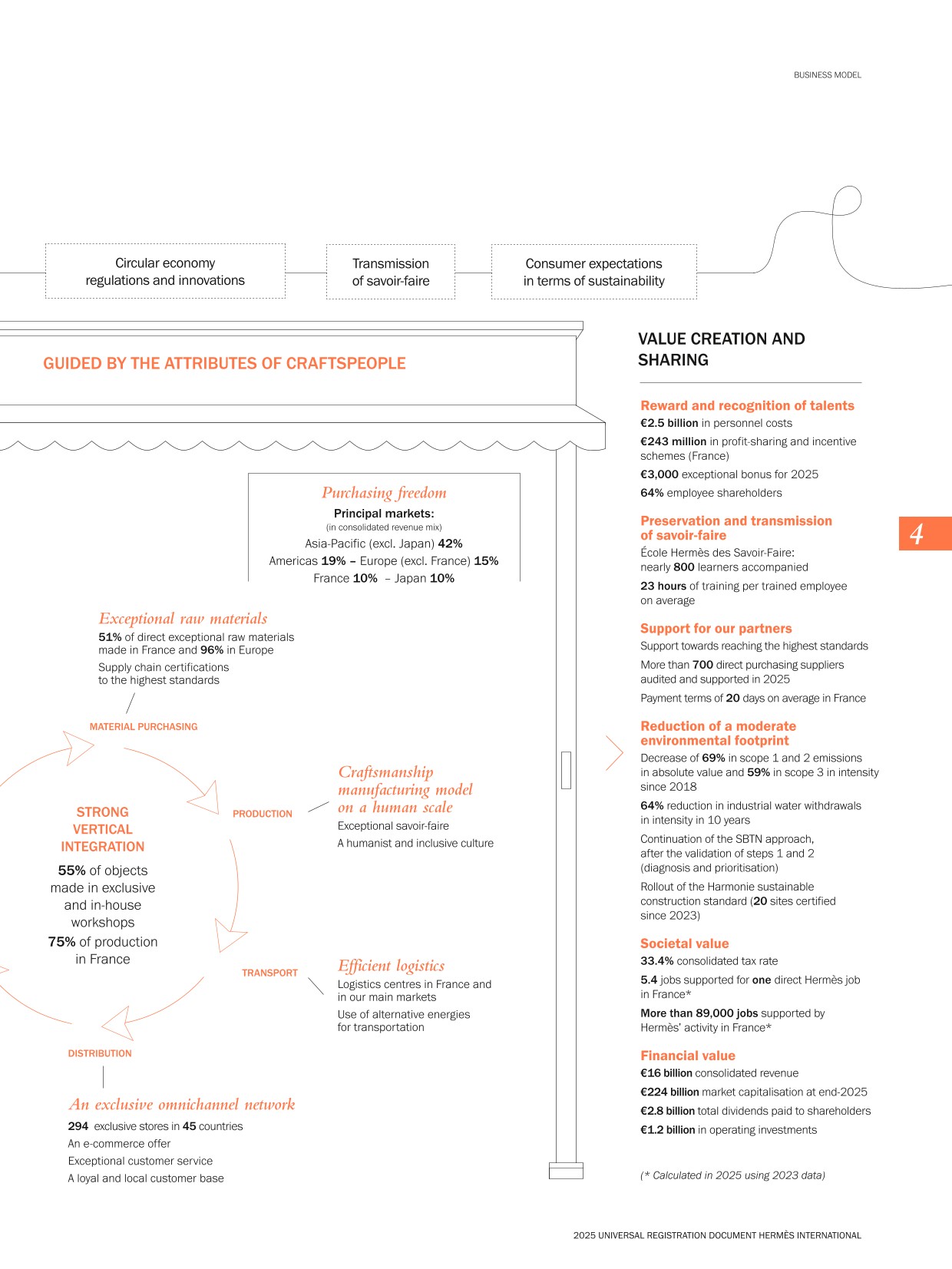
The group’s consolidated revenue amounted to €16 billion in 2025, up 9% at constant exchange rates and 5.5% at current exchange rates compared to 2024. Recurring operating income amounted to €6.6 billion (41% of sales), up 7%. Net profit (group share) reached €4.5 billion, up 5.5%, excluding the exceptional contribution on the profits of large companies in France, at the same pace as sales.
In the fourth quarter, sales reached €4.1 billion, increasing by 10% at constant exchange rates, as in the previous quarter. Sales growth was solid across all the geographical areas against a particularly high comparison basis. Europe, Japan, the Americas and the Middle East recorded double-digit growth.
Axel Dumas, Executive Chairman of Hermès, said: “The Hermès model based on an exclusive and qualitative network, as well as strong vertical integration, has once again proven successful. This distinctive strategy has enabled the house to achieve robust revenue growth and strong performance. I warmly thank the Hermès teams who share our commitment to uncompromising quality as well as our customers for their loyalty. In an uncertain environment, Hermès is moving into 2026 with confidence, underpinned by its creativity and exceptional savoir-faire.”
Sales by geographical area at the end of December
At the end of December 2025, all the geographical areas posted strong growth. The distribution network continued its qualitative expansion, with store openings and extensions.
Asia excluding Japan (+5%) delivered a solid performance across all countries in the region, all of which experienced growth. The fourth quarter grew by 8%. In June, the Four Seasons Macao store reopened after renovation and extension work. In Korea, two reopenings took place in Seoul with the Galleria store in August and the Shinsegae store in October. In Thailand, the IconSiam store in Bangkok reopened at the end of November after renovation and expansion. Finally, in China, the expanded Changsha IFS store reopened in December.
Japan (+14%) continued its strong momentum, driven by the loyalty of local clients and its exclusive distribution network. The traveling event Mystery at the Grooms’, an immersive experience around Hermès objects, was staged in Tokyo in November.
The Americas (+12%) completed an excellent year. The new stores in Scottsdale, Arizona, and Nashville, Tennessee, were inaugurated in September and October respectively. In Mexico City, the Molière store reopened in early October after being renovated. In Canada, an event showcasing the creations of petit h was staged at the Vancouver store in November.
Europe excluding France (+11%) and France (+9%) posted solid growth, supported by the loyalty of local customers and dynamic tourist flows. The Florence store in Italy, renovated and expanded, reopened in February, followed by the reopening of the Knokke store in Belgium in November.
-
Presentation of the Group and its results
-
1.1Six generations of craftspeople
The Hermès adventure began in 1837 when the harness-maker Thierry Hermès opened a workshop in rue Basse-du-Rempart in Paris. Gradually, generation after generation, the House followed a dual thread – on the one hand the painstaking work of the craftspeople in his workshop, and on the other the active lifestyles of its customers. Carried by an enduring spirit of freedom and creativity, Hermès remains highly sensitive and attentive to the changing nature and needs of society.
In 1880, Charles-Émile Hermès, the founder’s son, moved the workshops to 24, rue du Faubourg Saint-Honoré, and set up an adjoining store. At this now-emblematic address, harnesses and saddles were made to measure. The business was already standing out for the excellence of its creations.
An innovative house passionate about its era
During the interwar period, lifestyles changed and the House broke new ground under the management of Thierry’s grandson, Émile Hermès. He decisively influenced the family firm’s destiny when, while travelling in Canada, he discovered the opening and closing system of an automobile hood. In 1922 he obtained exclusive rights to this American “universal fastener” – known today as the zip – which was used extensively in the House’s luggage and other designs. Under the impetus of Émile Hermès, the House opened up to other métiers, while retaining a close connection with the equestrian world, drawing on its mastery of raw materials and its artisanal culture to create its first ready-to-wear collections. In 1937, the famous silk scarf was born with the Jeu des omnibus et dames blanches design, the first in a long series.
Robert Dumas – one of Émile Hermès’ sons-in-law, who took the helm of the House in 1951 – was a regular visitor to the workshops and designed objects whose details (buckles, fasteners, saddle nails and anchor chains) exuded an elegance that in no way diminished their practicality. Hermès objects stand out for their noble materials, their mastery of savoir-faire, and their bold creativity, stimulated by the House’s keen vision of the world. The Silk métier now invites artists to create unique designs.
-
1.2Group governance
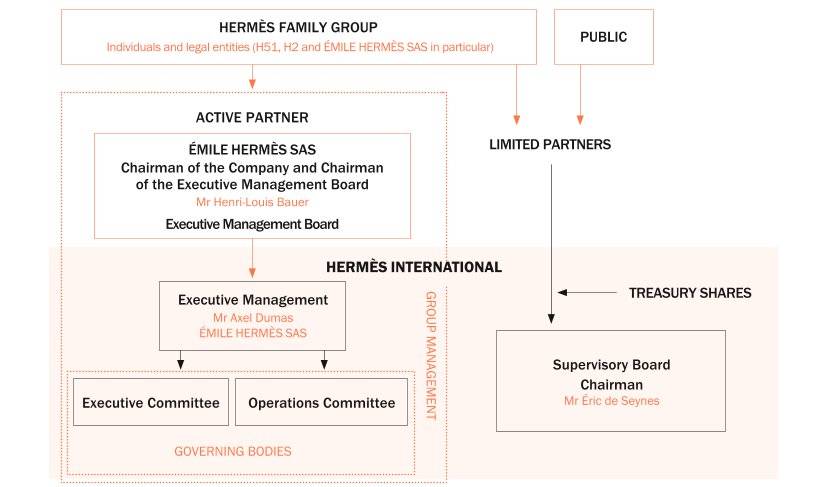
The Executive Management ensures the management of Hermès International. The role of Executive Chairman is to manage the Group and act in its general interest, within the scope of the corporate purpose and subject to those powers expressly granted by law or by the Articles of Association to the Supervisory Board, to the Active Partner and to Shareholders’ General Meetings.
The Executive Chairmen’s roles are distributed as follows: Axel Dumas is in charge of strategy and operational management, and Émile Hermès SAS, through its Executive Management Board, is responsible for vision and strategic priority areas.
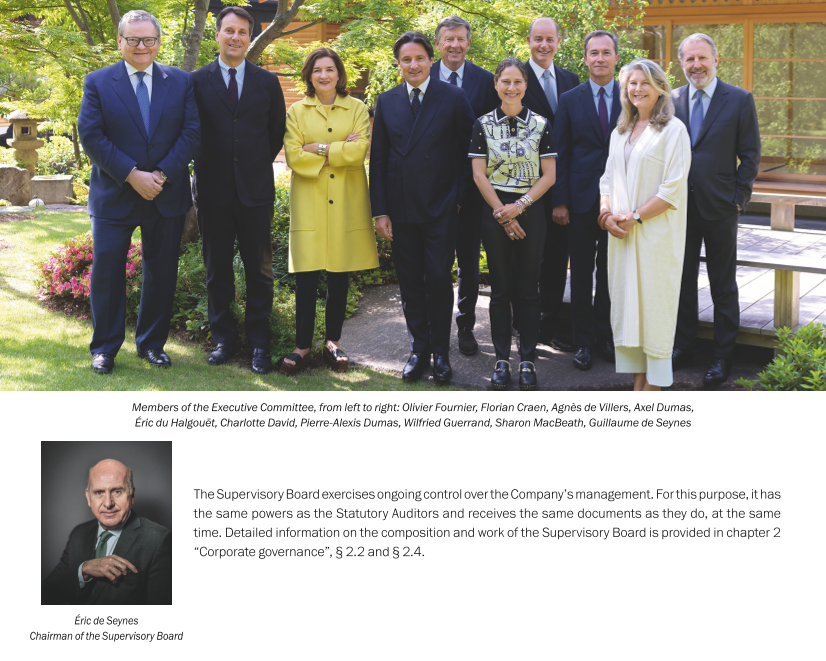
The Executive Chairmen are supported in their management of the Group by the Executive Committee. This consists of Executive Vice-Presidents, each of whom has well-defined areas of responsibility. The role of the Executive Committee is to oversee the Group’s strategic and operational management. Its composition reflects the Group’s main areas of expertise.
The Operations Committee, which reports to the Executive Management, is made up of certain members of the Executive Committee and the Senior Executives of the main métiers and geographical areas, as well as the sales and support functions of the Group.
- ◆to involve Senior Executives in the Group’s major issues and strategic orientations;
- ◆to promote communication, sharing and reasonable exchanges amongst its members in their area of responsibility;
- ◆to enable the Executive Committee to take certain decisions.
-
1.3Strategy
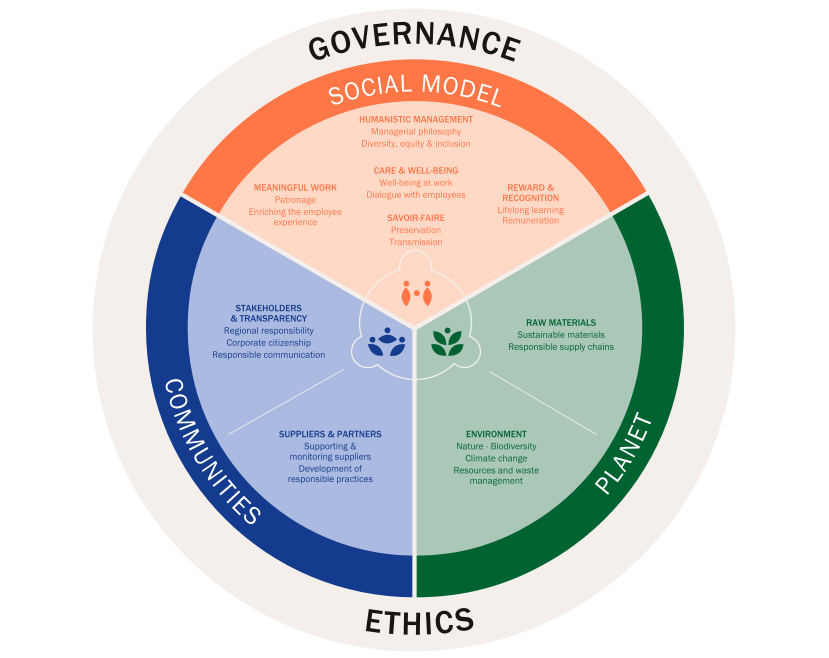
Hermès is an independent company backed by family shareholders. Its strategy is based on three pillars: creation, craftsmanship and an exclusive, balanced distribution network.
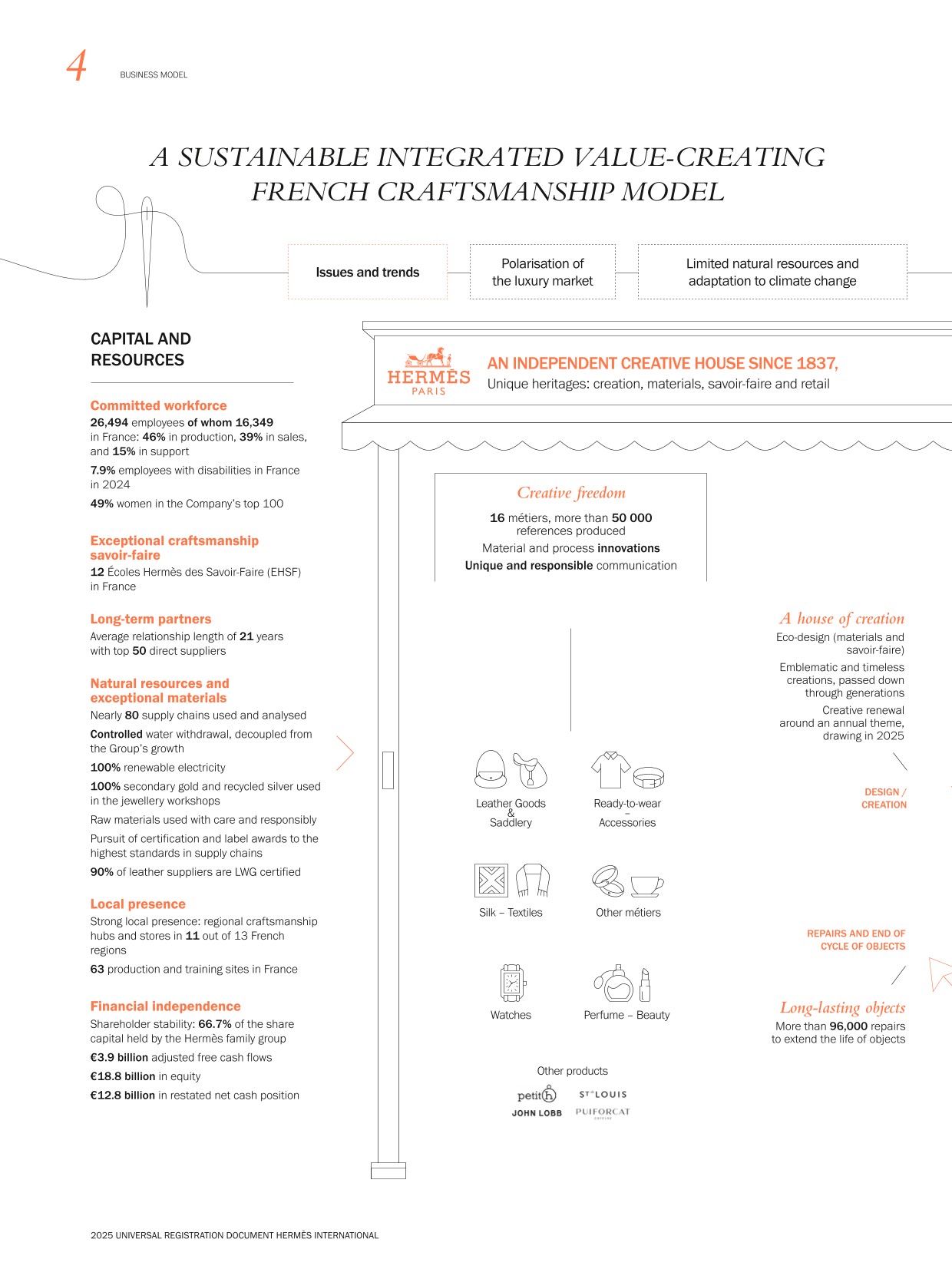
Since 1837, the Group has remained true to its values of freedom, demanding craftsmanship savoir-faire, authenticity and responsible growth. Its integrated craftsmanship business model places quality and sustainability at the centre.
In 2025, the House maintained its vision, preserving its major balances, committed more than ever to respecting its values.
Creation at the core of Hermès' strategy
Hermès creates and manufactures quality objects designed to last, to be passed on from one generation to the next, and to be repaired. This approach requires these issues to be taken into account at every stage, from design to sales.
Hermès’ strategy is based on creative freedom. Each year, a theme inspires creators and Artistic Directors. Driven by a history spanning nearly 200 years, during which the House has continued to develop with audacity and ingenuity, Hermès paid homage to the theme Drawn to craft in 2025. From saddle stitching to lines, drawing is the start of everything at Hermès. High standards in design and manufacturing encourage the creation of objects that aim to surprise and amaze customers. This creativity, revolving around traditional savoir-faire, is coupled with innovative processes to revisit timeless models and create exceptional pieces, without departing from Hermès’ trademark humour and imaginative flair. The unbridled creativity flourishes in all métiers, as reflected in the numerous scarf designs printed every year. It is then expressed through over 50,000 references, developed around a unique identity and a style blending exceptional quality, innovation, surprise, elegance and simplicity.
-
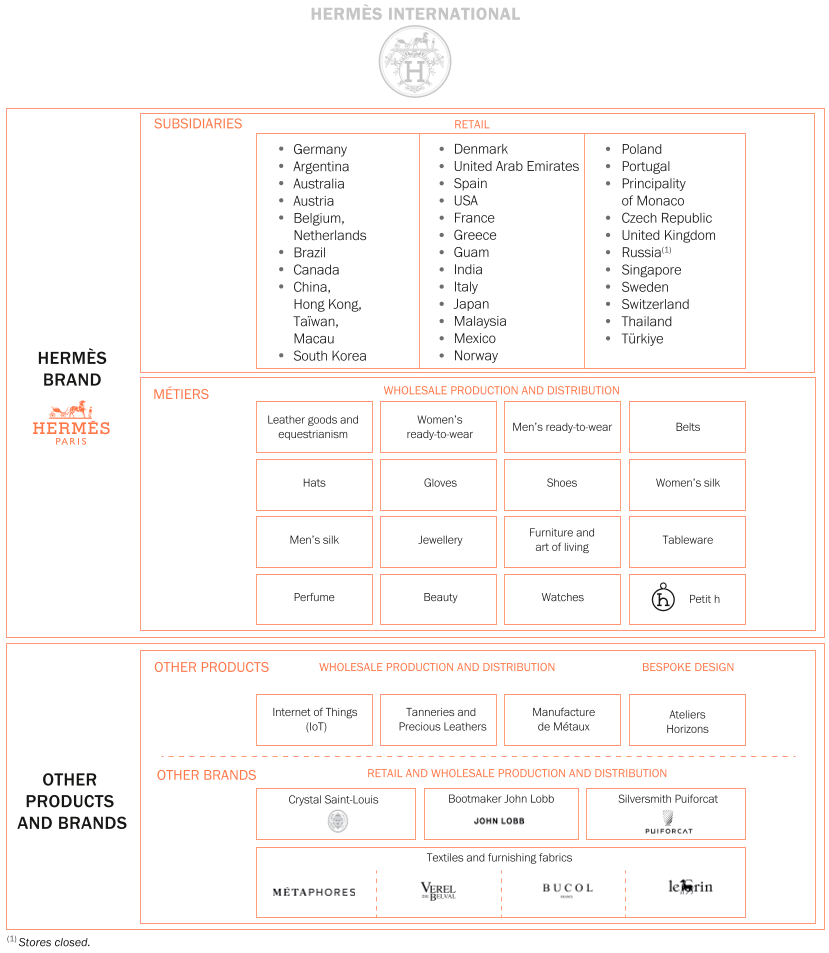
1.4Simplified organisation chart and Group locations
1.4.1Summary description of the Group as at 31 December 2025
-
1.5Key financial and non-financial figures AFR
1.5.1Revenue by métier for 2025 (2024)
-
1.6Revenue and activity by métier AFR
In millions of euros
2025
Mix
2024
Mix
Change
at current exchange rates
at constant exchange rates
Leather Goods & Saddlery
7,070
44%
6,457
43%
9%
13%
Ready-to-wear and Accessories
4,525
28%
4,405
29%
3%
6%
Silk and Textiles
964
6%
950
6%
1%
5%
Other Hermès sectors
2,055
13%
1,909
12%
8%
11%
Perfume and Beauty
489
3%
535
4%
(9)%
(8)%
Watches
549
4%
577
4%
(5)%
(2)%
Other products
349
2%
337
2%
3%
6%
CONSOLIDATED REVENUE
16,002
100%
15,170
100%
5.5%
8.9%
1.6.1Leather Goods & Saddlery
Leather Goods & Saddlery, Hermès’ original métier, groups together bags for men and women, travel articles, small leather goods and accessories, saddles, bridles, and a full range of equestrian products and clothing.
The Leather Goods & Saddlery métier represents 44% of consolidated sales. In 2025, it generated revenue of €7,070 million.
Hermès leather goods and saddlery objects are the result of a very special alchemy, based on a constant dialogue between designers and craftspeople, and the use of the finest materials, selected with the greatest care. The craftspeople use traditional savoir-faire, passed down from generation to generation. This patient daily dialogue with leather, crafted and fashioned by hand, gives these unique objects a distinctive additional measure of personality.
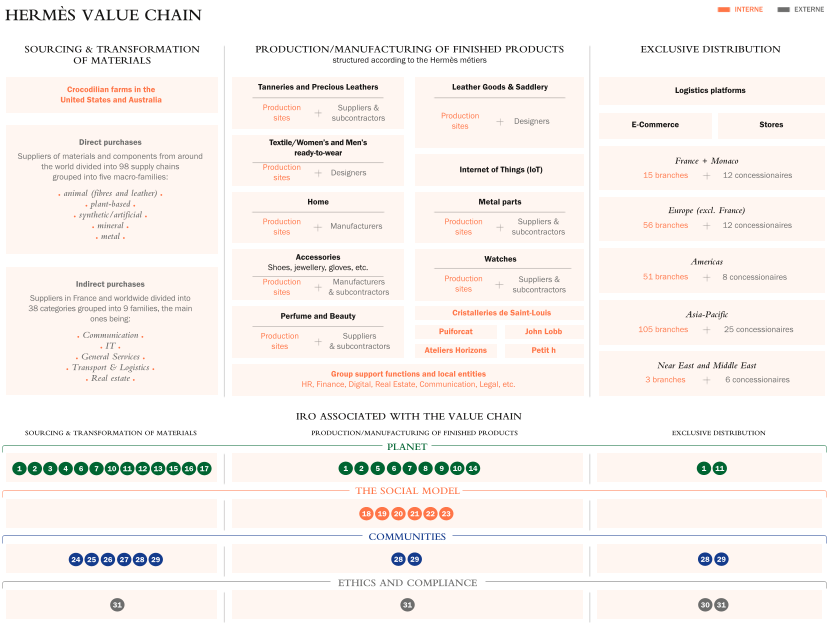
Manufacturing is carried out in 10 centres of expertise that bring together production units, workshops and training centres in Paris, Pantin and six regions of France. It also relies on a network of long-standing French partners, chosen with the greatest care and respect for Hermès' singular craftsmanship savoir-faire.
To meet continued strong demand, Hermès is expanding its network of manufacturing sites each year in order to strengthen its production divisions. Thus, a new leather goods workshop was inaugurated in September 2025 in L'Isle-d'Espagnac (Charente). Hermès also continued preparing for the construction of three future production units, which are scheduled to open in 2026 in Loupes (Gironde), 2027 in Charleville-Mézières (Ardennes) and 2028 in Colombelle (Calvados), and announced the opening of a new site in Les Andelys (Eure) by 2030. Each new establishment is set up in close collaboration with local stakeholders, administrative and economic development bodies. In this way, Hermès reaffirms its commitment to regions with a strong manufacturing savoir-faire and its will to provide high-quality jobs. Proud to contribute to the expansion of sectors of excellence in France, the House maintains long-term relationships with its suppliers and partners, with loyalty and high expectations, to maintain the unique qualities of a Hermès object: exceptional materials, training in savoir-faire and dedicated workshops.
Hermès also places great importance on constantly perfecting the skills and savoir-faire of its craftspeople through a range of training and professional qualification programmes. These programmes are delivered within the École Hermès des Savoir-Faire, which is present in each of the 10 production divisions.
1.6.1.1Women's bags
The House's equestrian roots remain a powerful source of inspiration and are the influence behind new women's styles this year. Thus, the Tablier Sellier bag, inspired by the leather apron worn by saddler craftspeople, combines leather and canvas for a new everyday bag. The Arçon line, whose curves evoke an equestrian saddle, is expanding with a new refined format, the Arçon Slim bag. Lastly, the Collier d’attelage bag takes up the curves, buckles and rings of the eponymous piece of equipment.
The silversmith's lexicon is expanded with ingenious new clasps and distinctive metal pieces. Likewise, the signature metal clasp of the Médor Clou bag, a brand-new version of the Médor bag, inspired by the dog collar storyline in Fashion Accessories. This line also welcomes a new bucket format, the So Médor bag. Lastly, the Faubourg Express line, a new style with an elongated format that echoes travel bags, highlights an elegant ultra-thin lock on two everyday formats.
2025 marks the return to the collections of the emblematic Plume bag, first seen at the end of the 1960s, in its two sizes, 28 and mini. For its part, the Herbag canvas and leather line, created in 1998, has been extended to offer a new mini size, the Herbag 20 bag.
The quest for the exceptional continues to be voiced through the implementation of numerous elements of savoir-faire and new materials that push the limits of creation, in an Arts & Crafts spirit. The Birkin à l'Envers bag offers a new look at the functionality of this emblematic large tote bag and reveals the beauty of its interior, in an exacting canvas and leather construction. Hand-painting on leather is magnified on the Kelly 28 bag with the delicate drawing of a jaguar "Dans la jungle" and expresses a certain fantasy on the latest part of the Birkin Faubourg story in an "En fête" version, signed with its disco ball padlock.
The finesse of the hand embroidery, combining cross stitching and straight stitching, highlights the contours of the leather patches that adorn the Kelly Elan and Kelly 25 Collage bags, evoking the stamp patterns of various silk scarves. Finally, horsehair finds a new voice in the collections: it adorns the Mini Médor bag in the shape of a diabolo, a nod to a dog collar from the archives, as well as a new Hermès Corricolo tote bag, in a tiered fringe construction that echoes charleston dresses.
1.6.1.2Men's bags
The men's collections confirm their dynamism and bring in new styles designed to meet contemporary needs. Thus, the emblematic Bolide line introduces a new essential to the men's wardrobe, the Bolide Messenger. Also in tune with the times, the Mousqueton story repurposes the harness part to make it an ingenious clasp on two everyday bags, the Seau Mousqueton and On-Body Mousqueton. The Chaîne d'ancre chainlink forms the adjustment buckle on the strap of an all-leather tote bag, the Cabas Ancrage, while the Étrivière buckle, emblematic of the men's universe, is the signature of an all-leather tote, rich in savoir-faire, with a unique construction.
The Haut à courroies bag unveils exceptional new Arts & Crafts versions, where daring constructions and savoir-faire are expressed: reflecting its original use as a saddle bag, the HAC en Selle deconstructs the Cavale II saddle and reveals its various stitched appliqués over the entire body of the bag. Echoing the theme of the year, the lines of the flap and straps of the Haut à Courroies are drawn on the leather of the HAC à relier in the form of printed and embossed dots to be connected.
Lastly, the theme of drawing also inspires a singular object, a nod to artists and rich in savoir-faire, the cylindrical Sac à dessin.
1.6.1.3Travel
The world of travel continues to expand in 2025. The R.M.S. carry-on case is adorned with a new print, "Dane des chevaux", in which three proud mounts dance in a graceful circle. It also introduces a more generous format, the R.M.S. Business Cabine.
Lastly, the emblematic Garden line offers a 41 format in the new Neo Garden style, ideal for short getaways or to place on top of the R.M.S. case, as an addition.
1.6.1.4Accessories and small leather goods
Attentive to changing uses, the small leather goods collections are continuing to grow and transform in order to provide new functionalities and styles in keeping with the times.
The To Go family of hands-free objects with their bold silhouettes sports new contemporary and elegant identities: the Charnière To Go picks up the clasp of the eponymous bracelet, the Zipengo line welcomes a To Go once again finished off with the Chaîne d'ancre chainlink as a pull tab, while the 1957 To Go is inspired by the Serviette 57 document case to create a resolutely masculine object.
A land of fantasy, small leather goods is also developing its range of bag accessories with the Robéo, which cloaks the Rodéo in a colourful new wardrobe, and the Budy Apic, which adorns the miniature dog's coat with notched and coloured leather lace.
To celebrate the annual theme, the In the Pocket line of unusual objects offers a colouring pencil case. Lastly, a book for the youngest, De fil en aiguille tells the story of Hermès craftsmanship through the encounter between a craftsman and a little dog.
1.6.1.5Materials
Since its founding, Hermès has never ceased to explore and create materials that can enhance the aesthetics, functionality and sustainability of its objects, while continuing to respond to the desires and uses of the present time.
Appearing in 2024 adorned with a gold finish, the Chamkilight goatskin adopts a new silver finish in 2025, obtained thanks to the perfect mastery of a new generation of metallic pigments that broadens the luminous palette of this delicate-grained material. The Chamkilight Silver goatskin gives a singular shine to the Kelly Mini and Constance Mini bags, as well as the Kelly To Go and Constance Slim bags.
A new calfskin has also entered the collection, the Chéri II calfskin. Smooth, supple and meltingly soft, this beautiful mellow leather could be described as combining the strength of calfskin with the delicacy of lambskin. With a quite intense shine, it thrives on bright colours, revealing all their subtleties. It offers a unique touch and a new dimension to the Kelly and 24/24 bags.
New exceptional finishes also complete the palette of precious hides. Like the Chantilly crocodile, a leather of absolute purity, whose white is extraordinary in more ways than one since it is obtained without any pigments or dyes. In a matte finish, it adorns the emblematic Kelly and Birkin. Alongside this immaculate finish, a gradual play on colours, evoking the light of the rising sun, is worked on the matte crocodile hide. The Sunrise finish, available in three shades, Lemon Yellow, Kraft and Chestnut on the Kelly Elan and Constance Mini bags, offers a subtle dip-dye effect and gives the sensation of seeing the colour come to life as the gaze focuses.
Lastly, the materials pay homage to Hermès' talent as a colourist, whose palette is enhanced with new timeless or seasonal shades. Gris Pantin, a medium grey with hints of blue, is revealed on the Togo, Epsom and Swift calfskins. Bleu Tie, a luminous blue saturated with red, deepens the range of Hermès blues. Baie Brun, a dark brown with a slight note of red, adds depth to the emblematic calfskins. As for the soft and orange-tinged Jaune Mango, it adds a touch of light and sunshine to the collections.
1.6.1.6Equestrianism
Hermès continues to affirm its commitment to its first customer, the horse, up to the highest sporting level, through the transmission of its excellence in savoir-faire, the search for exceptional materials, innovation for the well-being of the horse and the daily support of the House's partner riders and their mounts.
In 2025, the Hermès saddle was hoisted onto the most prestigious podiums in the world, adding new titles to its list of achievements, with Ben Maher and Dallas Vegas Batilly in the Hermès Vivace saddle as well as Simon Delestre and Caiman Jolly Jumper in the Hermès Cavale saddle, winners at the Saut Hermès under the dome of the Grand Palais.
2025 also marks the arrival of Jeanne Sadran, a talented young French rider, in the team of partners, as well as the celebration of 10 years of partnership with Jessica von Bredow-Werndl, a German dressage rider who contributed to the development of the Hermès Arpège saddle.
-
1.7Revenue and activity by geographical area AFR
In millions of euros
2025
Mix
2024
Mix
Change
Change at current exchange rates
Change at constant exchange rates
Europe
3,937
25%
3,594
24%
10%
10%
- ◆France
1,575
10%
1,447
10%
9%
9%
- ◆Europe (excluding France)
2,362
15%
2,147
14%
10%
11%
Asia-Pacific
8,293
52%
8,085
53%
3%
7%
- ◆Japan
1,591
10%
1,437
9%
11%
14%
- ◆Asia-Pacific (excluding Japan)
6,702
42%
6,648
44%
1%
5%
Americas
3,075
19%
2,865
19%
7%
12%
Other (Middle East)
697
4%
627
4%
11%
15%
CONSOLIDATED REVENUE
16,002
100%
15,170
100%
5.5%
8.9%
1.7.1Europe
In 2025, Hermès continued to assert its presence in Europe. Italy was in the spotlight, with the February inauguration of the new store in Florence, where the House has been established since 1991. Now located in a 16th century Florentine palazzo, this store has a remarkable Renaissance façade at the corner of via degli Strozzi and via dei Vecchietti. Inside, various lounges follow one after another in a hushed and refined atmosphere, with decoration that pays tribute to the rich heritage and art of the Tuscan city.
Austria welcomed a new store in the historic centre of Kitzbühel in October. This store is Hermès' third location in the country, following Vienna and Salzburg.
In November, Hermès also renewed its loyalty to the Flemish seaside resort of Knokke-le-Zoute, in Belgium, with the expansion and reopening of its store. Relocated opposite its historic address on the Kustlaan, where it has been since 1996, the new space is spread over two levels behind an elegant half-timbered façade and bow windows, typical of the coastal cottages. The interior is decorated in natural materials and soft shades reminiscent of the North Sea beaches.
In France, the year was eventful. Starting with the mid-January launch in Paris of a new dinner service, Hermès en Contrepoint. The presentation to the press was held within the walls of the Conservatoire national des arts et métiers, a place synonymous with excellence in savoir-faire. Then the Palais d'Iéna once again provided its majestic setting for the fall-winter 2025 Men's ready-to-wear collection show.
Early March brought the fall-winter 2025 Women's ready-to-wear collection show at the Garde Républicaine. Then, from 21 to 23 March, the Saut Hermès returned to its original setting, the glass conservatory of the Grand Palais, for a 15th colourful edition. Once again, this international CSI 5* competition brought together the world's elite in the discipline and saw Hermès' partner riders shine. Over these three days celebrating the horse, spectators were enthralled as the sporting events unfolded and they were able to admire the dexterity and quest for excellence of the House's saddler-leatherworkers.
The summer was all about airiness, with the presentation of the spring-summer 2026 Men's ready-to-wear collections at Palais d'Iéna, and three stops in the regions of the travelling event The endless line, inspired by the annual theme "Drawn to craft". In Nantes, Bordeaux and then Biarritz, passers-by were invited to experiment with the art of drawing in the middle of the street, through fun workshops, in an ephemeral offbeat setting conducive to creativity. An experience rich in spontaneous and fun sharing, where participants were able to immerse themselves in the spirit of fantasy that drives the House and receive the magazine Le Monde d'Hermès.
In October, the spring-summer 2026 Women's ready-to-wear collection show lit up the Garde Républicaine merry-go-round with summer light, while the nave of the Grand Palais hosted an exceptional edition of the Les de(ux)mains du luxe event. Organised by the Comité Colbert, this event, celebrating the creativity and vitality of the arts and crafts métiers, brought together 18 schools and 32 houses around a common ambition: to preserve, transmit and open the doors to exceptional métiers. In addition to discovering Hermès' craftsmanship savoir-faire, visitors had the opportunity to talk to some of the House's craftspeople about the training courses offered by the École Hermès des Savoir-Faire.
The métiers were also centre-stage elsewhere in Europe. Thus, in April, Milan Design Week put the spotlight on the collections of Hermès objects for the Home and the lighting of the Cristalleries Saint-Louis, while Hermès Watches once again participated in the Watches & Wonders trade show in Geneva, where the latest creations and complications that embody Hermès' singular vision of time were unveiled. In September, the Franco Parenti theatre in Milan hosted the mischievous and poetic Hermèstories show for the first time, which tells the story of Hermès through its emblematic creations and invites the public to take a close look at this unique heritage. Just before the fall, Greece received a visit from the travelling event The endless line, which came to offer an interlude full of fantasy to people strolling around Athens. Lastly, in October, the Hermès in the Making programme, which presents the House's savoir-faire, its creative uniqueness and its commitment to responsible practices through multiple demonstrations and interactive activities, made a stop in Istanbul, Türkiye.
-
1.8Comments on the consolidated financial statements AFR
1.8.1Income statement
In millions of euros
2025
2024
Revenue
16,002
15,170
Cost of sales
(4,623)
(4,511)
Gross margin
11,379
10,660
Sales and administrative expenses
(3,704)
(3,569)
Other income and expenses
(1,106)
(942)
Recurring operating income
6,569
6,150
Other non-recurring income and expenses
-
-
Operating income
6,569
6,150
Net financial income
207
283
Net income before tax
6,775
6,432
Income tax
(2,263)
(1,845)
Net income from associates
47
44
Consolidated net income
4,560
4,631
Non-controlling interests
(36)
(28)
Net income attributable to owners of the parent
4,524
4,603
In 2025, the Group’s consolidated revenue amounted to €16.0 billion, up 9% at constant exchange rates and 5.5% at current exchange rates compared to 2024.
The gross margin rate was 71% in 2025, compared with 70% for financial year 2024, despite the negative impact of exchange rates.
Sales and administrative expenses, which represented €3.7 billion (€3.6 billion in 2024), notably included €620 million in communication expenses (€637 million in 2024). Other sales and administrative expenses, which mainly include the salaries of sales and support staff as well as variable rents, amounted to €3.1 billion (€2.9 billion in 2024).
Other income and expenses amounted to €1,106 million (€942 million in 2024). They include depreciation and amortisation of €729 million (€693 million in 2024), half of which relates to property, plant and equipment and intangible assets and the other half to right-of-use assets. Other expenses also include €199 million related to free share plans in 2025 (€180 million in 2024).
Recurring operating income amounted to €6.6 billion, up by 7% compared to 2024. Recurring operating profitability reached 41.0% of sales compared to 40.5% in 2024.
Net financial income was positive in the amount of €207 million (income of €283 million in 2024). It includes the cost of foreign exchange hedges, interest on lease liabilities and interest payments on cash, which amounted to €286 million in 2025.
The income tax expense amounted to €2.3 billion. The effective tax rate for the 2025 financial year was 33.4%, compared with 28.7% for the 2024 financial year. It includes the exceptional contribution on the profits of large companies in France. Excluding the impact of this contribution, the effective tax rate for 2025 amounted to 28.5%.
After taking into account the net income from associates and non-controlling interests, consolidated net income attributable to owners of the parent amounted to €4.5 billion, compared with €4.6 billion in 2024. Restated for the exceptional contribution, consolidated net income attributable to owners of the parent amounted to €4.86 billion and grew by 5.5%, in line with sales.
-
1.10Outlook AFR
On the strength of its unique business model, based on its values of independence, entrepreneurial spirit, craftsmanship and creativity, Hermès has shown the solidity of the House's craftsmanship and entrepreneurial business model, posting solid performance in 2025, in a persistently uncertain environment. All geographical areas grew. All métiers, except Perfume and Beauty, and Watches, continued their steady progress, reflecting the strong desirability of the creations among its customers. Hermès, firmly rooted and inspired by its heritage, is enriched by its creative freedom and innovation, and its attachment to savoir-faire. Firmly believing that there can be no creation of economic value and long-term development without creation of social and societal value and without environmental responsibility, Hermès is committed to leaving a positive footprint on the world.
Thanks to the ongoing dialogue between creation and excellence in savoir-faire, the House will continue to blossom, affirming the uniqueness of its style. The year 2026 will be marked by the development of new collections based on the most beautiful materials and an abundant creativity. Among the new products, the Perfume and Beauty métier will launch a new version of Barénia in the fall, after launching the eau de toilette Un Jardin sous la Mer in the spring. The Perfume collections will also be enriched this year with two new Hermessences: Musc Pallida and Ginseng Biloba. Watches will continue the accompany the solid momentum of its Kelly and H08 lines, and will present its new products at the Watches & Wonders Salon in Geneva. As part of Milan Design Week, Hermès will present the collections of the Home universe and will in particular launch the Nature Marine tableware. Jewellery will unveil its ninth Haute Joaillerie collection. The emblematic bags Lindy and Picotin, with new ways of being worn and used, will enrich the Leather Goods collections alongside new creations.
The integrated and exclusive distribution network will continue to strengthen its omnichannel offering. In order to nurture the link with its particularly loyal local customers and to attract new customers, special attention will continue to be paid to the digitisation of uses, the development of services and the expansion of the online product offering. The qualitative development of the store network will continue in 2026, notably with projected openings of Sanlitun in Beijing and New Bond Street in London. Priority will continue to be given to the expansions and renovations of around 15 branches around the world, notably in Osaka (Japan), Berlin (Germany), San Diego (United States) and Geneva (Switzerland).
In light of the House’s strong momentum, the development of production capacities will continue in all métiers, and in particular in Tableware and Watches, with work continuing on the new site at Couzeix and the extension of the Noirmont site. The growing demand in Leather Goods & Saddlery will be supported by the ramp-up of new sites. The Group will continue its objective of opening on average one production unit per year, leading to around 300 new hires. In 2026, Hermès will inaugurate a new leather goods workshop in Loupes, the House's second production site in Gironde, following the inauguration of the workshops in Saint-Vincent-de-Paul in September 2021. The Charleville-Mézières (Ardennes) and Colombelles (Calvados) leather goods workshop projects, scheduled for 2027 and 2028 respectively, are continuing. At the end of January 2026, the House also announced the opening of a new site in Les Andelys (Eure) by 2030. Hermès will strengthen its integration in France in regions with high manufacturing savoir-faire and develop employment and training. The House’s other métiers will continue to use their extensive expertise to design and create exceptional objects. The Group’s operational investments will continue in 2026.
True to its commitment as a responsible employer, with the creation of nearly 6,200 jobs over three years, of which more than 3,500 in France, Hermès will continue this multi-local and multi-métier dynamic in 2026. The Group will step up its efforts in terms of social, societal and environmental performance. Hermès will pursue its commitment to the development of its employees, inclusion and diversity.
The enhancement and transmission of savoir-faire will remain at the heart of the priorities of the métiers, with, in particular, the ramp-up of the apprentice training centres (CFA) dedicated to the leather goods métiers, as well as the House's training in the unique savoir-faire of the other métiers, such as Jewellery. Present today in six regions in France, the École Hermès des Savoir-Faire will gradually be set up in all the regional Leather Goods divisions.
Control of the supply chains, guaranteeing the quality of materials, will continue with the continued implementation at the House’s partners of CSR briefs, supply chain briefs and a responsible purchasing policy. The latter bring together the Group’s requirements notably in terms of traceability, certification, carbon trajectory, reduction of water consumption and respect for human rights.
The House’s commitments to fighting climate change and the preservation of biodiversity will remain at the forefront. With the development of eco-design strategies for all métiers and the construction of an internal tool to make life cycle analyses systematic, the Group will continue its efforts to encourage the sparing use of resources and waste management. More broadly, the House’s actions in favour of biodiversity will be strengthened by the continuation of the Science Based Targets for nature (SBTN) initiative with the setting of targets as provided for in step 3 of the framework, and the deepening of impact analyses using the Global Biodiversity Score (GBS) method.
In line with its climate change mitigation commitments, Hermès will continue its actions in accordance with its reduction objectives, approved by the Science Based Target initiative (SBTi), to reduce scopes 1 and 2 emissions by 50.4% in absolute value and scope 3 emissions by 58.1% in intensity, over the 2018-2030 period. Work will also be undertaken in 2026 to identify the expenses, investments and financing specifically related to the implementation of the transition plan. The particularly demanding responsible construction framework will continue to be rolled out for new real estate projects. At the same time, Hermès will increase its contribution to projects with a strong environmental, social and economic impact outside its value chain, in particular through the Livelihoods Carbon Funds. The House will also continue undertaking studies for projects within its value chain, in order to prepare for the neutralisation of its residual emissions. In terms of adaptation, Hermès will continue the analysis of climate risks conducted on its sites and its main international flows, and will work on structuring action plans adapted to local issues.
Hermès will strengthen its role as a responsible company alongside its suppliers, which it will continue to support, with the rollout of its Responsible purchasing policy and its Supplier code of conduct, as well as working with the communities in which it operates, whether through site openings, job creation, the development of vocational training centres for its craftsmanship métiers, or contributions to the social and cultural life of the regions.
The Group is looking forward to 2026 with confidence, thanks to its highly integrated craftsmanship model, its balanced distribution network, the creativity of its collections and the loyalty of its customers.
In the medium term, despite the economic, geopolitical and monetary uncertainties around the world, the Group confirms an ambitious goal for revenue growth at constant exchange rates. Thanks to its unique business model, Hermès is pursuing its long-term development strategy based on creativity, maintaining control over savoir-faire and singular communication.
-
1.11Philanthropy
Driven by humanist values since its inception, Maison Hermès has always been committed to society by carrying out philanthropic actions over the years. As an extension of this culture of generosity, the Company is now more committed than ever to giving back to the world some of what it gives to it.
The Group's philanthropy policy is exercised through two distinct channels. On the one hand, the Fondation d'entreprise Hermès has been managing its own programmes since its creation in 2008. In addition, each entity has set up its own Local Patronage Committee to determine their own generous initiatives it intends to carry out and to ensure local monitoring.
1.11.1The work of the Fondation d'entreprise Hermès
Driven, since its creation in 2008, by the humanist values of the House from which it emanates, the Fondation d’entreprise Hermès carries out its philanthropic actions in ways that set it apart from the French philanthropic landscape. It has chosen to be an operator rather than a distributor, by developing specific programmes in four areas: the creation of new works of art, the transmission of savoir-faire, the protection of biodiversity and solidarity. Thus, the Foundation is committed to acting in situ, in the life of the city where it identifies particular needs in favour of the general interest: in this, it plays a fundamentally political role – in the etymological sense of the term, polis meaning city in Greek. Through the management of its tailor-made programmes, it takes its responsibilities at the very heart of society, by supporting its beneficiaries on the ground. Whether they are artists, project leaders or students, they all experience first-hand the way in which the Foundation contributes, alongside them, to building a better world.
As a stakeholder in this ambition, artistic creation involves broadening horizons and changing perspectives. This is evidenced by the Latitudes programme, launched in 2024, which aims to highlight low-visibility photographic scenes and support the creation and distribution of new series. The first winner of Latitudes, the Franco-Ivorian photographer François-Xavier Gbré, exhibited his work entitled "Radio Ballast" in the autumn of 2025 at the Henri Cartier-Bresson Foundation in Paris, as part of a biennial focus on Côte d'Ivoire. The winner of the second edition, the Ivorian photographer Nuits Balnéaires, has begun the production of a new series. Producing work in unprecedented conditions is one of the challenges of the Artists’ Residencies, which completed a new cycle in 2025, under the artistic direction of Emmanuelle Luciani. The visual artists Salomé Chatriot and Jacopo Pagin were invited to work respectively at the Sormonne leather goods workshop and the Saint-Louis crystal manufacturing plant. Co-published by Loose Joints and the Fondation d'entreprise Hermès, Passé Présent Futur retraces and illustrates the four residencies of this cycle carried out between 2024 and 2025. The Exhibitions programme is also an in situ commitment by the Foundation through its four dedicated spaces in Brussels (Belgium), Saint-Louis-lès-Bitche (France), Tokyo (Japan) and Seoul (South Korea). A total of 11 exhibitions were presented there in 2025. Another platform for encounters between the public and artists, the Transforme festival, co-constructed with the Foundation's institutional partners and rooted in four regions in Paris, Clermont-Ferrand, Lyon and Rennes, offers a programme that is in touch with society, in particular through a programme of actions "Going Further". The 13 shows of the second edition of Transforme brought together more than 24,000 spectators, and the third edition was successfully launched in the autumn of 2025. Whatever the forms of expression of the artists, the Foundation, through its programmes for creation, invites a wide public to reflect, be moved, meet and form society.
Among major contemporary issues, that of environmental protection encourages action in order to pass on a sustainable world to future generations. To this end, the Foundation is working in two places: firstly, through the Manuterra programme, learning from life, which aims to raise awareness of biodiversity among schoolchildren by developing and maintaining a plot of land using permaculture techniques. This educational system has continued to expand since its creation in 2021. During the 2024-2025 school year, 875 pupils aged from nine to 15, i.e. a total of 35 classes in 11 partner academies, cultivated a plot of land under the watchful eye of a gardening professional. At the same time, as part of its Biodiversity & Ecosystems programme, the Foundation is supporting 10 projects that act as levers for targeted action to maintain biodiversity.
Sustainability issues are very often associated with the transmission of savoir-faire which, in itself, promotes the preservation of natural resources. This is another political issue in view of the Foundation's community presence, in that it contributes to the empowerment of those who benefit from it, such as the school pupils who participate in the Manufacto programme, the Skills Factory. Constantly expanding since 2016, this educational system allows pupils aged from nine to 15 to discover the craftsmanship skills of four know-how (leather goods, saddlery and upholstery, carpentry, plastering) through the production of an object during school time. During the 2024-2025 school year, 2,400 students, or 96 classes in 16 academies, took part in this programme, which, along with Manuterra, demonstrates the importance the Foundation attaches to education.
For professionals, the Foundation proposed the seventh edition of the Skills Academy: dedicated to paper and under the educational direction of Constance Guisset, this edition brought together 21 craftspeople, designers and engineers who took part in five morning sessions (open to the public) before meeting again during discovery weekends. A large workshop spread over two non-consecutive weeks completed their exploration of paper. The third edition of the Skills Academy in Japan, dedicated to metal, was launched with the publication of the work Savoir & Faire – KINZOKU, Le Métal. A first public discussion session devoted to this subject took place in November, in parallel with the "Metal" exhibition scheduled at Le Forum in Tokyo. As regards the transmission of savoir-faire, the collective creation Avant toute chose, presented to the public on 9 and 11 September 2025 at the MC93 – Maison de la Culture de Seine-Saint-Denis in Bobigny, was a special highlight. Under the joint direction of three artists (Aurélie Charon, Régine Chopinot and Phia Ménard), 30 young talents made their début in a professional context. Having graduated in 2025, they form the fourth class of students who have completed the demanding courses of dance, theatre and circus schools, thanks to the support of the Foundation as part of the Artists in the Community scholarship scheme, a pivotal part of the eponymous program. These two evenings rich in emotions introduced these young artists in the performing arts: a springboard for everyone to flourish in their discipline and contribute, in the long term, to the renewal of stage arts. For the 2025-2026 school year, 119 students at all levels will receive support from the Foundation through this scholarship scheme. Of these, 34 are in their first year of dance, theatre, circus or puppetry studies: they make up the seventh class of scholarship holders.
Lastly, while the Fondation d'entreprise Hermès strives to encourage solidarity through all of its generous actions, this ambition has been at the heart of the internal H3 programme – Heart, Head, Hand – since 2013. Whether it is a financial donation or a donation of time, this scheme makes it possible to involve Hermès employees, on a voluntary basis, to support local solidarity initiatives. In 2025, 20 projects were supported by the Foundation.
Through all these programmes, throughout 2025, the Fondation d'entreprise Hermès continued to engage responsibly in the collective social framework – in the "city" – acting in the public interest. Through its operating model, it supports the women and men who work daily in line with its humanist values to build a fairer, more sustainable society conducive to the empowerment of everyone.
-
Supervisory Board report on corporate governance AFR
This chapter 2 “Corporate governance” incorporates in § 2.1 to 2.9 the Supervisory Board corporate governance report prepared pursuant to Article L. 22-10-78 of the French Commercial Code (Code de commerce) and in accordance with the recommendations of the French Financial Markets Authority (AMF).
A cross-reference table for the corporate governance report is presented in chapter 9 “Additional information”, § 9.5.3.
It was prepared with the assistance of the Chairman of the Supervisory Board, the CAG-CSR Committee and the Secretary of the Board, on the basis of the work and procedures carried out by the functional departments concerned. It was approved by the Supervisory Board at its meeting of 11 February 2026.
-
2.1The Company's corporate governance code
2.1.1Corporate governance principles applied
The Supervisory Board officially adopted the Afep-Medef recommendations on corporate governance in 2009, as it deemed these recommendations to be entirely in keeping with the Group’s corporate governance policy. This framework includes the Afep-Medef Corporate Governance Code for listed companies, updated in December 2022, available on the Afep website (www.lafep.org/en) or the Medef website (www.medef.com), and the application guide of the High Committee on Corporate Governance (HCGE), revised in June 2022, which explains the recommendations of this code.
The positions and recommendations issued by the French Financial Markets Authority (AMF) are also taken into account:
- ◆concerning corporate governance and the compensation of Executive Corporate Officers (AMF position-recommendation - DOC-2021-02 and AMF recommendation - DOC-2012-02);
- ◆on Shareholders' General Meetings of listed companies (AMF recommendation DOC-2012-05).
-
2.3Administrative and management bodies
2.3.1The Active Partner and its Executive Management Board
Composition as at 31/12/2025
ACTIVE PARTNER
Emile Hermès SAS
Represented by its Executive Management Board:

Mr Henri-Louis Bauer
Chairman of Émile Hermès SAS, Chairman and member of the Executive Management Board
Mr Frédéric Dumas
Vice-Chairman and member of the Executive Management Board
Ms Pascale Mussard
Vice-Chairwoman and member of the Executive Management Board
Other members of the Executive Management Board:
- ◆Ms Sandrine Brekke
- ◆Ms Capucine Bruet
- ◆Ms Alice Charbin
- ◆Mr Édouard Guerrand
- ◆Mr Laurent E. Momméja
- ◆Mr Jean-Baptiste Puech
- ◆Mr Guillaume de Seynes
2.3.1.1Presentation
Émile Hermès SAS is a société par actions simplifiée à capital variable (simplified joint stock company with variable capital), incorporated on 2 November 1989, whose partners are the direct descendants of Mr Émile-Maurice Hermès (see chapter 1 "Presentation of the Group and its results", § 1.1) and his wife. It is registered with the Trade and Companies Register under number 352 258 115 RCS Paris. Its registered office is located at 23, rue Boissy d’Anglas, 75008 Paris, France.
- ◆to serve as Active Partner and, if applicable, as Executive Chairman of Hermès International;
- ◆potentially, to hold direct or indirect equity interests in Hermès International; and
- ◆to carry out all transactions in view of pursuing and accomplishing these activities and to ascertain that any liquid assets it may hold are appropriately managed.
The control exercised by Émile Hermès SAS over Hermès International is described in chapter 7 “Information on the Company and its share capital”, § 7.2.2.3.
Émile Hermès SAS, incorporated as a SARL (société à responsabilité limitée, or limited liability company), was transformed in 2021 into a SAS (société par actions simplifiée, or simplified joint-stock company). This transformation took effect on 4 May 2021. The aim is to allow a number of partners that may exceed 100, the limit provided for in Article L. 223-3 of the French Commercial Code (Code de commerce) for SARLs.
The economy and the essential characteristics of the company, such as its operations, the organisation of its governance and the powers of its various corporate bodies, remain unchanged.
2.3.1.2Partners
- ◆the descendants of Mr Émile-Maurice Hermès and his wife, born Julie Hollande; and
- ◆their spouses, but only as usufructuaries of shares.
All partners of Émile Hermès SAS must have, for each share they hold on to deposit with the social funds:
- ◆either a number of Hermès International shares, undivided and free from any encumbrance or other commitment to third parties, equal to 2,250; or
- ◆the beneficial or bare ownership of a number of Hermès International shares, free from any encumbrance or commitment to third parties, equal to 4,500.
Any transaction that would result in a change of owner, even for the benefit of a spouse, ascendant or descendant of a partner, of wholly-owned shares, shares in bare ownership or usufruct, immediately, in the future or on option, is subject to the approval of the group of partners of Émile Hermès SAS. Nevertheless, transfers between partners may be freely made. The subscription of shares, other than by persons who are already partners, is also subject to this approval.
2.3.1.3Chairman
Émile Hermès SAS is chaired by Mr Henri-Louis Bauer, a direct descendant of Mr Émile-Maurice Hermès.
He has been a legal representative since 1 July 2012, first as Executive Chairman and then as Chairman since the transformation of the company into a SAS (société par actions simplifiée, or simplified joint-stock company) on 4 May 2021.
2.3.1.4Executive Management Board
Émile Hermès SAS has an Executive Management Board with 10 members, including the Chairman, who is an ex-officio member and chairs the Board.
-
2.5Functioning of the Supervisory Board
2.5.1Role of the Supervisory Board
2.5.1.1Duties of the Supervisory Board
2.5.1.1.1Principle of collegiality
The confidentiality of the Board’s work and the principle of collegiality prevent any individual public position being taken by members of the Supervisory Board.
2.5.1.1.2Legal and statutory duties
The duties of the Supervisory Board of a société en commandite par actions (partnership limited by shares) are mainly to exercise permanent control over the management of the Company in accordance with the law and the Articles of Association.
The role and powers assigned by law and the Articles of Association to the Supervisory Board are described in § 2.2.3.
The Supervisory Board describes the due diligence procedures it carried out during the financial year ended 31 December 2025 in a report presented to the General Meeting called to approve the financial statements (see chapter 8 “Combined General Meeting of 17 April 2026”, § 8.3).
In accordance with Article L. 22-10-78 of the French Commercial Code (Code de commerce), the Supervisory Board also presents this corporate governance report.
2.5.1.1.3Governance assignments not covered by the Articles of Association
The rules of procedure (Article 1.1.3) provide, in respect of governance assignments not covered by the Articles of Association, that the Supervisory Board:
- ◆approves or refuses the acceptance by an Executive Chairman of any new office in a listed company;
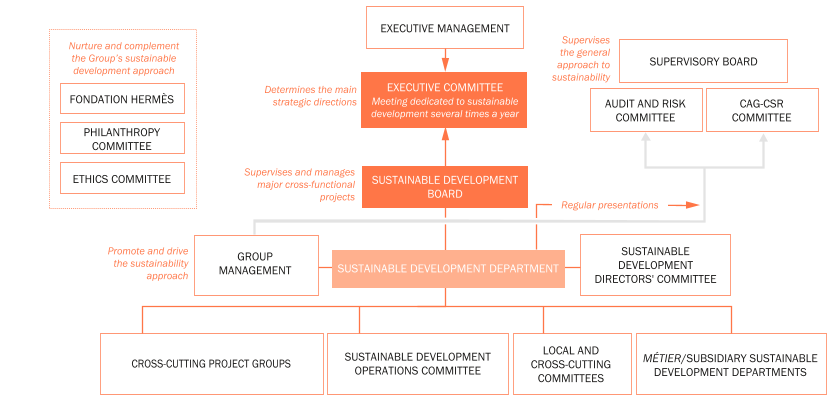
- ◆is informed about market developments, the competitive environment and the most important issues facing the Company, including in the area of social and environmental responsibility and non-financial performance;
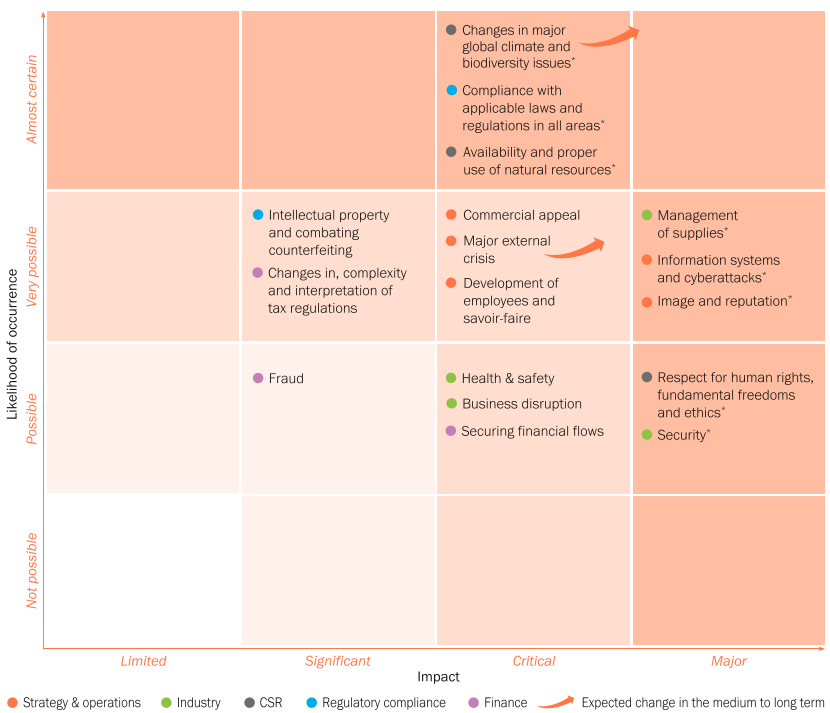
- ◆regularly reviews, via the Audit and Risk Committee, the opportunities and risks, such as financial, legal, operational, social and environmental risks, as well as the measures taken accordingly;
- ◆is regularly informed of the Company’s financial position, cash position and commitments;
- ◆ensures the establishment of a system for preventing and detecting corruption and influence-peddling;
- ◆ensures that the Executive Corporate Officers implement a policy of non-discrimination and diversity, notably with regard to the balanced representation of men and women on the Governing bodies;
- ◆examines the desired balance between its composition and that of its committees, and defines its diversity policy (see § 2.4.3).
2.5.1.2Duties of the Chairman of the Supervisory Board
2.5.1.2.1General duties
In relations with the other bodies of the Company and vis-à-vis third parties, the Chairman is the sole person authorised to speak and act on behalf of the Board, other than in exceptional circumstances.
- ◆with the support of the CAG-CSR Committee, the approval of the Board and of the Shareholders’ General Meeting where appropriate, he or she strives to create an effective and balanced Board, and to manage the replacement and succession planning processes concerning the Board and the appointments for which it is responsible;
- ◆he or she may attend all the committees and may add to the agenda any subject he or she considers relevant;
- ◆he or she ensures that the members of the Board have the documentation and information they need to carry out their duties in a timely manner, in a clear and appropriate form.
The Chairman organises and directs the work of the Supervisory Board in order to enable it to perform all its duties. In this respect, he or she:
- ◆calls meetings of the Supervisory Board, determines the agenda and chairs the meetings;
- ◆organises the proceedings, leads discussions of the Supervisory Board and reports on these to the General Meeting, and coordinates its work with that of the specialised committees;
- ◆ensures the quality of discussions and the collegiality of Board decisions;
- ◆oversees the proper functioning of the Board and its committees in accordance with the principles of good governance and ensures that the members of the Board are able to fulfil their duties;
- ◆chairs and directs discussions at Shareholders’ General Meetings;
- ◆deals with any conflicts of interest that may arise within the Supervisory Board as part of the procedure for managing conflicts of interest described in the rules of procedure.
As in previous years, the Chairman of the Supervisory Board was invited to attend all meetings of the Executive Management Board of Émile Hermès SAS.
2.5.1.2.2Duties relating to shareholder dialogue and the activity review
Since 20 March 2018, the Chairman of the Supervisory Board has been responsible for communicating with shareholders, on behalf of the Supervisory Board, with a view to:
- ◆explaining the positions taken by the Supervisory Board in its areas of competence (particularly with regard to governance and Senior Executive compensation), which were previously the subject of a communication;
- ◆ensuring that shareholders receive the information they expect from the Company.
The Chairman may seek the assistance of internal experts in these areas (in particular the Director of Financial Communications and Investor Relations or the Director of Corporate Law and Stock Exchange Regulations, Supervisory Board secretary and Compliance Officer).
In early 2026, the Chairman reported to the Supervisory Board on the performance of his duties in 2025. He was mainly asked to answer questions from institutional shareholders.
The AMF recommends that issuers establish a dialogue between the Board and shareholders, through the intermediary of a Lead Director, where applicable, on the main topics of concern to shareholders, in particular questions relating to strategy and social, environmental and governance (ESG) performance. It is specified that the replies to the questions relating to strategy and social, environmental and governance (ESG) performance, as well as to the written questions addressed to the Company at the General Meeting, are the responsibility of the Executive Management.
2.5.1.3Duties of the Vice-Chairmen of the Supervisory Board
-
2.6Specialised committees
2.6.1Applicable principles
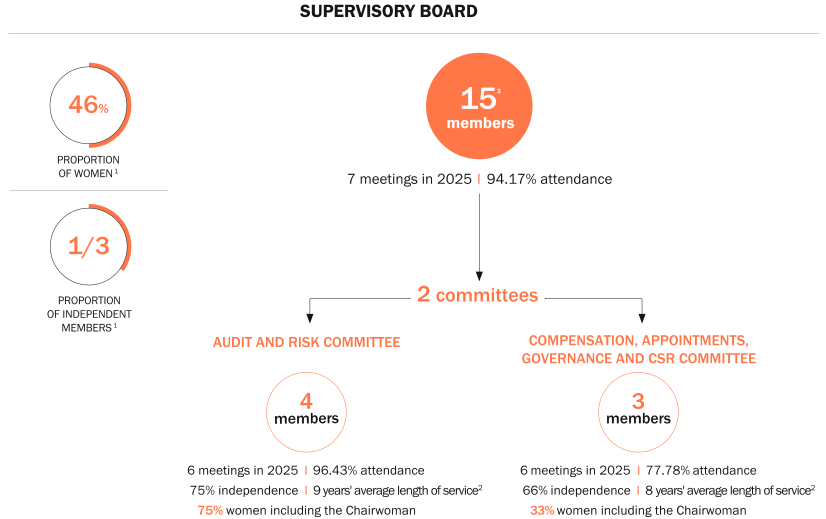
Since 2005, the Supervisory Board has relied on the work of two permanent specialised committees:
- ◆the Audit Committee (26 January 2005), set up in application of Article L. 823-19 of the French Commercial Code (Code de commerce), whose remit was subsequently extended by the Board and which was renamed the Audit and Risk Committee (19 March 2019);
- ◆the Compensation Committee (26 January 2005), which was subsequently assigned new duties and responsibilities by the Board and renamed the Compensation and Appointments (18 March 2009), Governance (20 January 2010) and CSR (16 November 2018) Committee or the “CAG-CSR Committee”.
These committees act under the collective and exclusive responsibility of the Supervisory Board. Their role is to discuss, analyse and prepare for certain deliberations of the Board, to which they submit their opinions, proposals or recommendations. Their powers do not reduce or limit the powers of the Board and the opinions, proposals or recommendations made are in no way binding on the Board.
The members of the committees do not incur any legal responsibilities in respect of their duties other than those of members of the Supervisory Board.
The Company’s CAG-CSR Committee is not tasked with setting the compensation of the Executive Chairmen, a task governed by the provisions of the Articles of Association and which falls within the remit of the Active Partner and not the Supervisory Board. It was therefore not relevant to create separate Compensation and Appointments Committees.
The Supervisory Board decides on the composition of the specialised committees, taking into account the skills of the Board members in the areas in question and their availability, as well as the legal requirements (Article L. 821-67 of the French Commercial Code (Code de commerce)) and the recommendations of the Afep-Medef Code updated in December 2022 (see § 2.1.2).
2.6.1.1Committee member skills required
The skills of the members of a committee must correspond to the missions entrusted to this committee (see § 2.6.2.4 and § 2.6.3.4).
The skills and experience matrix presented in § 2.4.5.2 lists the skills of the members of each committee.
2.6.1.2Changes in the composition of the committees over the financial year
- ◆reappointed as members of the Audit and Risk Committee Mses Monique Cohen (Chairwoman), Estelle Brachlianoff and Mr Renaud Momméja;
- ◆noted the end of the terms of office of Messrs Charles-Éric Bauer and Alexandre Viros as members of the Audit and Risk Committee;
- ◆appointed Ms Cécile Béliot-Zind as a member of the Audit and Risk Committee;
- ◆reappointed Ms Estelle Brachlianoff and Mr Matthieu Dumas as members of the CAG-CSR Committee;
- ◆noted the end of the term of office of Ms Dominique Senequier as Chairwoman and member of the CAG-CSR Committee;
- ◆appointed Mr Jean-Laurent Bonnafé as a member of the CAG-CSR Committee; and
- ◆appointed Ms Estelle Brachlianoff as Chairwoman of the CAG-CSR Committee.
Summary of changes in 2025
Departures
Appointments
Renewals
Audit and Risk Committee
Mr Charles-Éric Bauer (30/04/2025)
Mr Alexandre Viros (30/04/2025)
Ms Cécile Béliot-Zind (30/04/2025)
Ms Monique Cohen, Chairwoman (30/04/2025)
Ms Estelle Brachlianoff (30/04/2025)
Mr Renaud Momméja (30/04/2025)
CAG-CSR Committee
Ms Dominique Senequier, Chairwoman (30/04/2025)
Ms Estelle Brachlianoff, Chairwoman (30/04/2025)
Mr Jean-Laurent Bonnafé (30/04/2025)
Ms Estelle Brachlianoff (30/04/2025)
Mr Matthieu Dumas (30/04/2025)
2.6.1.3Future changes within the committees
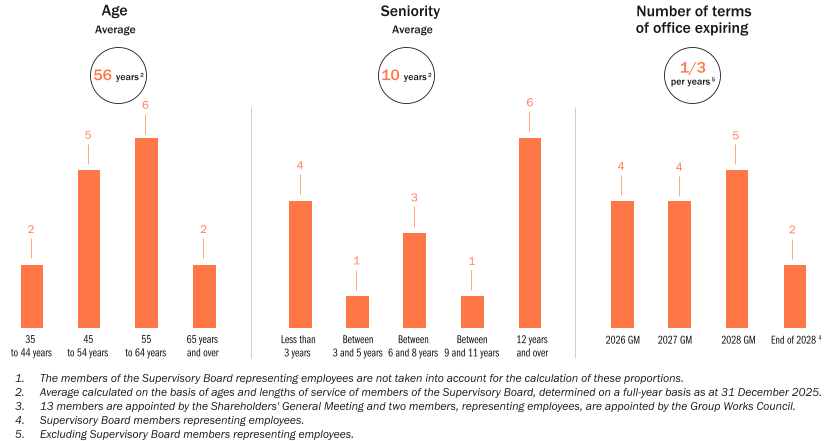
The terms of office of Supervisory Board members Mr Renaud Momméja and Ms Monique Cohen expire in 2026. The term of office of Ms Monique Cohen will not be renewed, as she has served on the Supervisory Board for 12 years. It is therefore proposed that the General Meeting appoint Ms Lucia Sinapi-Thomas to replace Ms Monique Cohen (as member and Chairwoman) (see chapter 8 "General Meeting of 17 April 2026" – explanatory statement to the sixteenth resolution).
In addition, Mr Renaud Momméja announced to the Supervisory Board his wish to end his duties as a member of the Audit and Risk Committee from the end of the General Meeting of 17 April 2026. It was decided by the Supervisory Board to replace him with Ms Julie Guerrand.
Subject to the renewal of the aforementioned terms of office as members of the Supervisory Board and the appointment of the candidate proposed to the General Meeting of 17 April 2026, the composition of the specialised committees would be modified as follows:
-
2.7Evaluation of the Supervisory Board and committees
2.7.1Methodology
2.7.1.1Whether or not to use an external advisor
During the formal 2022 evaluation, the CAG-CSR Committee considered, as it had done in 2019, that it was undesirable to call on an outside firm to conduct the formal evaluation of the Supervisory Board. The reasons for this decision are as follows:
- ◆confidentiality issues raised by giving information on the Supervisory Board to a third party;
- ◆the relative absence of weak signals raised by previous evaluations;
- ◆the steady progress made in terms of governance;
- ◆the small amount of added value expected from an external firm, particularly given the specific nature of a société en commandite par actions (partnership limited by shares), which provides for few comparable companies.
2.7.1.2Evaluation Process
The evaluation is carried out, in accordance with the recommendations of the Afep-Medef Code revised in December 2022 (Article 11.3), as follows:
- ◆a formal evaluation is carried out every three years (year N). It is implemented, under the direction of the CAG-CSR Committee, with the help of the secretary of the Board;
- ◆the following year (year N+1), the Supervisory Board organises an in-meeting discussion, during which a review is undertaken of the actions carried out since the last evaluation in order to respond to the areas for improvement identified;
- ◆the following year (year N+2), the Chairman of the Supervisory Board meets individually with each member of the Supervisory Board in order to discuss in particular the functioning of the Board since the last evaluation and to assess the individual contribution of its members;
- ◆the shareholders are informed each year in the corporate governance report of the performance of the assessments and, where applicable, the follow-up given to them.
2.7.1.3Objectives of the evaluation
The evaluation shall have three objectives (Article 11.2 of the Afep-Medef Code updated in December 2022):
-
2.8Compensation and benefits of Corporate Officers
2.8.1Compensation policy for the Executive Chairmen (Executive Corporate Officers) and members of the Supervisory Board (non-Executive Corporate Officers)
2.8.1.1General principles of the compensation policy for Corporate Officers
Pursuant to paragraph 4 of Article L. 22-10-76, I of the French Commercial Code (Code de commerce), resulting from the aforementioned order, the compensation policy for Corporate Officers (Executive Chairmen and members of the Supervisory Board) is presented below.
This policy describes all components of fixed and variable compensation and explains the decision-making process applied for its determination, review and implementation.
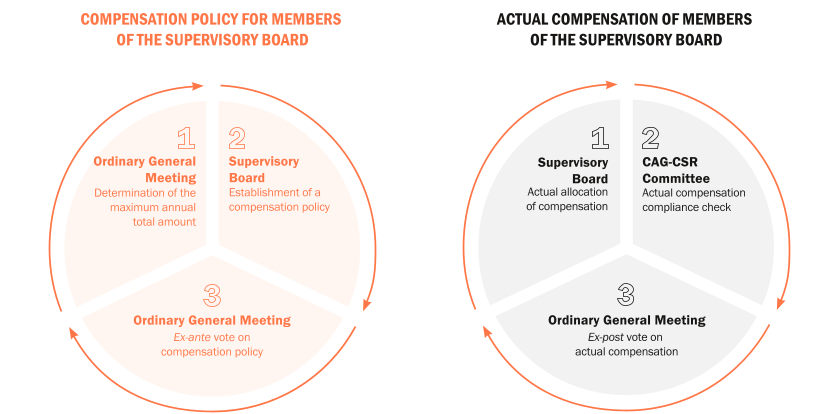
The operating rules specific to sociétés en commandite par actions (partnerships limited by shares) and the Company’s governance system have resulted in the establishment of the compensation policy for Senior Executives (Executive Chairmen) and other Corporate Officers (Supervisory Board members) being entrusted to the Active Partner and the Supervisory Board respectively.
2.8.1.1.1Manner in which the compensation policy respects the interests of the Company and contributes to the Company’s commercial strategy and sustainability (Article R. 22-10-40, I-1° of the French Commercial Code (Code de commerce))
The compensation policies for the Executive Chairmen and Supervisory Board members are aligned with the corporate interest and contribute to the Company’s commercial strategy and sustainability for the following reasons:
- ◆since the Company’s transformation into a société en commandite par actions (partnership limited by shares), the maximum amount of variable compensation set by the Articles of Association (“statutory compensation”) of the Executive Chairmen has been determined by the Articles of Association (Article 17);
- ◆the maximum amount of fixed (“additional”) compensation of the Executive Chairmen and the terms of its indexation were determined by the Ordinary General Meeting of 31 May 2001.
- ◆On 7 February 2024, the Executive Management Board of Émile Hermès SAS, Active Partner, decided to limit the indexation of fixed compensation to 5%. This change to the compensation policy for the Executive Chairmen was approved by the General Meeting of 30 April 2024. This ceiling was applied for the first time to the fixed compensation of the Executive Chairmen that was paid in 2025 (see § 2.8.1.2.1).
- ◆The compensation of the Executive Chairmen is determined on the basis of clear, quantifiable criteria (notably growth in revenue and change in consolidated net income before tax, as described in § 2.8.1.2.4 below) that are relevant to its business model and have remained unchanged for a considerable number of years.
- ◆the variable compensation is subject in part (10%) to a CSR criterion reflecting the Group’s firm and ongoing commitments to sustainable development (for the composition of the CSR criterion, see § 2.8.1.2.4);
- ◆the composition of compensation is simple and clear – fixed and variable compensation, without resorting to complex deferred compensation mechanisms and without guaranteeing a minimum variable compensation in the event of a poor economic performance by the Company;
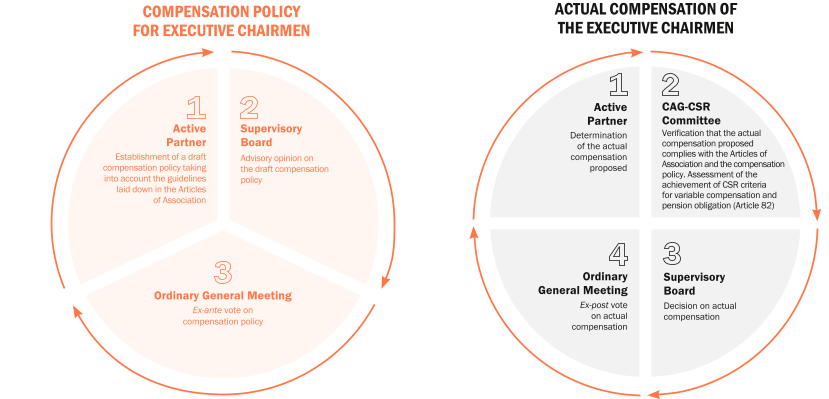
- ◆the Executive Management Board of Émile Hermès SAS, Active Partner, sets the actual amount of each Executive Chairman’s annual compensation set by the Articles of Association (“statutory compensation”). To this end, it uses the recommendations of the CAG-CSR Committee and in particular, in addition to the level of achievement of CSR criteria, takes into account in its decision the performance achieved by the Group in respect of the previous financial year, the strategic challenges in respect of the Group’s medium- and long-term development and the competitive environment in which it operates.
- ◆the principles governing allocation set out in the compensation policy for members of the Supervisory Board result in amounts being awarded on the basis of the tasks entrusted to them and their attendance at meetings;
- ◆these principles are periodically reviewed in line with market practices.
2.8.1.1.2Manner in which the conditions of compensation and employment of the Company’s employees are taken into account in the decision-making process (Article R. 22-10-40, I-3° of the French Commercial Code (Code de commerce))
The compensation and employment conditions of the Group’s employees are detailed in chapter 4 “Corporate social responsibility and non‐financial performance”, § 4.1.3.2.2.
With regard more specifically to the conditions governing compensation, Hermès’ economic successes are regularly shared with all Group employees, both in France and around the world, in various forms. The aim is to acknowledge the contribution made by employees to the House’s development, regardless of their role in the value-creation chain, in order to share the benefits of our growth over the long term.
The Group’s policy is to allow its employees to benefit from its long-term growth prospects through various mechanisms:
- ◆in general, in all the countries where the Company operates, its employees are paid in line with market standards in terms of their total compensation;
- ◆the Company also offers its employees:
- •employee shareholding plans: such plans have been in place for many years (the first plan dates back to 1993) and acknowledge the contribution made by employees to the House’s development, regardless of their role or geographical location, by providing a single component of compensation in order to share the benefits of the Company's growth, enabling employees to identify more closely with decisions having an impact on Hermès’ long-term growth,
- •incentive schemes involving employees with the development of locally determined indicators that are relevant with regard to the activity and environment of each of the French subsidiaries, notably quality, safety and productivity,
- •a Group profit-sharing agreement giving all employees of companies in France a share of the Group’s profits in a harmonised manner,
- •other mechanisms enabling employees of foreign subsidiaries to benefit from additional compensation adapted to local performance and practices,
- •voluntary and supra-legal social protection and pension plans, set up by the subsidiaries in order to supplement the employer offer in a comprehensive and competitive manner and to offer compensation and social protection schemes in the short, medium and long term,
- •lastly, exceptional bonuses were awarded to all employees (fixed-term and permanent employment contracts) worldwide in 2022, 2023, 2024, 2025 and 2026.
The Group’s employee compensation policy is ambitious and comprehensive; it incorporates a wide range of compensation tools.
The budget guidelines for wage increases during the annual salary review take account of inflation and changes in local wage markets. Particular attention is paid to gender equality and gaps in relation to the markets (internal and external). Specific budgets may be provided if adjustments are necessary.
The desire to reward both collective and individual performance can also be seen in the development of variable compensation at both individual and collective levels in recent years.
2.8.1.1.3Measures to avoid or manage conflicts of interest (Article R. 22-10-40, I-2° of the French Commercial Code (Code de commerce))
- ◆the maximum amount of variable compensation set by the Articles of Association (“statutory compensation”) of the Executive Chairmen is determined by the Articles of Association (Article 17);
- ◆the maximum amount of fixed (“additional”) compensation of the Executive Chairmen and the terms of its indexation were determined by the Ordinary General Meeting of 31 May 2001. On 7 February 2024, Émile Hermès SAS, Active Partner, decided to cap this indexation (see § 2.8.1.2.1);
- ◆since its creation on 24 March 2010, the CAG-CSR Committee of the Supervisory Board of Hermès International has been tasked each year with ensuring that compensation paid to the Executive Chairmen complies with the provisions of the Articles of Association and the decisions made by the Active Partner;
- ◆changes to the two components of the Executive Chairmen’s compensation depend on clear and objective long-term criteria that are both qualitative and quantifiable, and which are publicly available and predefined by nature, as described in § 2.8.1.2;
- ◆when setting the actual amount of each Executive Chairman’s compensation set by the Articles of Association (“statutory compensation”), the Executive Management Board of Émile Hermès SAS uses the recommendations of the CAG-CSR Committee and takes into account in its decision the performance achieved by the Group in respect of the prior financial year, the strategic challenges in respect of the Group’s medium- and long-term development and the competitive environment in which it operates;
- ◆since 2020, the compensation policy for the Executive Chairmen has been subject to the advisory opinion of the Supervisory Board and the approval of the General Meeting, and the actual compensation of the Executive Chairmen is subject to a decision by the Supervisory Board.
2.8.1.1.4Procedures for publishing the compensation of Corporate Officers
Pursuant to Article R. 22-10-40, V of the French Commercial Code (Code de commerce), the compensation policy for Corporate Officers, together with the date and result of the last ex-ante vote in the General Meeting, is disclosed on the Company’s financial website on the business day following the date of the vote.
Pursuant to Article 27.1 of the Afep-Medef Code, all potential or vested compensation of the Executive Chairmen is disclosed on the Company’s financial website https://finance.hermes.com/en/corporate-officers/ immediately after the meeting of the Executive Management Board of Émile Hermès SAS, Active Partner, that approved it.
2.8.1.2Specific principles applicable to the compensation policy for the Executive Chairmen (Executive Corporate Officers)
Decision-making process followed for the determination, review and implementation of this policy
Decision-making process relating to the establishment of the Executive Chairmen’s compensation policy (Article R. 22-10-40, I-2° of the French Commercial Code (Code de commerce))
The components of the Executive Chairmen’s compensation policy are established by Émile Hermès SAS, Active Partner. The decision is made by taking into account the principles and conditions provided for in Article 17 of the Articles of Association with respect to the variable compensation set by the Articles of Association (“statutory compensation”) and, by reference to the Articles of Association, the decision of the Ordinary General Meeting of 31 May 2001 with respect to fixed (“additional”) compensation.
The Supervisory Board issues an advisory opinion on the compensation policy for the Executive Chairmen.
Since 2020, the compensation policy for the Executive Chairmen is submitted each year to the Ordinary General Meeting for approval (ex-ante vote).
Decision-making process followed for the determination of the actual compensation of the Executive Chairmen (Article L. 22-10-76 of the French Commercial Code (Code de commerce))
The actual amount of the Executive Chairmen’s compensation is determined each year by Émile Hermès SAS, Active Partner, in accordance with the approved compensation policy, which is then submitted to the Supervisory Board for approval.
- ◆evaluates the achievement of the indicators comprising the CSR criterion for the Executive Chairmen’s variable compensation and retirement benefit obligations (Article 82);
- ◆checks that the actual compensation of the Executive Chairmen complies with the Articles of Association and the compensation policy.
Since 2020, the actual overall compensation of Corporate Officers (including that of the Executive Chairmen) and the actual individual compensation of each Executive Chairman will be subject, each year, to approval by the Ordinary General Meeting (ex-post votes).
2.8.1.2.1Changes made to the compensation policy for the Executive Chairmen since the last General Meeting (Article R. 22-10-40, I-5° of the French Commercial Code (Code de commerce))
The General Meeting of 30 April 2025 approved, at 91.12% and without reservation, the compensation policy for the Executive Chairmen (see § 2.8.5).
In accordance with the decision-making process described in § 2.8.1.2, at its meeting of 11 February 2026, the Executive Management Board of Émile Hermès SAS proposed the renewal of this compensation policy without changes compared to the previous financial year.
2.8.1.2.2Terms of application to newly appointed or reappointed Executive Chairmen (Article R. 22-10-40, I-6° of the French Commercial Code (Code de commerce))
The term of office of the Executive Chairmen is indefinite under the terms of the Articles of Association, and is therefore not subject to renewal.
The compensation policy would apply to newly appointed Executive Chairmen on a pro rata basis in accordance with their presence during the first year of their term.
2.8.1.2.3Exceptions to the application of the compensation policy (Article R. 22-10-40, I-7° of the French Commercial Code (Code de commerce))
In the event that exceptional circumstances should arise, the Executive Management Board of Émile Hermès SAS is authorised, under the conditions provided for by law, to waive the application of the compensation policy used to set the variable compensation of the Executive Chairmen, within the limit authorised by the Articles of Association, and after the favourable opinion of the Supervisory Board.
2.8.1.2.4Specific elements comprising the compensation policy for the Executive Chairmen (Article R. 22-10-40, II of the French Commercial Code (Code de commerce))
Pursuant to Articles L. 22-10-76 and R. 22-10-40, II of the French Commercial Code (Code de commerce), the specific components comprising the compensation policy for the Executive Chairmen are set out below.
Reminder of the compensation structure for the Executive Management
- ◆Fixed compensation, indexed to changes in consolidated revenue (upwards only), up to a limit of 5% (cap introduced in 2024).
- ◆Short-term variable compensation, indexed to the change in consolidated net income before tax, 10% of which is linked to the achievement of three indicators (each weighing for one-third of the 10%) making up the CSR criterion (introduced in 2019).
- ◆No long-term incentive (LTI) in the form of shares or otherwise, and no eligibility for the Group's profit-sharing or incentive schemes or exceptional bonuses.
- ◆Supplemental pension plans (from which only the natural person Executive Chairman benefits):
- •"Article 82" type defined-contribution pension plan, whose gross annual contribution is based on the reference compensation of the natural person Executive Chairman, with a rate varying from 0% to 20%, subject to the achievement of performance conditions (introduced in 2024).
- •"Article 83" type defined-contribution pension plan, applicable to all employees.
- •"Article 39" type defined-benefit pension plan (frozen in 2019).
- ◆Eligibility for health and welfare expense plans, applicable to all employees, and company car.
- ◆Severance payment representing 24 months of total compensation (fixed and variable) in the event of forced departure, with performance conditions.
When the office is taken up
During their term of office
The term of office of the Executive Chairmen is open-ended. The Executive Chairmen may be dismissed by a decision of the Active Partner.
Annual fixed and variable compensation and respective importance – CSR criterion for variable compensation
In accordance with the principles set out in Article 17 of the Articles of Association, each Executive Chairman is entitled to fixed compensation (referred to as “additional” in the Articles of Association) for which the maximum amount is determined by the Ordinary General Meeting with the unanimous approval of the Active Partners and, potentially, variable compensation set by the Articles of Association (“statutory compensation”):
- ◆fixed compensation (referred to as “additional compensation” in the Articles of Association) was introduced by the Ordinary General Meeting of 31 May 2001, which set a limit of €457,347.05, and provided for it to be indexed upwards only, in accordance with any increase in consolidated revenue for the previous financial year over the year prior to that, at constant scope and exchange rates. On 7 February 2024, the Executive Management Board of Émile Hermès SAS decided to limit the indexation of fixed compensation to 5%. This change was approved by the General Meeting of 30 April 2024;
- ◆the calculation of the variable compensation referred to as “compensation set by the Articles of Association (“statutory compensation”)” – set by Article 17 of the Articles of Association – has remained constant since the IPO on 3 June 1993. This compensation is capped at 0.20% of the consolidated net income before tax generated in the previous financial year. This mode of determination naturally leads to a strict variability in the compensation set by the Articles of Association (“statutory compensation”) of Executive Chairmen, in a transparent way and without any guarantee of a minimum amount.
The variable compensation of the two Executive Chairmen is partially conditioned (10%) on a “CSR” criterion reflecting the Group’s stated and constant commitments in respect of sustainable development. The CSR criterion contributes to the objectives of the Executive Chairmen’s compensation policy.
- ◆decoupling between business growth at constant scope and exchange rates and the evolution of industrial energy consumption (quantifiable environmental criterion);
- ◆actions implemented in favour of the Group’s local integration in France and throughout the world, excluding major cities (qualitative societal criterion);
- ◆Group initiatives in favour of gender balance (qualitative social criterion).
These indices are in line with the CSR strategy and the action priorities presented in chapter 4 “Corporate social responsibility and non‐financial performance” § 4.1.1.5.2).
The Executive Management Board of Émile Hermès SAS, Active Partner, sets the actual amount of the annual compensation of each Executive Chairman, not exceeding the maximum amount of the approved compensation policy defined herein, and in accordance with the criteria and targets set out in § 2.8.1.1 and § 2.8.1.2.
Changes to the two components of the Executive Chairmen’s compensation depend on clear and objective long-term quantifiable criteria, which are publicly available and predefined by nature, as described in paragraphs 1) and 2) above.
Thus, no minimum variable compensation set by the Articles of Association (“statutory compensation”) is guaranteed for the Executive Chairmen.
The quantifiable criteria are paramount in the calculation of the variable compensation of the Executive Chairmen.
The Executive Management Board of Émile Hermès SAS, Active Partner, relies on the recommendations of the CAG-CSR Committee.
Mr Henri-Louis Bauer, the Legal Representative of Émile Hermès SAS (Executive Chairman), does not personally receive any compensation from Hermès International. He receives compensation from Émile Hermès SAS for his functions as Executive Chairman of this company, which is unrelated to the appointment of Émile Hermès SAS as Executive Chairman of Hermès International.
The Executive Chairmen do not receive any compensation or benefits of any kind from the subsidiaries of Hermès International.
The breakdown of the actual compensation of the Executive Chairmen for the last two financial years is shown in § 2.8.4.2.
Each year, the CAG-CSR Committee of the Supervisory Board of Hermès International is tasked with ensuring that the Executive Chairmen’s compensation is compliant with the Articles of Association and the compensation policy.
No predetermined weighting is applied with respect to fixed and variable compensation, which depend on the components described above.
History of fixed and variable compensation paid to the Executive Chairmen over the last three financial years and respective importance
Mr Axel Dumas
2025
Proportion (not
pre-established)2024
Proportion (not
pre-established)2023
Proportion (not
pre-established)Fixed compensation (referred to as “additional” in the Articles of Association)
€2,790,386
36%
€2,657,510
36%
€2,203,574
38%
Variable compensation set by the Articles of Association (“statutory compensation”) awarded in respect of the previous financial year
€5,042,291
64%
€4,630,203
64%
€3,648,702
62%
of which CSR criterion
10%
10%
10%
Total
€7,832,677
€7,287,713
€5,852,276
Emile Hermès SAS
2025
Proportion (not
pre-established)2024
Proportion (not
pre-established)2023
Proportion (not
pre-established)Fixed compensation
(referred to as “additional” in the Articles of Association)
€948,562
29%
€903,392
29%
€749,081
31%
Variable compensation set by the Articles of Association (“statutory compensation”) awarded in respect of the previous financial year
€2,351,359
71%
€2,159,191
71%
€1,701,490
69%
of which CSR criterion
10%
10%
10%
Total
€3,299,921
€3,062,583
€2,450,571
Methods for assessing the achievement of performance criteria for variable compensation or share-based compensation (Article R. 22-10-40, I-4° of the French Commercial Code (Code de commerce))
The variable compensation set by the Articles of Association (“statutory compensation”) of the Executive Chairmen is evaluated in accordance with the change in consolidated net income before tax for the prior financial year compared with the preceding financial year, and conditioned in the proportion of 10% on the achievement of the CSR criterion.
The evaluation of the amount of compensation subject to the CSR criterion is limited to a target of 100%, with no possibility of exceeding that limit.
Each of the three indices mentioned in § 2.8.1.2.4 “Annual fixed and variable compensation and respective importance – CSR criterion for variable compensation”:
- ◆shall count as one-third of the CSR criterion;
- ◆has an annual reference period;
- ◆is subject to an annual evaluation of their achievement by the CAG-CSR Committee.
The allocation to Executive Chairmen of deferred or multi-year variable compensation is not provided for.
Share-based compensation (Article R. 22-10-40, II-2° of the French Commercial Code (Code de commerce))
The current compensation policy does not provide that the Executive Chairmen are entitled to share-based compensation.
In accordance with Article 26.3.3 of the Afep-Medef Code, Executive Chairmen who are natural persons and who are beneficiaries of stock options and/or performance-based shares must make a formal commitment not to hedge their risk on options or on shares resulting from the exercise of options or on performance-based shares, until the end of the share retention period.
Mr Axel Dumas, the only eligible Executive Chairman, has not received any stock options or performance-based shares since he was appointed Executive Chairman.
Émile Hermès SAS, a legal entity, is not eligible for the stock option or performance-based share plans.
In order to comply with the Afep-Medef Code, Mr Axel Dumas decided to end his employment contract with immediate effect on 5 June 2013, upon his appointment as Executive Chairman of Hermès International.
The Executive Chairmen do not receive any compensation as Board members paid by the Company or by the Group's subsidiaries.
Similarly, note that the Group’s allocation rules specify that the members of the Executive Committee of Hermès International who are directors in subsidiaries do not receive compensation in that capacity.
Mr Axel Dumas is eligible for the mandatory collective death and disability plan established by the Group for the benefit of all staff of French entities that have joined this plan (decision taken by the Supervisory Board on 19 March 2014).
- ◆a disability pension at 51% of reference compensation in the case of Category 1 disability and 85% of reference compensation in the case of Category 2 or 3 disability. The reference compensation (gross annual compensation) is capped at 8x the annual social security ceiling (PASS). The payment of the disability pension is discontinued when the recipient in question is no longer categorised as having the disability or permanent impairment and, at the latest, on the day of the normal or early liquidation of an old age insurance pension from the mandatory retirement plan, for any reason whatsoever;
- ◆a death benefit equal to a maximum of 380% of the reference compensation, capped at 8x PASS, depending on the family situation;
- ◆contributions paid to the insurer are split between the Company (80% of contributions) and the beneficiary (20% of contributions);
- ◆these contributions are deductible from the corporation tax base, subject to corporate social contributions at the rate of 8%, and excluded from the base for social security contributions, within the limit of an amount equal to the sum of 6% of PASS and 1.5% of compensation retained within the limit of 12x PASS.
Mr Axel Dumas benefits from the mandatory collective healthcare plan implemented by the Group for the benefit of all staff of French entities that have joined this plan (decision made by the Supervisory Board on 19 March 2014).
At the end of the term of office
The Company made a commitment to pay Mr Axel Dumas an amount equal to 24 months of total compensation (variable compensation set by the Articles of Association ("statutory compensation") and "additional" fixed compensation) in the event of the termination of his duties as Executive Chairman (decision of the Supervisory Board of 4 June 2013, approved by the General Meeting of 3 June 2014 − tenth resolution "Approval of the commitments owed to Mr Axel Dumas in respect of the termination of his duties as Executive Chairman" − in accordance with Article L. 225-42-1 of the French Commercial Code (Code de commerce) applicable at that date).
The payment of a severance payment is subject to the termination of duties as Executive Chairman resulting:
- ◆either from a decision by Mr Axel Dumas by reason of a change of control over the Company, a change in the Chairman of Émile Hermès SAS, which is an Executive Chairman of the Company, or a change in the Company’s strategy; or
- ◆from a decision taken by the Company.
Given the importance of the role of the Active Partner in a société en commandite par actions (partnership limited by shares) – who has the power to appoint and dismiss any Executive Chairman – and in the case of a legal entity, its legal representative, it was considered that the termination of duties as Executive Chairman of Mr Axel Dumas, which would result from the replacement of the Chairman of Émile Hermès SAS, was to be treated as a forced departure.
The criteria for granting severance payments are therefore strictly confined to cases of forced departure.
Moreover, the payment of such compensation is subject to the following performance conditions, such that the conditions of his departure are in equilibrium with the situation of the Company: achieving budget targets in at least four out of the five previous years (with revenue and operating income growth measured at constant rates), without deterioration in the Hermès brand image.
The Supervisory Board therefore considered that the deferred compensation commitment made to Mr Axel Dumas complied with the requirements of the Afep-Medef Corporate Governance Code.
Mr Axel Dumas is not subject to any non-competition agreement, therefore no compensation is made in this respect.
The total compensation of Mr Axel Dumas was determined taking into account the benefit of a supplemental pension plan.
Mr Axel Dumas is eligible for the supplementary defined-contribution pension plan established for all employees of the Group’s French companies that have joined it (decision by the Supervisory Board on 4 June 2013 approved by the General Meeting of 3 June 2014 − fifth resolution “Approval of related-party agreements and commitments”).
- ◆the defined-contribution pension plan is funded as follows: 1.1% for the reference compensation for an amount of 1x PASS, 3.3% for the reference compensation between 1x and 2x PASS, and 5.5% on the reference compensation between 2x and 6x PASS. Reference compensation means the gross annual compensation in accordance with Article L. 242-1 of the French Social Security Code (Code de la sécurité sociale);
- ◆these premiums are shared between the Company (90.91%) and the beneficiary (9.09%);
- ◆the employer contributions are deductible from the corporation tax base, subject to corporate social contributions at the rate of 20% and excluded from the base for social security contributions within the limit of the higher of the following two values: 5% of the PASS or 5% of the compensation retained within the limit of 5x PASS (€235,500 in 2025).
Defined-benefit pension plan (Article 39 of the French General Tax Code – Article L. 137-11 of the French Social Security Code)
Mr Axel Dumas is also eligible for the supplemental pension plan established in 1991 for Company Senior Executives (decision by the Supervisory Board on 4 June 2013, approved by the General Meeting of 3 June 2014 − fifth resolution “Approval of related-party agreements and commitments”).
This provision is not limited solely to the Executive Chairmen but also encompasses a wider group of Senior Executives. It may be terminated, in the case of Mr Axel Dumas, by decision of the Supervisory Board.
In accordance with Order no. 2019-697 of 3 July 2019 relating to defined-benefit occupational plans, no new members may join this scheme from 4 July 2019 and no new conditional right to benefits may be awarded for periods of employment after 31 December 2019.
As a fundamental condition of the pension regulations, in order to be eligible for the scheme, beneficiaries must have reached the end of their professional career with the Company, have at least ten years of seniority as evaluated at 4 July 2019 given the provisions of the aforementioned order of 3 July 2019, and be eligible to draw pension benefits under the statutory French social security regime.
Each participant gradually acquires potential rights, calculated each year on the basis of his or her annual reference compensation, it being specified that 2019 is the last year taken into account when calculating such rights (in application of Order no. 2019-697 of 3 July 2019). These potential rights represent, depending on the seniority and for each year, a percentage of the reference compensation ranging between 0.9% and 1.5%.
- ◆on the average yearly compensation for the last three years;
- ◆on a percentage of the reference compensation, ranging from 0.9% to 1.5% per year of service (as at 31 December 2019). In accordance with the regulation, as Mr Axel Dumas has a length of service exceeding 16 years, this percentage is set at 1.50%. It is in any event, below the legal limit of 3%.
In addition, the regulation provides for the application of two ceilings to the final amount of the annual pension:
- ◆the amount of the annual pension is capped at 8x PASS, i.e. €376,800 in 2025; and
- ◆the sum of (i) pensions accrued in respect of statutory and collective agreement plans (excluding increases for children raised) including rights accrued in overseas pension plans, pensions resulting from any supplementary plan that may be put in place within the Hermès Group and (ii) the amount of the top-up pension resulting from the regulations is capped at 70% of the last reference compensation.
For information, subject to fulfilling the conditions of the plan at the time of the liquidation of his pension, the maximum amount of the future pension, limited by the plan’s regulations to eight times the annual social security limit, compared with the compensation received during financial year 2025 of the natural person Executive Chairman, would represent a replacement rate (excluding mandatory plans) of 4.81%.
The plan is financed by the Company through a contract taken out with an external insurance company, and, if necessary, additional provisions are recorded in the financial statements.
Mr Axel Dumas is eligible for the "Article 82"-type defined-contribution funded pension plan as provided for under the French General Tax Code. This plan is also set up for certain Senior Executives in the form of free share allocations calculated based on their fixed and variable compensation, this latest being subject to the achievement of performance criteria.
This plan provides for a gross annual contribution based on the “Reference Compensation” of the Executive Chairman, consisting, at the payment date, of (i) the annual fixed compensation for year N and (ii) the annual variable compensation awarded in respect of year N-1 and paid in year N (subject to approval by the Shareholders’ General Meeting).
The contribution is calculated by applying a rate to the Reference Compensation that varies from 0% to 20% depending on the achievement of the applicable performance conditions, as shown in the diagram below.
- ◆achievement of 80% of the performance conditions for the reference financial year: maximum payment of the contribution, i.e. 20% of the Reference Compensation;
- ◆achievement of 50% of the performance conditions in respect of the reference financial year: lower limit payment, i.e. 10% of the Reference Compensation;
- ◆achievement of performance conditions in respect of the reference financial year between these two limits (i.e. between 50% and 80%): payment of the contribution according to a straight-line increase;
- ◆achievement of performance conditions below 50% of targets: no payment.
The acquisition rate of the rights varies according to the achievement rate of the performance criteria, as follows:
Performance criteria
Weighting
Performance
% allocation
Sales growth (at constant exchange rates)
40%
Lower limit
50% of target (annual budget)
50%
Target
80% of target (annual budget)
100%
Recurring operating income (at current exchange rates)
40%
Lower limit
50% of target (annual budget)
50%
Target
80% of target (annual budget)
100%
CSR criterion
Objectives related to decoupling between activity growth at constant scope and exchange rates and the evolution of industrial energy consumption
20%
Lower limit
50% of target
50%
Target
80% of target
100%
The payment of contributions, the rate of which is set according to the principles and conditions set out above, constitutes a benefit for the Executive Chairman, fully subject to social security contributions and taxation on entry, entirely at the expense of the beneficiary.
Summary of compensation and benefits potentially owing to the Executive Chairman Axel Dumas (a natural person), in the event of his departure
Method of determination as at 31/12/2025
Voluntary departure
(excluding retirement)
Forced departure
Retirement
Severance payment
n/a
Subject to the applicable performance conditions:
24 months of compensation
(fixed and variable)
n/a
Non-compete indemnity
n/a
n/a
n/a
Supplementary defined-benefit pension (Article 39 of the French General Tax Code – Article L. 137-11 of the French Social Security Code)
n/a
n/a
Annual pension amount:
number of years' length of service x (0.9% to 1.5%) x average annual compensation for the last three years
The pension will be capped at 8x PASS.
Additional defined-contribution pension (Article 83 of the French General Tax Code)
The annual amount of the pension will be determined by conversion to a pension annuity of savings established as at the date of liquidation of retirement entitlements.
Supplemental defined-contribution pension ("Article 82"-type under the French General Tax Code)
The annual amount of the pension will be determined by conversion to a pension annuity of savings established as at the date of liquidation of retirement entitlements.
n/a: not applicable.
2.8.1.3Specific principles applicable to the compensation policy for members of the Supervisory Board (Non-Executive Corporate Officers)
Decision-making process followed for its determination, review and implementation
Decision-making process relating to the compensation policy for members of the Supervisory Board (Article R. 22-10-40, IV of the French Commercial Code (Code de commerce)
The components of the compensation policy for Supervisory Board members are established by the Supervisory Board.
Since 2020, the compensation policy for members of the Supervisory Board has been submitted to the Ordinary General Meeting each year for approval (ex-ante vote).
Decision-making process relating to the actual compensation of members of the Supervisory Board (Article L. 22-10-76 of the French Commercial Code (Code de commerce)
The actual annual amount of compensation paid to the members of the Supervisory Board is determined by the Supervisory Board at the start of the year in respect of the previous year by applying the compensation policy and taking into account the individual attendance of each member during the previous financial year.
The Supervisory Board’s CAG-CSR Committee checks that the actual compensation of Supervisory Board members complies with the total amount set by the General Meeting and the compensation policy for the members of the Supervisory Board.
Since 2020, the actual application of the compensation policy (including the overall actual compensation paid, and/or awarded) of the Corporate Officers (including that of Supervisory Board members) and the actual individual compensation of the Chairman of the Supervisory Board will be submitted each year to the approval of the Ordinary General Meeting (ex-post vote).
2.8.1.3.1Changes made to the compensation policy for members of the Supervisory Board since the last General Meeting (Article R. 22-10-40, I-5° of the French Commercial Code (Code de commerce))
The General Meeting of 30 April 2025 approved, at more than 99.99% and without reservation, the compensation policy for the members of the Supervisory Board (see § 2.8.5).
In accordance with the decision-making process described in § 2.8.1.3, the Supervisory Board, at its meeting of 9 January 2026, proposed renewal of this compensation policy unchanged from the previous financial year.
2.8.1.3.2Terms of application to newly appointed or reappointed members of the Supervisory Board (Article R. 22-10-40, I-6° of the French Commercial Code (Code de commerce))
If a member is appointed during the year, the fixed component is shared between the outgoing member and his or her replacement, and the variable component is allocated according to attendance at meetings.
2.8.1.3.3Exemptions provided by the Supervisory Board (Article R. 22-10-40, I-7° of the French Commercial Code (Code de commerce))
There are currently no temporary exceptions from the application of the compensation policy for the Supervisory Board members subject to the occurrence of exceptional circumstances.
2.8.1.3.4Specific elements comprising the compensation policy for members of the Supervisory Board (Article R. 22-10-40, II of the French Commercial Code (Code de commerce))
Compensation of Supervisory Board and committee members
Supervisory Board members receive compensation in a total amount that is approved by the General Meeting and for which the allocation criteria are laid down in the Supervisory Board’s compensation policy.
Compensation paid to members of the Audit and Risk Committee and the CAG-CSR Committee is deducted from the total amount of compensation of Supervisory Board members.
The General Meeting of 20 April 2023 set the maximum annual amount of compensation allocated to the Supervisory Board and its committees at €900,000.
The allocation criteria (on a full-year basis) approved by the Board on 24 November 2023 and set out in Article 5.1 of the Board’s rules of procedure are as follows:
- ◆the maximum amounts that may be allocated to each member are set out in the table below;
- ◆the variable component proportional to the actual attendance at meetings is preponderant;
- ◆employee representatives on the Supervisory Board do not receive compensation as members of the Supervisory Board;
- ◆the variable component proportional to a member’s attendance at meetings is calculated by applying to the maximum amount of the variable component the ratio between the number of meetings attended (in the numerator) and the total number of meetings held during the last financial year (in the denominator);
- ◆no variable component is allocated to the Chairman of the Supervisory Board or the Chairs of the committees, since they must chair all meetings, unless they are prevented from doing so;
- ◆the fixed and variable components are determined by the Board at its first meeting of the year following the year for which the compensation is paid.
Allocation criteria applicable to 2025
Fixed component
Proportion
Variable component proportional to attendance at meetings
Proportion
Maximum amounts attributable
Supervisory Board
Chairman
€180,000
100.00%
n/a
n/a
€180,000
100.00%
Vice-Chairmen
€12,000
33.33%
€24,000
66.66%
€36,000
100.00%
Members
€12,000
33.33%
€24,000
66.66%
€36,000
100.00%
Employee representative members
n/a
n/a
n/a
n/a
n/a
n/a
CAG-CSR Committee
Chairman
€40,000
100.00%
n/a
n/a
€40,000
100.00%
Members
€8,000
40.00%
€12,000
60.00%
€20,000
100.00%
Audit and Risk Committee
Chairman
€40,000
100.00%
n/a
n/a
€40,000
100.00%
Members
€8,000
40.00%
€12,000
60.00%
€20,000
100.00%
n/a: not applicable.
The allocation criteria include a fixed component and a majority variable component proportional to actual attendance at meetings (66.66% for the Board and 60.00% for the specialised committees).
No additional compensation is paid to Board members who are not resident in France. The attendance record and the corresponding allocation of annual compensation for a financial year are prepared by the CAG-CSR Committee and then approved by the Supervisory Board in the first quarter of the following financial year.
Employment contract
The members of the Supervisory Board of a société en commandite par actions (partnership limited by shares) may be bound to the Company by an employment contract with no condition other than that resulting from the existence of a relationship of subordination with the Company and the recognition of effective employment.
- ◆Mr Prescience Assoh (Sales associate – Hermès Sellier); and
- ◆Ms Laurence Dunand-Chatellet (head of the Other Hermès Métiers division – Hermès Textile Holding),
and Ms Anne-Lise Muhlmeyer (preparation manager – Ateliers d'Ennoblissement d'Irigny), Supervisory Board member representing employees from 15 November 2022 to 17 November 2025,
hold employment contracts within the Hermès Group and receive compensation in this respect that was not granted by virtue of their office. Consequently, and for reasons of confidentiality, their salaries are not disclosed.
Options to subscribe for and purchase shares
No options to subscribe for or purchase shares were granted to Supervisory Board members in financial year 2025, nor were any such options exercised by them.
Allocation of free shares
-
2.9Other information
2.9.1Agreements
2.9.1.1Related-party agreements and transactions
Information on the related-party agreements described in the summary table below and the status of ongoing agreements is presented in chapter 8 “Combined General Meeting of 17 April 2026” in the report of the Supervisory Board to the General Meeting, § 8.3 and in the Statutory Auditors’ special report, § 8.4.3.
In application of Articles L. 226-10, L. 225-38 to L. 225-43 of the French Commercial Code (Code de commerce), any agreement entered into directly or through an intermediary between the Company and:
- ◆one of its Executive Chairmen;
- ◆one of the members of the Supervisory Board; or
- ◆one of its shareholders holding a fraction of the voting rights greater than 10% or, in the case of a shareholder company, the company controlling it within the meaning of Article L. 233-3 of the French Commercial Code (Code de commerce),
These provisions are applicable to agreements in which one of these persons has an indirect interest.
Agreements entered into directly or through an intermediary between the Company and a company are also subject to prior authorisation by the Supervisory Board if:
is an owner, partner with unlimited liability, Executive Chairman, Director, Chief Executive Officer, member of the Management Board or member of the Supervisory Board of the company.
The foregoing provisions are not applicable either to agreements on current transactions entered into on an arm’s length basis or to agreements concluded between two companies in which one holds, directly or indirectly, the entire share capital of the other, where applicable, after deduction of the minimum number of shares required by law. These agreements are communicated by the person concerned to the Chairman of the Supervisory Board, who communicates the list to the members of the Board and to the Statutory Auditors.
In accordance with the provisions of Article L. 225-38 of the French Commercial Code (Code de commerce), authorisation decisions of the Supervisory Board since 1 August 2014 are all supported by justification.
A review of the related-party agreements entered into during previous financial years and whose execution has continued over time is carried out by the Supervisory Board each year in accordance with the provisions of Article L. 225-40-1 of the French Commercial Code (Code de commerce).
Related-party transactions are shown in chapter 5 “Consolidated financial statements”, § 5.6 (note 13).
Summary of related-party agreements in force deSCribed in the Statutory Auditors' special report
Nature of the agreement
Persons concerned
Nature, purpose and terms of the agreement
Amount
Service agreement with Studio des Fleurs
Mr Frédéric Dumas, member of the Executive Management Board of Émile Hermès SAS, Executive Chairman of Hermès International
The Supervisory Board authorised the conclusion of a contract between Hermès International and Studio des Fleurs relating to photography and retouching services for e-commerce product packshots.
Reasons why the agreement is beneficial for the Company
Studio des Fleurs agreed to the following points, which were fundamental to Hermès International:
- ◆Studio des Fleurs' obligations: compliance with very precise specifications, duty of advice, monitoring of services, quality control;
- ◆performance indicator monitoring criteria;
- ◆no minimum order guaranteed;
- ◆fixed three-year term followed by indefinite duration;
- ◆long notice of termination (18 months);
- ◆non-exclusivity;
- ◆undertaking by Studio des Fleurs to take the necessary measures to maintain its economic independence (in particular by expanding and diversifying its customer base) from the Hermès Group;
- ◆confidentiality and prohibition on using Hermès as a reference;
- ◆no revision of rates before the expiry of three years, and then revision possible but capped.
Date of approval by the Supervisory Board
20 March 2018 Contract
29 July 2021 New commercial conditions
For 2025, €72,372 was invoiced for services provided under the agreement.
Design agreement with architectural firm RDAI 1
Ms Sandrine Brekke, partner with a stake of more than 10% in RDAI and member of the Management Board of Émile Hermès SAS, Executive Chairman of Hermès International.
The Supervisory Board authorised a new framework agreement between Hermès International and all the companies that it controls either directly or indirectly, and RDAI, defining the outline of RDAI’s assignment for the exclusive application of the architectural concept in Hermès projects.
Date of approval by the Supervisory Board
7 July 2017 and 13 September 2017
For 2025, €25,941 was invoiced for services provided under the agreement.
- (1)At the time of approval of this agreement, related-party agreements did not need to be justified.
2.9.1.2Agreements entered into between senior executives or shareholders of the Company and controlled companies (Article L. 225-37-4 - 2° of the French Commercial Code (Code de commerce))
Pursuant to the provisions of Article L. 225-37-4 of the French Commercial Code (Code de commerce), this report must disclose any agreements entered into, directly or through an intermediary, between, on the one hand, an Executive Chairman, a member of the Supervisory Board or one of the shareholders holding more than 10% of the voting rights of the Company and, on the other hand, another company controlled by said other party within the meaning of Article L. 233-3 of the French Commercial Code (Code de commerce).
These are not related-party agreements subject to prior approval by the Supervisory Board, as Hermès International is not a party to the agreement. Agreements entered into with a wholly owned subsidiary are not excluded (Order no. 2014-863 of 31 July 2014 relating to company law).
You are advised that no such agreements were entered into during the financial year ended 31 December 2025.
2.9.1.3Procedure for monitoring ongoing and arm's length agreements and implementation
Pursuant to the provisions of Article L. 22-10-12 of the French Commercial Code (Code de commerce), the Company has put in place a procedure to regularly assess whether agreements relating to current transactions and concluded on an arm's length basis meet these conditions.
2.9.1.3.1Procedure
This procedure, which applies only to Hermès International and not to its subsidiaries, was approved by the Supervisory Board on 25 February 2020.
Its purpose is to enable Hermès International to periodically assess the appropriateness of the classification used for ongoing agreements entered into during the financial year, those that continue over several years, and any agreements that may have been modified.
An “Ongoing Agreements Committee” tasked with conducting the evaluation has been established; it comprises the following members as a minimum:
- ◆a representative of the legal, corporate law and securities law department;
- ◆a representative of the finance department.
- ◆the notion of agreements bearing on ongoing transactions entered into on an arm’s length basis and transactions deemed to be ongoing and entered into on an arm’s length basis within the Hermès Group;
- ◆the notions of related-party agreement and prohibited agreement;
- ◆the roles and responsibilities related to the identification of related-party agreements and the control and disclosure procedure applicable to them.
The procedures for the regular evaluation of agreements relating to ongoing transactions concluded on an arm’s length basis are then described:
- ◆periodicity of the assessment: annual;
- ◆nature of the work required to carry out the evaluation:
- •determining each year the scope of the agreements to be assessed, for example by selecting a category of agreement taking into account duration, maturity, importance (in particular, financial), nature or by adopting a risk-based approach,
- •assessing the relevance of the criteria used to distinguish between ongoing transactions concluded on an arm’s length basis and related-party agreements, and their correct application in the Company,
- •carrying out a review of the terms and conditions applicable to these agreements in order to ensure, for those that may be revised or renewed in the coming year, that they still qualify as ongoing transactions concluded on an arm’s length basis, in particular in view of the criteria used,
- •detecting any anomalies that could make it necessary to supplement existing internal control procedures;
- ◆consequences of the evaluation;
- ◆report to the Supervisory Board and follow-up.
2.9.1.3.2Implementation
In 2025, the Ongoing Agreements Committee conducted a review of the agreements relating to ongoing transactions and entered into on an arm’s length basis and concluded that all these agreements continue to meet these two conditions. A report was presented to the Supervisory Board, which took note of it.
-
2.10Other information from the Executive Management report
2.10.1Interests of Corporate Officers and Executive Committee members in the share capital
In accordance with point 16.1 of Annex 1 to European Commission Delegated Regulation (EU) 2019/980, the direct interests of Senior Executives in the Company’s share capital as at 31 December 2025, as reported to the Company, were as follows.
Shares in full ownership or with usufruct 1 (Ordinary General Meeting votes on the allocation of net income)
Full or bare ownership shares 1 (other General Meeting votes)
Number of shares
%
Number of votes
%
Number of shares
%
Number of votes
%
Share capital as at 31/12/2025
105,569,412
100.00%
178,517,494
100.00%
105,569,412
100.00%
178,517,494
100.00%
Executive Chairmen
Émile Hermès SAS
49,792
0.05%
83,028
0.05%
49,792
0.05%
83,028
0.05%
Axel Dumas
11,668
0.01%
23,336
0.01%
11,638
0.01%
23,276
0.01%
Members of the Supervisory Board
Éric de Seynes
226
0.00%
452
0.00%
511
0.00%
1,022
0.00%
Prescience Assoh
24
0.00%
24
0.00%
24
0.00%
24
0.00%
Dorothée Altmayer
200
0.00%
400
0.00%
200
0.00%
400
0.00%
Charles-Éric Bauer
71,748
0.07%
143,496
0.08%
71,748
0.07%
143,496
0.08%
Cécile Béliot-Zind
50
0.00%
50
0.00%
50
0.00%
50
0.00%
Jean-Laurent Bonnafé
1
0.00%
1
0.00%
1
0.00%
1
0.00%
Estelle Brachlianoff
100
0.00%
200
0.00%
100
0.00%
200
0.00%
Monique Cohen
250
0.00%
500
0.00%
250
0.00%
500
0.00%
Matthieu Dumas
1,463
0.00%
2,926
0.00%
1,433
0.00%
2,866
0.00%
Laurence Dunand-Chatellet
84
0.00%
164
0.00%
84
0.00%
164
0.00%
Bernard Emié
5
0.00%
5
0.00%
5
0.00%
5
0.00%
Blaise Guerrand
200
0.00%
400
0.00%
200
0.00%
400
0.00%
Julie Guerrand
6,825
0.01%
13,650
0.01%
6,825
0.01%
13,650
0.01%
Olympia Guerrand
600
0.00%
1,200
0.00%
600
0.00%
1,200
0.00%
Renaud Momméja
113,903
0.11%
178,822
0.10%
3,959
0.00%
7,918
0.00%
Executive Committee (excluding Executive Chairmen and members of the Supervisory Board)
Florian Craen
6,675
0.01%
11,775
0.01%
6,675
0.01%
11,775
0.01%
Charlotte David
5,746
0.01%
9,746
0.01%
5,746
0.01%
9,746
0.01%
Pierre-Alexis Dumas
99,753
0.09%
125,140
0.07%
95,630
0.09%
116,894
0.07%
Olivier Fournier
5,087
0.00%
9,282
0.01%
5,087
0.00%
9,282
0.01%
Wilfried Guerrand
7,408
0.01%
14,533
0.01%
7,408
0.01%
14,533
0.01%
Éric du Halgouët
4,037
0.00%
7,077
0.00%
4,037
0.00%
7,077
0.00%
Sharon MacBeath
1,357
0.00%
1,557
0.00%
1,357
0.00%
1,557
0.00%
Guillaume de Seynes
7,859
0.01%
13,214
0.01%
8,144
0.01%
13,874
0.01%
Agnès de Villers
1,837
0.00%
3,476
0.00%
1,837
0.00%
3,476
0.00%
- (1)Voting rights that can be exercised in the General Meeting. In accordance with Article 12 of the Articles of Association of the Company, the voting right is exercised by the bare owner for all decisions taken by all General Meetings, except for decisions concerning the allocation of net income, for which the voting right is exercised by the usufructuary. The procedures for publication and allocation of voting rights are detailed in chapter 7 “Information on the Company and its share capital”, § 7.2.1.2.
-
3.1Risk factors
In accordance with European regulation no. 2017/1129 of 14 June 2017 (Prospectus), supplemented by European Delegated Regulation no. 2019/980 of 14 March 2019, and the ESMA guidelines, the risk factors presented in this chapter are, as at the date of this universal registration document, those that the Hermès Group believes could have a material adverse effect on its activity, results, financial position or prospects. These are the risks specific to the Hermès Group identified in the Group risk mapping, updated in 2025.
Generally, the Group has set up a system enabling it to anticipate and control the risks identified. It is periodically updated to take into account regulatory, legislative, economic, societal, geopolitical and competitive developments. A detailed description of the management of these risks is presented in this chapter.
Risk factors are presented in five main categories according to their nature, the most material risks being presented first. The mapping below classifies these risk factors according to their potential impact and probability of occurrence, and therefore reflects the Group’s exposure, after taking into account the control measures implemented. It includes emerging risks and their changes. The impact of the risks identified is assessed using a multi-criteria grid defined at Group level and shared with the subsidiaries. The analysis criteria include, as an inseparable whole, financial, reputational and legal criteria, as well as criteria relating to social, societal and environmental responsibility.
The risks related to sustainable development were identified as part of the double materiality analysis, an exercise carried out collectively by the teams of the audit and risk management department, finance department, sustainable development department and legal department. Involvement at all stages of the audit and risk management department ensures consistency between the double materiality (see chapter 4 “Corporate social responsibility and non-financial performance”) and the mapping of Group risks, for which it is responsible. This consistency is notably guaranteed by the use of the same assessment criteria for risks and the contribution of the various Group risk-owning departments. This double materiality analysis resulted in action plans aimed at managing the risks identified.
The Audit and Risk Committee was involved in the risk mapping exercise and the double materiality analysis.
Group risk mapping (major risks are marked with an *)
-
3.2Insurance policy and risk hedging
In line with the Group risk analysis, the Hermès Group’s policy regarding insurance is to transfer any exposure that is liable to produce a material impact on profits to the insurance market. The Group insurance programmes represent most of the insurance coverage for the subsidiaries. They are placed via the intermediary of brokers who are amongst the 10 largest French brokers and with first-rate insurance companies. The main international insurance programmes cover:
Type of insurance
Guarantees and limits of the main policies taken out
Property damage and business interruption
- ◆FM Global “All risks except” policy
- ◆Coverage of all Group sites: production, logistics, distribution, various premises and goods in all locations
- ◆Policy renewed for 2025 with the same coverage limit of €500 million and the same insurer
General civil liability (operations and products)
- ◆Policies subscribed for a period of two years from 1 January 2024 with Zurich, Liberty Mutual and BHSI, in the amount of €150 million
- ◆Covers civil liability for damages to persons, property and intangibles caused to third parties in the conduct of business operations or by products
Transportation
- ◆Policy taken out with Chubb and renewed for 2025 with coverage of €7 million per event, all cover combined
Liability for environmental damage
- ◆This policy was taken out with AIG Europe on 1 January 2025 for a period of 36 months
- ◆Coverage limit of €15 million per claim and €25 million for the period
Other contracts have been subscribed to fulfil specific requirements, particularly in the context of building operations (new work or renovation) carried out as project managers.
The Corporate Officer liability and cyber risk policies were taken out respectively for periods of two years and one year from 1 January 2025, with AIG and Zurich respectively, as well as other well-known insurers. These cyber risk policies cover data recovery, business interruption related to a security incident, civil liability and costs, including in particular defence and notification costs.
-
3.3Risk management, internal control and internal audit
3.3.1A demanding control environment
While Hermès has attained the stature of an international group, it remains a company with family values, dedicated to a culture and spirit of craftsmanship and seeks to cultivate strong values among its employees.
At the forefront of these values is the demand for quality, the very essence of Hermès’ activity. The Group’s commitment to quality applies not only to its products and services, but also to its management methods. Hermès attaches great importance to its Senior Executives’ managerial skills. Induction programmes for new managers and specific training sessions forge the Hermès culture. Everyone can thus understand their place in the organisation and integrate the House’s rules of conduct and integrity. The demanding quality-oriented values and commitment shared by employees also serve as a solid foundation to underpin behaviours and observance of stringent internal control policies and procedures. The culture of risk management, the management of teams and the ethics of the Company ensure the demonstration and balance of these values.
In this respect, an ethics charter has been in place and has been distributed to employees since 2009. The code of business conduct, which specifies the behaviour expected of the Group’s employees, has been supplementing it since 2012. These two documents are updated regularly. They are the foundation of Hermès Group integrity and ethics:
- ◆the ethics charter promotes respect for the broad fundamental principles. It is intended as an instrument of progress and dialogue, and encourages employees to discuss with their line managers in cases where the principles are difficult to apply or are open to misunderstanding;
- ◆the purpose of the code of business conduct is to raise employees’ awareness about ethics risks and to instil behavioural and alert reflexes.
The anti-corruption code of conduct, including concrete illustrations, is distributed to all employees (see chapter 4 “Corporate social responsibility and non-financial performance”, § 4.1.4 on the corruption prevention system). Since 2021, the employees most exposed to corruption risks have been required to complete a dedicated e-learning course. The code of conduct is also available on the Hermès Finance website.
These documents are available on “Our ethics” section of the Company intranet, and on the Hermès Finance website and must be formally acknowledged when they are sent to employees. Additional training on the Group's anti-corruption system and human rights is organised for operational staff, thus strengthening the Group’s ethics culture. Actions relating to ethics and compliance are presented in chapter 4 “Corporate social responsibility and non-financial performance”, § 4.1.4.
-
4.1Sustainability information
4.1.1General disclosures (ESRS 2)
4.1.1.1Basis of reporting (BP-1 and BP-2)
Preparation context
The sustainability disclosures have been prepared as part of the application of the legal and regulatory requirements of the European Corporate Sustainability Reporting Directive ("CSRD").
The Group endeavours to apply the normative requirements set by the ESRS, as applicable at the date of preparation of the sustainability report, on the basis of available information (for example, information required on policies, actions, measures or objectives), within the deadlines for preparing the sustainability statement. Uncertainties remain regarding the state of scientific or economic knowledge, as well as the quality of the external data used. Several interpretations of the texts remain possible, and additional clarifications from standardisation or regulatory bodies are expected, in particular on future simplifications of normative expectations.
In some cases, difficulties in accessing reliable data, particularly along the value chain, have forced the Group to resort to estimates that may be refined as the quality of available data improves. Forward-looking estimates and statements should be interpreted as set forth at the end of this report.
Over the financial year, the Group was nevertheless able to build upon a sector benchmark of sustainability reports published in 2025 in order to improve its understanding of expectations and make its reporting part of a continuous improvement approach.
Scope of the sustainability report
The sustainability report corresponds to § 4.1 "Sustainability-related information”. The scope of this sustainability report covers all of the Hermès Group operations, including all sites, métiers and subsidiaries, as well as all regions, the scope of which is detailed in chapter 1 “Presentation of the Group and its results”, § 1.4. The scope of consolidation used for this sustainability report is identical to that of the consolidated financial statements, with the exception of companies consolidated by the equity method which are not included and have been deemed non-material as regards sustainability matters.
For acquisitions made during the financial year, once the materiality of an entity with regard to a required indicator is considered significant, information concerning it is included from the date on which control was obtained.
This sustainability report covers the Group’s entire value chain as well as its business model, as presented in § 4.1.1.5.
Social information
Environmental information
Governance information
12-month reporting period
01/01-31/12
01/10-30/09
01/01-31/12
Environmental information is collected on an annual basis ending at the close of the third quarter to enable timely consolidation and analysis of the data, with the exception of GHG emissions in the scope 3 category "Investments", which are carried over a calendar year as presented in § 4.1.2.1.9, to take into account projects commissioned at the end of the financial year that could impact the reported data. There were no significant events in the fourth quarter of 2025 that would call into question the significance of these data compared with an analysis based on a financial year.
In accordance with the "Quick Fix" delegated act no. 2025/1416 adopted by the European Commission on 11 July 2025, the Hermès Group applied the transitional measures planned for the 2025 financial year. As such, certain information relating to the S3 and S4 standards is not detailed in this report. As these standards concern matters that are material for the Group (see § 4.1.1.6.2), Hermès publishes the information required by paragraph 17 of ESRS 2.
In addition, Hermès has applied the provision allowing the publication of certain datapoints initially due in 2025 to be postponed for up to three years.
Time horizons
In accordance with ESRS 1, Hermès assessed the time horizon of occurrence of each IRO whenever the IRO in question was “material”, both in terms of impact materiality and financial materiality. The thresholds were set in accordance with the implementation guidelines published by EFRAG:
- ◆short-term (ST): one year (“the period adopted by the company as the reference period in its financial statements”);
- ◆medium-term (MT): more than one year up to five years;
- ◆long-term (LT): more than five years.
Hermès uses the same definitions throughout the report, in particular for the expected figures and for the objectives relating to different time horizons.
Changes during the financial year and comparative data
As part of a continuous improvement approach, Hermès has developed certain methodologies and worked on making the data more reliable in 2025.
- ◆the climate physical risk analyses (E1), which have been supplemented in order to use more conservative scenarios as modelled in the Altitude(1) tool. More details on the results and the methodology used are available in § 4.1.2.4.2;
- ◆in this second year, Hermès identified and prioritised sites near biodiversity-sensitive areas (E4), also using the Altitude tool. Altitude comes as close as possible to the definition of sensitive areas recommended by the ESRS, and covers the main key biodiversity areas (KBAs), with no material divergence from the recommendations of ESRS E4. More precise information on this tool as well as on the results obtained, their processing and their use is available in § 4.1.2.4;
- ◆for the recognition of resource inflows required by ESRS E5, Hermès has worked on improving the reliability of data relating to materials, including materials from sustainable sources. Hides and precious stones that could not be reported last year have been included in the indicator published in 2025;
- ◆for greenhouse gas emissions accounted for in scope 3, the data for Transportation items (category 4 and category 9) have been recategorised for 2025 so that the breakdown between upstream and downstream complies with the GHG Protocol, with no impact on total emissions.
As indicated in the body of the report, the readjusted value for 2024 with regard to these new methodologies could not be recalculated for the last three indicators listed above (sites near sensitive areas, resource inflows and recategorisation of transportation data in the Group’s carbon footprint).
Any other comparative data restated compared to the data published in 2024 is specified in the document and mainly concerns the recycled water indicator presented in § 4.1.2.3.6 and the recycled waste indicator, presented in § 4.1.2.5.7.
The sustainability information may be subject to inherent uncertainty due to the state of scientific and economic knowledge and the quality of internal and external data used (data calculated for the value chain, for example). The subject of estimates concerning Hermès and its value chain is addressed in the following topical standards:E1 (energy consumption and scope 3 data in § 4.1.2.5.8), E2 (substances of very high concern in § 4.1.2.2.7), E4 (sites located in sensitive areas in § 4.1.2.4.2) and E5 (resource inflows in § 4.1.2.5.6). In addition, the quantification of certain sustainability-related information, in particular environmental information, is subject to estimates and judgements based on experience and internationally recognised sustainability standards as well as the best information available to date. These estimates are sensitive to methodological choices and the assumptions used to prepare them.
Elements of progressivity
In the context mentioned in the introduction, the Group has initiated work that it intends to continue in the coming years.
The transition plan was drawn up in the following context: SBTi validated the emission reduction objectives for scopes 1, 2 and 3 (horizon 2030) at the end of 2021, based on a reference year of 2018, including a reduction objective for the relative value of scope 3 emissions, whose objective is to contain global warming “well below 2°C”, in accordance with SBTi sector recommendations at the time of its certification. There is no scope 3 emission reduction objective in absolute value as of this date. Thus, Hermès presents in its sustainability report targets for 2030 and does not present targets for 2050, in line with its SBTi objectives. Moreover, in this second reporting year, Hermès is not in a position to communicate on the consolidation of the quantification of decarbonisation levers for scope 3 emissions implemented and planned in the various Group entities, or to disclose the full capital expenditure (CapEx) and operating expenditure (OpEx) related to the transition plan.
Projected emissions trajectories are likely to vary due to future changes in the climate scenario and/or other parameters (e.g. changes in the global level of emissions, available technologies and/or economic outlook); this could lead Hermès to review its methodology. Hermès continues to monitor these developments, as well as any improvement in the visibility, quality and/or availability of data, and will continue to assess the need to revise its benchmarks and objectives if necessary.
In setting its objectives, Hermès relies on its own assessment of what it considers reasonable. The achievement of these various objectives depends on several elements: the successful implementation of initiatives aimed at achieving them, but also the achievement of other essential preconditions and considerations, which may or may not be beyond its control and impede the achievement of these objectives and/or the successful implementation of these initiatives. Hermès intends to continue to evaluate both its objectives and the ad hoc initiatives set up, and to make any adjustments it deems necessary in light of the above.
The Group aims to review its carbon emission reduction targets during 2026, which will involve a change in the methodologies for calculating baseline emissions and scopes, as well as an adaptation of the Group's decarbonisation trajectory and levers.
Hermès has also indicated in this sustainability report that it is not able to quantify certain data points as required under ESRS, of which the main points are: resources inflows related to finished products (E5-4-31) and the gender pay gap (S1-16-97) (2).
Hermès will continue its efforts to supplement this information and increase the compliance of its transition plan with respect to ESRS,, taking into account best practices, market recommendations and new regulatory and normative provisions.
The table summarising the incorporations by reference is available in the notes to this report in § 4.1.5.1.1
4.1.1.2Sustainability governance (GOV 1 AND GOV 2)
4.1.1.2.1Composition of executive and supervisory bodies
Hermès, present throughout the world, is an independent House supported by family shareholders, a sign of stability and longevity.
The House benefits from an experienced and balanced governance, allowing proper consideration of sustainability matters and issues in its strategy.
Hermès details the composition and role of its administrative, management and/or supervisory bodies in chapter 2 "Corporate governance". For Hermès International, these bodies are the Executive Management and the Supervisory Board. The cross-reference table below highlights the sections relating to the information on the administrative, management and supervisory bodies as structured in chapter 2.
Executive Management assisted by its Executive Committee
Supervisory Board
GOV-1-21-a – Membership and composition
§ 2.3.1 and § 2.3.3
§ 2.4.5
GOV-1-21-b – Employee representation
Not applicable
§ 2.4.5
GOV-1-21-c – Experiences and expertise
§ 2.3.3.1.2
§ 2.4.5.2
GOV-1-21-d – Gender diversity and other diversity indicators
§ 2.3.4
§ 2.4.3
GOV-1-21-e – % of board members who are independent
Not applicable
§ 2.4.3.2
At Executive Management level
The Executive Management plays an active role in the definition and implementation of the policies, actions and results associated with the most material impacts, risks and opportunities (IRO). In 2025, several joint sessions were held with the Group's Executive Committee in order to validate the major strategic orientations relating to the disclosures concerning the IROs that were material for the Group, monitor the objectives and associated results, and ensure that the resources allocated were appropriate, as well as make any necessary adjustments.
Definition of major governance bodies above
Sustainable Development Board
The Sustainable Development Board comprises directors of the Group’s main central functions and integrated supply chains. This Board oversees the implementation of the CSR approach, steers major cross-functional projects, oversees the roadmaps of the House’s main entities, launches and monitors ad hoc working groups, and identifies key decisions to be submitted for approval to the Executive Management and its Executive Committee. It is led by the sustainable development department.
Group sustainable development department
Reporting to a member of the Executive Committee, this proposes and implements the Group’s strategy and oversees the approach taken by the committees and all functional and operating departments and Group subsidiaries, both in France and internationally. It monitors achievements, coordinates the operation of various committees, provides support to local committees and manages, with its internal partners, cross-functional projects and non-financial reporting.
Sustainable Development Directors’ Committee (C3D)
To complement the Board’s functions and structure the management of the sustainable development function within the Group, this body brings together the sustainable development directors of the métiers, sustainable development functions and subsidiaries within the House. This Committee addresses the management of the entity’s roadmaps and promotes discussion on cross-functional training and internal communication issues.
Group Operations Committee
Composed of more than 100 members representing the main métiers and central functions, as well as the French-speaking distribution subsidiaries, it analyses the technical and functional aspects of the projects carried out by the various entities of the House and enables its members to share best practices and topical sustainable development information.
Local and topical Sustainable Development Committees
Led by the main métiers and subsidiaries, they initiate and monitor the actions undertaken. These bodies may be supplemented by management and ad hoc committees when new sustainable development projects are implemented by subsidiaries and entities. Cross-functional committees, led by Group departments, manage issues, often of a medium-term nature, that are of common interest. They focus in particular on issues relating to recycling, materials innovation, the circular economy, sustainable construction and logistics. In 2025, for example, a cross-functional committee bringing together the sustainable development managers of the distribution entities was created in order to accelerate the rollout of the sustainable development priorities applied to this activity. In an extension of existing systems, a dedicated mitigation committee, led by the sustainable development department, was set up to structure and coordinate concrete and concerted action plans aimed at better controlling and reducing the Group's carbon footprint.
Métier/subsidiary sustainable development departments
These are responsible for leading the approach at their level and for committing to a CSR roadmap each year, coordinated and monitored by the Group sustainable development department. The Group’s main métiers and subsidiaries have a part-time or dedicated sustainable development manager.
At Supervisory Board level
The Group's Supervisory Board is involved, through its committees (see chapter 2 "Corporate governance", § 2.5.6), in supervising the publication of information and data related to the impacts, risks and opportunities identified, in particular through its committees. In 2025, the multi-year training programme initiated in 2023 continued, thus enabling all the challenges of the House's strategic framework, as well as the IROs that this strategy addresses, to be overseen in full (see chapter 2 “Corporate governance” § 2.5.6.1.2.).
The Supervisory Board, in accordance with the powers granted to it (see chapter 2 "Corporate governance", § 2.5.6.2), through its two committees, is also responsible for overseeing the processes, controls and procedures in place to address issues relating to the IROs identified. This role involves regular presentations by the House’s experts on the House’s major sustainable development issues (i.e. Group sustainable development department, finance department, human resources department, compliance department, industrial department, audit and risk management department, etc.). These presentations make it possible to verify in particular the definition and achievement of the targets for the various material IROs.
Lastly, in November 2025, the Supervisory Board reviewed the results of the work to update the Group's double materiality analysis. It issued recommendations to support the operational teams in their analysis, and a finalised analysis was presented to the two Supervisory Board committees in March 2026.
The majority of Supervisory Committee members (excluding employee representative members) have skills in one or more areas of sustainability. These skills enable adequate supervision of the management of information and data relating to material impacts, risks and opportunities, within the framework of the role strictly allocated to the Supervisory Board. In addition to the aforementioned training programme, Supervisory Board members also benefited from awareness-raising conferences on environmental issues led by WWF France (World Wildlife Fund). Details of the training received by members of the Supervisory Board as well as attendance statistics are available in chapter 2 "Corporate governance", § 2.5.6.1.2.
Cross-reference table between the skills of Supervisory Board members (§ 2.4.5.2) and the major issues covered by the IROs (table in § 4.1.1.6.2)
4.1.1.2.2The role of the administrative, management and supervisory bodies in the conduct of business (G1 related to ESRS 2 GOV-1)
At Executive Management level, assisted by its Executive Committee
Alongside other members of the Executive Committee, the Executive Management drives compliance with ethics rules, applying a firm policy of zero tolerance of any breach of internal policies relating to compliance. Thus, the governing bodies’ commitment in terms of business conduct can be seen at the Group’s highest level. In addition, the Executive Vice-President Corporate Development and Social Affairs receives reports on the work of the Compliance and Vigilance Committee from the Legal Compliance Director and the Group General Counsel. In this way, these subjects are supervised directly by the Executive Committee, which supports the Executive Management.
At Supervisory Board level
The Hermès Supervisory Board monitors in particular matters relating to business conduct covered by the 2.1.4. standard. This covers in particular the fight against corruption, ethical and balanced relations with suppliers and the duty of care. The Supervisory Board’s expertise on business conduct matters is also presented in chapter 2 “Corporate governance”, § 2.4. Thus:
- ◆the Supervisory Board is regularly informed of the ethics and compliance programmes as well as the progress of the Group’s corruption prevention plan, in accordance with the Sapin II law, notably through its Audit and Risk Committee;
- ◆since 11 September 2018, the Supervisory Board’s rules of procedure include missions relating to the system for preventing and detecting corruption and influence-peddling;
- ◆in 2025, Hermès published the third update to its vigilance plan(3) and continues its continuous improvement approach to the Group’s vigilance, including: a strengthened risk mapping methodology, an in-depth risk assessment, the continued rollout of risk mitigation measures and the development of the whistleblowing system. In this respect, a presentation was made to the Audit and Risk Committee on the measures put in place to strengthen all the key processes implemented in the Group, in particular those relating to the assessment of third parties and the H-Alert! whistleblowing system.
4.1.1.2.3Information provided to and sustainability matters addressed by the undertaking’s administrative, management and supervisory bodies
In 2025, as in 2024, the issues covered by the Group's most material IROs were the subject of dedicated presentations to the Audit Committee and the CAG-CSR Committee, which reported on this work to the Supervisory Board. The Executive Management is involved in more direct oversight of the policies and actions associated with the main material IROs, as well as the monitoring of Group targets, included in the double materiality analysis. In 2025, the Group included in the Executive Committee's work programme several sessions dedicated to the requirements of the CSRD, demonstrating a strong commitment at the highest level to in-depth control of IOs and material matters.
At Executive Management level
- ◆the IROs relating to eco-design and the circular economy (E5);
- ◆the IROs relating to own workforce (S1);
- ◆the IROs relating to communities (S3);
- ◆the IROs relating to consumers and end-users (S4).
At Supervisory Board level
The Supervisory Board reviewed the following topics (as detailed in chapter 2 “Corporate governance”, § 2.5.6.2):
- ◆the assessment of the CSR criterion on which the variable compensation of the Executive Chairmen for 2024 was based;
- ◆the external evaluation;
- ◆the guidelines for the 2025 financial year;
- ◆presentation of CSR risks (jointly with the Audit and Risk Committee);
- ◆review of Hermès International's sustainability report (jointly with the Audit and Risk Committee);
- ◆the presentation of the work of the sustainability auditor (jointly with the Audit and Risk Committee);
- ◆presentation of the "transmission" section of the Fondation d'entreprise Hermès.
4.1.1.2.4Integration of sustainability-related results in incentive schemes (GOV-3)
At Executive Management level
The Executive Management receives a portion of variable compensation set by the Articles of Association (known as “statutory compensation") which is subject in part (10%) to a CSR criterion consisting of three quantifiable indices measured each year:
- ◆decoupling of activity growth at constant scope and exchange rates and the evolution of industrial energy consumption;
- ◆Group initiatives in favour of gender equality;
- ◆actions taken to promote the Group’s local presence in France and around the world, outside of major cities.
Details relating to the implementation of this criterion and the achievement of this objective are given in chapter 2, “Corporate governance”, § 2.8.
At Supervisory Board level
Given the role assigned to the Supervisory Board and the compensation policy for Board members, as described in chapter 2, "Corporate governance", § 2.8, this compensation is not subject to performance criteria. It includes a fixed component and a variable component, based on the attendance of Board members. As a reminder, the employee representative members of the Supervisory Board do not receive any compensation for their duties.
4.1.1.2.5Integration of climate sustainability performance in incentive mechanisms (E1 related to ESRS 2 GOV-3)
To date, the compensation of Hermès’ Executive Corporate Officers does not include any incentive criterion directly related to climate change mitigation or adaptation. Nevertheless, a corollary criterion determines the receipt of part of their variable compensation, i.e. the decoupling of industrial energy consumption and growth in activity.
4.1.1.3Statement on due diligence (GOV-4)
The table relating to the due diligence statement is available in the notes to the sustainability report in section § 4.1.5.1.
4.1.1.4Risk management and internal controls over sustainability-related information (GOV-5)
The Group’s internal control is organised into a network of correspondents, coordinated by a central unit. It operates under the authority of the audit and risk management department, which ensures the rollout of an internal control system adapted to the Group’s issues and risks across all processes (see chapter 3 “Risk factors and management”, § 3.3.4).
A universe of CSRD risks was defined, allowing the analysis and ranking of indicators with regard to these risks. Work thus focused on quantitative metrics presenting a higher risk of error (e.g. new or manual processes, use of a new tool, complex restatements, high expectations of stakeholders, etc.) (4).
For these quantitative risk metrics, the central internal control unit ensured the clarity and precision of the associated reporting protocols in order to ensure homogeneity of the data reported by all contributors (precision of definitions, scope, calculation methods, etc.). Where appropriate, these protocols also specify the expected key controls to ensure the reliability of the data, from their collection to their publication in the final report, including calculation, consolidation, restatement and correction if necessary. These documents have been supplemented and clarified taking into account feedback from stakeholders for the previous financial year.
In addition to the initial requirement to formalise and document level 1 controls, level 2 controls, carried out by internal control officers within entities and subsidiaries, were undertaken for a selection of quantitative risk indicators deemed to be priorities. For this, these officers took part in training, Q&A and workshops aimed at providing them with the technical elements necessary to carry out their verifications.
Following the same approach, the strengthening of the internal control culture continued with training for contributors provided by the central internal control unit. This involved reminding participants of the objectives of the system, the roles and responsibilities of each function, as well as expectations in terms of documentation.
Thus, central internal control based its work on the level 1 controls carried out at the level of sites and entities/subsidiaries, as well as on the new level 2 controls carried out by local internal control officers, to verify the reliability of the data collected locally. At the consolidated Group level, central internal control verified the consolidation of the quantitative risk indicators identified as priorities. It thus ensured that the controls at the level of consolidation of the central departments were carried out and documented to the expected level of requirement.
Furthermore, the transfer of the tools for collecting quantitative environmental indicators to a new single collection tool in 2025 required the involvement of central internal control: verification of the proper transfer of historical data, review of accesses prior to the official opening of the collection campaign, use of the new tool's automatic checks whenever possible. The Group relies on information, data, software and tools provided by third parties, which may evolve or be subject to changes, and which may contain inaccuracies, errors or incorrect results that the Group may not be able to identify. Moreover, given the possibility of changes in market dynamics, climate science and technologies, it is possible that the Group may have to revise its approach.
To facilitate the appropriation of sustainability matters, the conclusions of the reviews carried out and the progress of the project in terms of internal control were presented at CSRD project steering committees. These committees include three members of the Executive Committee: the Executive Vice-President Finance, the Group Director of Human Resources and the Executive Vice-President of Governance and Organisational Development.
A presentation of the work to update the double materiality analysis was presented to the Audit and Risk Committee in November 2025. The entire sustainability report, including the conclusions of the certification report (§ 4.2), was reviewed, and the conclusions presented to the Audit and Risk Committee meeting in March 2026.
4.1.1.5Sustainability strategy
4.1.1.5.1Strategy and business model (SBM-1)
Details regarding the major groups of products and services offered by the Group, including its major geographic markets over the reference period, are provided in chapter 1 “Presentation of the Group and its results”, § 1.5.
The breakdown of the Group’s own workers is described in chapter 1 “Presentation of the Group and its results”, § 1.4, and § 4.1.3.2.
The Group has no activity in the sectors listed by ESRS 2 in point 40b (fossil fuels, production of chemicals, weapons, cultivation and production of tobacco).
Strategy and business model
Since 1837, Hermès has been producing exceptional objects designed to last and be passed on. Moreover, with its craftsmanship savoir-faire, its exclusive distribution network and its creative heritage, Hermès integrates sustainability into all aspects of its business model, taking into account its product and service offering, its customers, geographical areas and relations with stakeholders.
Products and services
Hermès ensures that all its products are responsibly manufactured, using sustainable materials, with a frugal use of materials, an approach based on craftsmanship and by applying the principles of the circular economy in its production approach as much as possible. The Company is also working to reduce the carbon footprint of its activities, contributing to the transformation of its supply chain practices and favouring less emitting practices in its direct operations (i.e. energy efficiency, adoption of renewable energy, optimisation of logistics transport chains, etc.).
Customers
The Company strives to meet the growing expectations of its customers in terms of transparency on ethics and the environment. Since 2022, it has been gradually providing them with a labelling on the environmental footprint of its products. The House is particularly attentive to respecting the personal data of its customers, § 4.1.3.5.
Geographical areas
Hermès is present in 45 countries, and its commitment to sustainability is global, yet adapted to local specificities. The Group is mainly present in France (62% of its own workers, and 63 production sites). In each region where the Company operates, it works with local partners to promote sustainable practices, support a community presence and comply with local environmental regulations. In 2025, the Group initiated a process to measure the socio-economic impacts generated in France, and in the most significant regions in which Hermès is present. The results of this analysis are available in § 4.1.3.4.3.
Stakeholder relations
Hermès maintains close relationships with its internal and external stakeholders to achieve its sustainability objectives, objectives that are based on a long-term approach and the building of trust. The procedures for dialogue with Group employees are described in § 4.1.3.2. For external stakeholders, dialogue is fuelled by long-term relationships of trust. An example of this is the average length of relationships between Hermès and its top 50 direct purchasing suppliers, which is 21 years (5). The Company undertakes not only to engage in dialogue with its suppliers, customers, employees and local communities, but also to contribute, at its own level, to the adoption of more responsible practices (e.g. raising awareness among and sharing information with its customers, supporting and transforming its suppliers’ practices, dialogue and joint development with local public authorities, etc.).
Hermès has adopted a system for assessing its products and services, as required for its sustainability objectives. Sustainability, the quality of the raw materials used and the quality of the savoir-faire are intrinsic goals for Hermès’ products. This assessment includes, for example:
Products and objects
- ◆an analysis of the environmental impact of the raw materials used (for example: leather, cashmere, silk, cotton, precious metals);
- ◆management of the environmental footprint throughout the product life cycle;
- ◆the implementation of eco-circular manufacturing practices (including reuse and recycling);
- ◆measurement of the biodiversity footprint related to the consumption of the natural resources needed for Hermès objects;
- ◆limitation of unnecessary single-use plastics (particularly in product packaging and for packing items);
Significant markets and customer groups
- ◆certain product ranges that can be based on a circular approach (for example, petit h, upcycled leather goods or ready-to-wear items, packaging for perfume and beauty products);
- ◆an after-sales service and repair service at each point of sale, and monitoring of the number of repair operations in the various markets;
- ◆raising customer awareness of sustainable consumption practices by training sales associates in sustainable development issues.
House strategy and sustainability matters
Backed by a history shaped by six generations, Hermès evolves with the times while always respecting tradition, transmission and innovation. Thus, true to its values of freedom, demanding savoir-faire and authenticity, the House of Hermès business model includes several strategic pillars focused on sustainability issues:
- ◆committed women and men united in a "family spirit": the values of the craftspeople and high standards drive Hermès' employees, and the company operates a social model based on four strategic priorities that define and affirm its uniqueness. This social model is described in more detail in § 4.1.3.2.2;
- ◆exceptional and sustainable materials: the House’s emblematic objects are made from raw materials, mainly of natural origin. Hermès limits its consumption of these exceptional raw materials by promoting their frugal use. The Group sources resources whose origin is controlled and certified, and even participates directly in the creation of social and environmental “best practices” in certain sectors (e.g. participation in the construction of the SAOBC (6) standard in the Ostrich sector);
- ◆craftsmanship production and a moderate and controlled environmental impact: Hermès is one of the lowest greenhouse gas emitters in the CAC 40 (7) and is committed to reducing its carbon footprint (SBTi reduction trajectory) and to even more rigorous management of water and waste resources;
- ◆a balanced and long-term relationship with its supply chain: thanks to long-standing relationships - some of which are more than 60 years old - Hermès exercises its duty of care with regard to the social, ethical and environmental practices of its partners. The Company supports and promotes changes in practices in order to prevent harm to the environment and breaches of human rights;
- ◆a strong local footprint, particularly in France: France is the heart of the Group’s production, source of 75% of its production, and location of its 63 production sites.
4.1.1.5.2Sustainable development and value chain strategic framework (SBM-1)
In 2015, Hermès developed a strategic framework to address the social, environmental and societal issues identified. This framework has structured its sustainable development actions around three axes (see figure below). This framework, which has been in place for 10 years, was updated in 2025 to better reflect the priorities and guidelines to which the House is now committed. For example, social issues are now managed under the aegis of Hermès' social model, as reflected in the update below.
This framework is based on a premise: “all artisans of sustainable development”. It constitutes the sustainable development reference framework applicable to all Group employees and entities. This strategic framework is based on appropriation and implementation of topics at a collective level, key factors in its sustainability.
The results obtained annually through the rollout of this approach are presented in the Group roadmap in § 4.1.1.6.
As part of this reporting exercise, the correspondence between the challenges of the new strategic framework and the Group's most material IROs was also updated.
Value chain (taken from the 2025 vigilance plan, data at end‐2024)
Hermès stands out on account of a highly integrated upstream and downstream value chain. The Group continues its efforts to ensure the traceability and transparency of its sources of supply by working closely with a large network of direct (raw materials) and indirect (other goods and services) suppliers. Details of the production, manufacturing and distribution operations managed by the Group are set out in chapter 1 “Presentation of the Group and its results”, § 1.4.
The major challenges ahead as well as the solutions developed by the Group in terms of sustainability are described in chapter 1, § 1.10 “Outlook”
4.1.1.5.3Interests and views of stakeholders (SBM-2)
The Group’s interactions with its stakeholders take many forms. The following chart illustrates the various stakeholders with which the Group interacts in its value chain. The Group bases its stakeholder relations on three areas: inform, dialogue and collaborate.
All of these stakeholders are included in the Company’s due diligence and materiality assessment processes (IRO 2 - SBM3).
True to its culture of dialogue and attentive listening to its partners, Hermès has mapped the main modes of dialogue as well as the key expectations of its various stakeholders, presented in the table below:
Stakeholders
Inform
Dialogue
Collaborate
Needs and expectations
Employees and their representatives
Communication to employees
Manager/employee interviews
Hermès Hears survey
Staff representation bodies
- ◆Employee health and safety
- ◆Employee working conditions
- ◆Diversity, equity and inclusion
- ◆Development of skills and preservation of savoir-faire
- ◆Personal data protection
Education/Savoir-faire (schools, universities, etc.) and employment (France Travail)
Information conferences
Participation in student fairs and events
Creation of professional training courses in craftsmanship métiers
Funding of scholarships
Funding of university chairs
Academic research projects (Sciences Po)
Collaborative projects to promote local employment (École des Savoir-Faire/France Travail)
Interventions and participation in professional and university training courses
- ◆Access to training and employment
- ◆Support for schools and sector métiers
- ◆Attractiveness of the métiers to younger generations
- ◆Apprenticeship and transmission of savoir-faire programs
Suppliers & production partners, EA/ESAT 1 & integration companies
Communication of the Group’s commitments to company representatives
Internal network of Disability Ambassadors
Supplier assessment and audits
Discussions with stock market groups and sector initiatives
Organisation of supplier days
Joint contracting agreements with EA/ESAT 1, off-site assignments
Quality support, product co-development
CSR training actions
Supply chain certification programme
Social and environmental value-added purchases from SMEs (ESS, EA/ESAT, ZRR, QPR)
- ◆Compliance with deadlines and contractual commitments
- ◆Sustainability of relationships and fair pricing
- ◆Accompaniment and support in the development of social and environmental skills
- ◆Maintaining a high level of quality requirements
Local elected representatives & public services
Meeting and welcoming of elected representatives
Local integration projects
Adaptation strategies
Co-reflection on local projects (mobility, local employment, local economy, etc.)
- ◆Local economic development
- ◆Regional consultation
- ◆Job retention and creation
- ◆Protection of biodiversity
- ◆Public-private collaboration on regional issues
Professional associations, coalitions and other companies
Detailing sector-specific characteristics
Monitoring of market discussions
Participation in studies, surveys and working groups (Afep, Medef, Interprofession des métiers, etc.)
- ◆Support for sectoral initiatives
- ◆Sharing and inspiration on best practices
Governmental, supranational and regulatory bodies
Dialogue at Global Compact France events (United Nations)
Participation in industry working groups
Participation in SBTN (Science Based Targets Network) initiatives
- ◆Compliance, anticipation and adaptation to standards and regulations
- ◆Transparency of activities
Customers, consumers and their representatives
Website and social networks
Empreintes sur le Monde (“Footsteps across the World”) films
Le Monde d’Hermès magazine
In-store interaction with sales staff
Hermès in the Making event
Open days
Site visits
Links with the CRC (Customer Relations Centre) to improve the safety of Hermès products in the event that a quality defect is identified
- ◆The House's history and values
- ◆Product quality
- ◆Safety and traceability (origin of materials, craftsmanship savoir-faire)
- ◆Personalised customer experience
- ◆Transparency on environmental and societal impacts
- ◆Repair and maintenance services
- ◆Management and security of personal data
Concessionaires and distribution partners
Regular interactions (at least every month) with the various concessionaires
Raising awareness of the Group’s regulations and commitments
Participation in internal purchasing days (Podiums)
- ◆Consistency in the customer experience
- ◆Alignment with the House's values
- ◆Quality and sustainability of business partnerships
Local communities (local residents, communities along the value chain, indigenous peoples, etc.)
Real estate location projects
Projects with local stakeholders (e.g.: recovery of condensation water from neighbouring sugar cane farms in Australia – see § 4.1.2.3.4)
- ◆Local economic and social benefits
- ◆Preservation of the environment and biodiversity
- ◆Dialogue with local stakeholders
- ◆Respect for local cultures and savoir-faire
Associations and NGOs
Internal WWF France conferences
NGO surveys
Collaboration to review internal charters
Co-development of projects (Water Risk Filter, WWF, GBS, see § 4.1.2.4)
- ◆Development of partnerships with non-profit organisations
- ◆Financial support for causes of general interest
- ◆Commitments to global initiatives
- ◆Transparency of commitments
- ◆Commitment for access to culture
Financial community (investors, shareholders, other) & media
Press releases and letters to shareholders
Investors section on the Hermès Finance website
Non-financial publications and Group policies on the Hermès Finance website
Legal publications
General Meeting
Dialogue with shareholders Roadshows
Dialogue with non-financial rating agencies
Investor meetings
Store events and meetings with institutions
Double materiality analysis
- ◆Sustainable growth and value creation
- ◆Responsible and transparent communication
- ◆Long-term investments and vision
- ◆Integration of ESG issues into strategy
- ◆Governance ethics
- (1)EA: adapted company; ESAT: sheltered work establishment.
The Group maintains balanced relationships with its stakeholders. They are particularly involved in the context of the development of joint projects benefiting both the Company and its communities (i.e. regional mobility plans, university chairs with academic bodies, supplier decarbonisation plans, etc.). Whenever necessary, the conclusions of this ongoing dialogue with stakeholders are shared with the governance bodies.
Creative and commercial freedom, a value at the heart of the Group’s strategy, guides Hermès’ business model. Hermès is deeply committed to dialogue with its stakeholders and has remained an independent creative house since 1837. To preserve its identity, these inherent values determine the choices and orientations of its business model.
Amongst the areas of its strategy that demonstrate this virtuous balance which favours the interests of its stakeholders, it is worth mentioning:
- ◆maintaining its craftsmanship production primarily in France, and supporting local employment in regions where it is located;
- ◆cultivating close relationships with suppliers, helping them in their development and improving management of social and environmental issues in the value chain;
- ◆developing a carbon emission reduction trajectory for emissions generated by its activities.
Company workforce (S1 linked to ESRS 2 SBM-2)
Hermès, a family business committed to humanist values, places its employees at the heart of its strategy. The Group favours local dialogue based on the exchange of information, listening to and expressing ideas, in order to inform and adapt its strategy.
This dialogue is based on several mechanisms: regular interviews between managers and employees to support career paths, a biennial survey ("Hermès Hears") measuring well-being and working conditions, as well as an ethics alert mechanism for reporting incidents and complaints. Employee feedback is incorporated into the social strategy thanks to dedicated HR governance. Details of these mechanisms for hearing employees are presented in § 4.1.3.2.2.
In France, dialogue with our employees is structured around specific bodies (H-Day, commission for monitoring dialogue with employees, Group Works Council). Internationally, equivalent systems exist, adapted to local practices, in order to contribute to continuous dialogue with employees in all the countries where Hermès operates.
Value chain workers (S2 related to ESRS 2 SBM-2)
Listening to the expectations of workers in the value chain is at the heart of the process of supporting suppliers towards more responsible practices. It is enabled by the true proximity, anchored in time, of the House’s partners and suppliers. Such an approach enables Hermès to adapt its control practices by focusing on the highest priority issues (safe and pleasant working conditions, decent compensation, etc.). The H-Alert! ethics whistleblowing line is accessible to all workers in the value chain, and makes it possible to prevent and identify possible situations detrimental to respect for human rights identified directly by the employees of its partner companies. In addition, a more direct dialogue with workers in the value chain can take place through interviews during field audits.
Collecting and listening to the point of view of workers in the value chain therefore has a direct influence on the Group’s sourcing strategy and practices. If practices are identified where these workers are at risk, Hermès initially seeks to support suppliers in resolving any problems identified, however if necessary, it may decide to suspend its supplies in the supply chain concerned, thus modifying its value chain, or even its product offering.
Affected communities (S3 related to ESRS 2 SBM-2)
Dialogue with the local communities neighbouring Hermès’ sites and activities is mainly carried out through their representatives (public authorities, elected representatives, associations, representatives of indigenous communities). It focuses in particular on the challenges of employment, environmental protection, skills development, mobility, the provision of essential services (local shops, associations, etc.) and economic development.
The Group’s local presence strategy, which is at the heart of its business model, is based on this dialogue with local stakeholders. Hermès adapts the solutions and initiatives it develops (training courses, École des Savoir-Faire, biodiversity projects, etc.) through dialogue with communities that may be affected by its activities.
Consumers and end-users (S4 linked to ESRS 2 SBM-2)
The Hermès Group pays particular attention to any concerns and expectations of its customers. In this respect, the direct relationship between the customer and the sales associates is often a preferred channel. Although mainly intended for product quality and customer experience, the dedicated consumer telephone service is also a means for discussion and listening. Furthermore, the Group has put in place a specific system aimed at better addressing its customers’ expectations related to the management of their personal data (detailed in § 4.1.3.5).
4.1.1.6Approach to identifying material impacts, risks and opportunities (IRO-1) and their link with strategy and business model (SBM-3)
Impact, risk and opportunity management
Description of the procedures to identify and assess material impacts, risks and opportunities (IRO-1)
In the context of the CSRD, Hermès updated its double materiality analysis in 2025 in order to identify the priority impacts, risks and opportunities (IRO) for the Group, in line with its business model and specificities. This update helps this sustainability report to reflect, with greater relevance and clarity, the social, environmental and governance issues that structure and transform Hermès' activity.
The first double materiality analysis, as well as the update work in 2025, was carried out with the assistance of a leading consulting firm. This updating exercise capitalised in particular on:
- ◆the contribution of internal thematic experts, during dedicated bilateral workshops on each pillar (E, S and G);
- ◆the use of sectoral benchmarks and comparative exercises, carried out following the publication of the first sustainability reports, in order to identify the material priorities addressed by Hermès' peers and comparable companies;
- ◆the critical review of external stakeholders, associated with the double materiality analysis exercise for the first year in order to supplement the internal perception of the issues, also carried out here for each pillar (E, S and G).
The governance set up for the Group’s second double materiality analysis is summarised in the table below:
THE VARIOUS GOVERNANCE BODIES OF THE PROJECT AND THEIR ROLE IN THE EXERCISE OF DOUBLE MATERIALITY
Bodies
Role and activities
Steering Committee (representing the sustainable development, finance, audit and risk management and compliance departments)
- ◆Critical review of the material IROs conducted in 2024
- ◆Validation of methodological choices as they arise
- ◆Validation of the final results of the analysis
Hermès internal stakeholders
- ◆Participation in IRO rating workshops, organised by major métier expertise
- ◆Proposal for deletions, reformulations and additions, based on the critical review conducted by the Steering committee, as well as by benchmarks
Governance body (Executive Management assisted by its Executive Committee/Supervisory Board)
- ◆Validation of the results by the Executive Management and its Executive Committee in September 2025
- ◆Review of the work by the Audit and Risk and CAG-CSR Committees, followed by reporting to the Supervisory Board in November 2025
- ◆Presentation of the final materiality analysis in March 2026
4.1.1.6.1Double materiality analysis: methodology
General methodology
In 2024, the methodology followed by Hermès for carrying out the double materiality analysis complied strictly with the rules set by the directive's ESRS 1, in compliance with the following steps:
- 1.step 1: identification of ESG issues on the basis of the topics and sub-topics suggested by AR16 of ESRS 1 and broken down into impacts, risks and opportunities (IRO) specific to Hermès;
- 2.step 2: assessment of the materiality of the IROs, i.e. their materiality given the Group’s activities (rating exercise);
- 3.step 3: consolidation and validation of the results of the double materiality analysis to identify the Hermès Group’s reporting obligations.
In accordance with the ESRS, Hermès links the significant impacts and dependencies resulting from the double materiality analysis to the associated risks and opportunities throughout the value chain. This analysis feeds into the Group's risk mapping and strategic decisions.
In 2025, the simplified update of this exercise consisted of a critical review and update of the first and second steps, in order to establish a list of material IROs more representative of the Group's operational reality.
It should be noted that the topics and sub-topics of AR16 below that were ruled out in 2024 remain not relevant:
The rating criteria used for financial materiality and impact materiality remain the same as those in the methodology used in 2024. As a reminder, these regulatory criteria are as follows:
- ◆financial materiality: scale of possible financial effects, and probability of risks and opportunities;
- ◆impact materiality: severity (measured by three factors: scale, scope and remediable character), and probability of impact if it is potential.
The rating scales used in 2024, as well as the materiality threshold (strictly higher than 2.5 for both financial materiality and impact materiality) have been maintained unchanged. As a reminder, these rating scales are based on the scales used by the audit and risk management department as part of the Group risk mapping (§ 3.3.1). This scale has four levels, with 1 being the lowest and 4 being the highest.
The thresholds used to assess the time horizon are aligned with the requirements of ESRS 1 (excluding items specific to an ESRS), according to the following methods:
Nature of IRO updates carried out in 2025
Using the final list of material IROs established in 2025, Hermès conducted the following updates in workshops with its internal experts and a specialist consulting firm:
- ◆reformulation of certain IROs in order to better specify the scopes, targets or activities concerned;
- ◆deletion of certain IROs, as a result of revised scores placing the issue below the materiality threshold;
- ◆addition of IROs, due to reassessment of materiality in view of the importance of the issues.
The assessment of the materiality of the IROs is based on dialogue with both internal and external stakeholders.
Internal stakeholders
The rating of the various impacts, risks and opportunities identified was based on the knowledge of the thematic experts interviewed during the workshops. In 2025, these internal experts also directly proposed, alongside the project committee, updates relating to the most material IROs (additions, deletions, scope clarifications), as well as their rating.
External stakeholders
At the end of 2025, Hermès carried out three stakeholder consultations respectively with experts in environmental, social (Company personnel), and governance and human rights topics. These consultations made it possible to deepen the perception and understanding of the most material issues managed by the Group, and to take advantage of their critical eye in order to enrich the exercise and the disclosure carried out by Hermès as part of its sustainability report. These consultations also complement the online surveys conducted in 2024 on a broader panel of external stakeholders
Internal experts who contributed to the update of the double materiality analysis
Nature of external experts who carried out a critical review of the 2025 double materiality analysis
Nature of stakeholders surveyed for the 2024 double materiality analysis
- ◆Group sustainable development department
- ◆Financial consolidation department
- ◆Audit and risk management department
- ◆Direction of industrial affairs
- ◆Director of Human Resources
- ◆Legal department
- ◆Leading international NGO/association (environmental issues)
- ◆Employee representative body (employee-related social issues) - Hermès International Economic and Social Committee
- ◆Law firm with expertise in governance and human rights
- ◆Customers and end users
- ◆Employees
- ◆Suppliers and workers in the value chain
- ◆Local communities
- ◆Social partners
- ◆Associations and NGOs
- ◆Shareholders and investors
UPDATE OF THE DOUBLE MATERIALITY ANALYSIS
The Group's double materiality analysis will be updated at least every two years, or annually if appropriate, depending on news and significant events, at the Group's discretion.
4.1.1.6.2Results analysis (SBM-3)
The 31 material IROs identified structure the House’s sustainable development policy, in line with the strategic framework previously defined.
IRO title
Nature of IRO
Scope
Time
horizon
Potentiality
of impacts
Policy
Hermès actions
Target
Results
Standard
Planet
Environment
Climate change
1
Climate change impact of the Group's direct activities and those of its value chain
Negative impact
Direct operations and value chain (upstream and downstream)
Short term
Actual
Environmental policy
Transition plan
Responsible purchasing policy
Supply chain brief
CSR brief
Direct operations
Monitoring of energy consumption, refrigerant leaks and their GHG emissions
Energy sobriety, notably through a change in energy consumption habits
Improvement of energy efficiency, both for buildings and for industrial processes
Phase-out of fossil fuels and the use of electrification
Use of renewable energy (direct purchase of renewable energy or certificates, photovoltaic panels, geothermal energy)
Gradual replacement of industrial equipment and equipment in buildings that use fossil fuels with electrical equipment or equipment operating with renewable energy
Technology watch to identify new technologies that could pave the way for new decarbonisation opportunities
Value chain
Raising the awareness of Tier-1 suppliers and partners
Cross-sharing of greenhouse gas (GHG) emission reduction ambitions between Hermès and its suppliers
Collection of suppliers’ GHG assessments
Support for suppliers and the Group's major raw materials supply chains in order to reduce their carbon footprint
Use of fuels made from sustainable raw materials
Optimisation of transportation
Setting up of alternative, less carbon-intensive transport
Integration of environmental and carbon criteria in the selection of partners
Harmonie sustainable construction standard
Target scientifically validated by the Science Based Target Initiative:
-50.4% GHG emissions in absolute value for scopes 1 and 2 (by 2030 compared to the 2018 base year)
-58.1% GHG emissions in relative value (per million euros of gross margin) for scope 3 (by 2030 compared to the 2018 base year)
68.9% reduction in absolute value for scopes 1 and 2 compared to 2018
59.2% reduction in intensity for scope 3
Increase in the number of life cycle analyses carried out on Hermès products
Increase in the maritime modal shift
A score on the CDP Climate
E1
2
Impact related to the use of carbon energies in operations and the upstream value chain
Negative impact
Upstream value chain and direct operations
Short term
Actual
Environmental policy
Sobriety plan
Transition plan
Responsible purchasing policy
Monitoring of energy consumption, refrigerant leaks and their GHG emissions
Energy sobriety, notably through a change in energy consumption habits
Energy efficiency, both for buildings and for industrial processes
Gradual replacement of industrial equipment
100% renewable electricity by the end of 2025 and 100% renewable energy by 2030
100% renewable electricity and 77% renewable energy at Group scale
E1
3
Hermès’ contribution to climate change mitigation within its value chain
Positive impact
Upstream value chains
Medium term
Actual
Responsible purchasing policy
Supply chain brief
CSR brief
Transition plan
Integration of environmental and carbon criteria in the selection of partners
Supporting the value chain to develop low-carbon solutions
Decarbonisation of transportation
Increase in the number of suppliers supported in carrying out their carbon assessments
Evaluation of transport suppliers with the EcoVadis platform
E1
4
Risk related to the impacts of climate change on raw materials
Risk
Upstream value chains
Long term
Responsible purchasing policy
Supply chain brief
CSR brief
Assessment of physical risks at internal sites as well as at suppliers
Study of transition risks in priority supply chains
Study and implementation of adaptation actions
Physical climate risk analysis carried out for all sites and suppliers
Implementation of internal governance on the subject of adaptation
E1
Resource & waste management
5
Impact of aquatic pollutants from the Group's operations on the environment, in particular from the Tannery and Textile activities
Negative impact
Tanneries, Textiles
Short term
Potential
Environmental policy
Health and safety policy
Responsible purchasing policy
Supply chain brief
Compliance with use of restricted substances
19 water discharge treatment units across all of the Group’s manufacturing sites
100% of tannery water discharges treated in-house
E2
6
Impact of soil pollution due to the Group’s supply chain
Negative impact
Upstream value chain, Farms
Short term
Actual
Reuse of water from farms for plantations and crops, while protecting the soil
Support for suppliers in the management of chemical products
E2
7
Contribution to soil protection through support for supply chains
Positive impact
Upstream value chain, Farms
Long term
Actual
Environmental policy
Responsible purchasing policy
Supply chain brief
Certifications required in the supply chains
Support for suppliers in the management of chemical products
Supply chain certification objectives
E2
8
Impact on the environment and local communities through excessive pressure on water resources due to withdrawals
Negative impact
Tanneries, Textiles, Farms
Medium term
Potential
Environmental policy
Responsible purchasing policy
Supply chain brief
Supplier code of conduct
Own operations:
- ◆monitoring of site exposure to the risk of water stress
- ◆efficiency measures (preventive maintenance, metering, employee awareness, etc.)
- ◆actions to recover and reuse water in order to reduce withdrawals (circular water management)
5% reduction in the intensity of water withdrawals per year
64% reduction in intensity of water withdrawals for industrial use over the last 10 years
A- score on the CDP water questionnaire
E3
9
Environmental impact of waste generated by the Group's operations, particularly on manufacturing sites
Negative impact
Direct operations on industrial sites
Medium term
Actual
Environmental policy
Circular economy policy described in the Sustainability report
Classification, measurement and monitoring of waste emitted
Recycling and recovery actions
Improved recycling of waste produced by the Group
Improved recycling of waste produced by the Group (approximately one-third of the waste emitted in 2025)
E5
Nature - Biodiversity
10
Impact of the Group’s direct activities and those of its value chain on biodiversity and ecosystems
Negative impact
Direct operations and upstream value chain
Medium term
Actual
Environmental policy
Policies related to biodiversity and ecosystems
Biodiversity and ecosystem protection policy for operating sites (Harmonie real estate standards)
Supply chain brief
Forest policy
Direct operations
Biodiversity assessment and action plan on production sites (zero phytosanitary products, adapted mowing, treatment of invasive alien species, etc.)
New site construction impact study
Reconversion of former industrial or brownfield sites
Upstream value chain
Diagnosis and studies on the impacts of biodiversity on priority supply chains
Preferential use of certified materials
Planting action on Australian farms
Ensure the resilience of the Ostrich sector by combating invasive alien species
Fight against deforestation through certification and supply chain analysis
Implement the SBTN strong sustainability tool
Measure the biodiversity footprint using the Global Biodiversity Score approach
Establish diagnostics and biodiversity action plans for French production sites
Participate in three biodiversity projects per year
Conduct technical and scientific studies on biodiversity
Obtain certification and/or label status for raw materials supply chains
Source from responsible supply chains
Continued use of SBTN method
Continuation of biodiversity diagnostics on production sites, e.g. printing sites
Conclusion of value chain studies for cashmere and silk in China, led by WWF China and Donghua University in Shanghai
Update of supply chain briefs
CDP Forests score A
Full GBS biodiversity footprint underway for silk
E4
11
Impact of the Group’s activity and its value chain on threatened species
Negative impact
Direct operations and value chain
Medium term
Actual
Policies related to biodiversity and ecosystems
Supply chain brief
Forest policy
Preferential use of certified materials
Ensure the resilience of the ostrich sector by combating invasive alien species
Fight against deforestation through certification and supply chain analysis
Source from supply chains without deforestation
Establish diagnostics and biodiversity action plans for French production sites
Obtain certification and/or label status for raw materials supply chains
Update of supply chain briefs
Update of the Group Forest policy
E4
12
Impact on land use caused by value chain activities
Negative impact
Upstream value chains
Medium term
Actual
Policies related to biodiversity and ecosystems
Supply chain brief
Forest policy
Preferential use of certified materials
Fight against deforestation through certification and supply chain analysis
Diagnosis and studies on the impacts of biodiversity on priority supply chains
Implement the SBTN strong sustainability tool
Measure the biodiversity footprint using the Global Biodiversity Score approach
Obtain certification and/or label status for raw materials supply chains
Source from responsible supply chains without deforestation
Update of supply chain briefs
CDP Forests score A
E4
13
Risk to the supply of raw materials caused by the degradation of biodiversity
Risk
Upstream value chains
Long term
Policies related to biodiversity and ecosystems
Responsible purchasing policy
Field analysis of the supply chains
WWF field study on nature issues
Diversity of geographical origins of natural materials
Preferential use of certified materials
Participate in three biodiversity projects per year
Conduct technical and scientific studies on biodiversity
Implement the SBTN strong sustainability tool
Measure the biodiversity footprint using the Global Biodiversity Score approach
Conclusion of value chain studies for cashmere and silk in China, led by WWF China and Donghua University in Shanghai
Full GBS biodiversity footprint underway for silk
E4
Materials
Sustainable materials
14
Group contribution to the dissemination of circular economy practices, in particular related to the use of materials, packaging and finished products
Positive impact
Emblematic materials of each métier (leather, cashmere, silk, gold and silver metals) and packaging
Medium term
Actual
Supply chain brief
CSR brief
Circular economy policy described in the Sustainability report
Improving livestock farming practices by participating in various collective initiatives (e.g.: Responsible French Calfskin Initiative)
Repairability grids
Reuse, recycling and optimised management of production waste (with partners)
Packaging circularity and plastic reduction
After-sales (repair and extension of objects' lifespan)
100% secondary gold used in Hermès Bijouterie and Hermès Horloger workshops
Recycle 100% of textile source offcuts from French manufacturers by 2025
Discontinuation of use of unnecessary single-use plastics by 2030
After-sales service offered to the House’s customers in all stores
Recycling trajectory for all unsold products by 2030
As part of its after-sales service, the House repaired more than 96,000 products in 2025.
Development of recycled materials for non-visible components of objects
Internal recycling of some textiles
E5
Responsible supply chain
15
Impact of the Group’s supplies on natural resources
Negative impact
The Group’s emblematic materials (leather, wool, cashmere, silk, metals and precious stones) and packaging
Medium term
Potential
Responsible purchasing policy
Supply chain brief
CSR brief
Contribution to the sustainability of supply chains
Supplier audits
Improve knowledge of the supply chains (including studies with partners)
Certification
Audit protocols
Traceability: marking of hides
Maintain more than 95% by revenue from certified tanneries by 2030
Within Hermès Leather Goods & Saddlery: maintaining zero destruction of whole hides
Implementation of a supply chain certification programme using the highest standards
Strengthening of traceability measures by targeting priority supply chains (100% of countries and regions): 100% traceability for tier 1 (at least geographical origin and aiming for 100% traceability for tier 2 by 2030)
100% recycled or GOTS-certified cotton in packaging (herringbone canvas, ribbons, garment covers)
90% of tier 1 leather suppliers are Leather Working Group (LWG)-certified
100% of the ostrich hide supply comes from SAOBC-certified sites
100% of orange packaging boxes are made from recycled cardboard
E5
16
Impact of the Group’s practices and its value chain on animal welfare
Negative impact
Upstream value chain and Farms
All time horizons
Actual
Animal welfare policy
Supply chain brief
Certification
Animal welfare roadmap in place in animal supply chains
Promote the alignment of all the Group’s suppliers of animal materials with its animal welfare policy
Rollout and monitoring of the animal welfare roadmap in all animal supply chains.
G1
17
Risk of damage to the Group’s image related to animal welfare
Risk
Upstream value chain and Farms
All time horizons
Animal welfare roadmap in place in animal supply chains
Promote the alignment of all the Group’s suppliers of animal materials with its Animal welfare policy
G1
IRO title
Nature of IRO
Scope
Time
horizon
Potentiality
of impacts
Policy
Hermès actions
Target
Results
Standard
The social model
Humanistic management
Diversity, equity and inclusion
18
Potential negative impact on employee well-being, engagement and rights in the event of discriminatory practices
Negative impact
Direct operations
All time horizons
Potential
Vigilance plan, ethics charter, code of conduct
Diversity, Equity and Inclusion policy
Training modules were rolled out for human resources communities, managers and employee representatives
Awareness-raising on the theme of inclusion (e.g. the annual Disability Forum brings together all of the House’s internal players with time for inspiration, discussion and engagement; a D&I seminar brings together all those involved in diversity)
2025 target: Draft a Group policy
2026 target: Continue the rollout of the Group's Diversity, Equity and Inclusion policy
Development of a Group Diversity, Equity and Inclusion policy
67.5% of the House’s employees are women, and 49% in senior management positions.
S1
Care and well-being
Health and safety
19
Potential negative impact on the health and safety of employees related to risks specific to the activities of the métiers, in particular concerning production activities
Negative impact
Direct operations
(Tanneries, Textiles and Crystal manufacturing)
All time horizons
Actual
Health and Safety policy
Rollout of a Group e-learning module on health and safety for all House employees
Second annual Health and Safety awareness day held at the Group level
Health and Safety day for all employee representatives in France held
Health and safety leadership awareness workshops led
2025 target: Reduce the occupational injury frequency and severity rates by 50% between 2016 and 2025
2026 target: Define a health and safety prevention objective for 2030
Occupational injury frequency rate 6.18; severity rate 0.39
S1, E2
Work-life balance and wellbeing
20
Positive impact on employees linked to work conditions conducive to their well-being and development
Positive impact
Direct operations
All time horizons
Actual
Work-Life Balance and Wellbeing policy
Dialogue with Employees policyFormalisation of Group policies on policies on Work-Life Balance and Wellbeing and Dialogue with Employees
Continued roll-out of initiatives to support employees in periods of vulnerability; communication and awareness-raising campaigns carried out to increase knowledge of and access to the platform dedicated to employee well-being and support
Rollout of core social protection
Rollout of local action plans following the Hermès Hears commitment survey 2024
2025 targets: Process the admissibility of H-Alert! whistleblowing (reports concerning human rights, discrimination, etc.) within a maximum of one month
Regularly measure employee opinions on their working conditions through a survey every two years.
Draft a Group policy
2026 targets: Process the admissibility of H-Alert! whistleblowing (reports concerning human rights, discrimination, etc.) within a maximum of one month
Measure employee opinions on their working conditions through a survey every two years.
Continue the rollout of the Group's policies on Work-Life Balance and Wellbeing and Dialogue with Employees
Admissibility of H-Alert! whistleblowing processed within a maximum of one month
Analysis of the results of the 2024 Hermès Hears ("Hermès à l'écoute") engagement survey and rollout of action plans
Development of Group policies on Work-Life Balance and Wellbeing and Dialogue with Employees
S1
Reward and recognition
Development, savoir-faire and employability
21
Positive impact on employability of employees as a result of skills development via individual training pathways
Positive impact
Direct operations
All time horizons
Actual
Learning, Development and Employability policy
Development programmes:
- ◆Facilitation of several development pathways related to management, internal mobility, sustainable development, etc.
Hermès Campus:
Design and rollout of multimodal programmes for everyone, in the areas of corporate culture, management, expertise and personal development; including in particular:- ◆"Rendez-vous Conteurs", a series of workshops to strengthen the role of stakeholders in the transmission of Hermès Culture;
- ◆dissemination of the Hermès managerial philosophy from the moment managers are integrated, with the "H Keys" programme;
- ◆creation and rollout of "My Hermès Store", a training course to convey the House's vision and new expectations relating to the position of Store Manager at Hermès
École Hermès des Savoir-Faire:
- ◆opening of two new schools, making a total of 12;
- ◆support for nearly 800 learners;
- ◆average success rate of 100% of exam entrants on the CAP and CQP exams;
- ◆workshop visits by high school students and middle-school presentations to discover the craftsmanship métiers;
- ◆organisation of collective information with France Travail and visits with institutional partners;
- ◆creation of appropriate local training programmes;
- ◆participation in events promoting craftsmanship métiers, such as the European Craftmanship Days (JEMA) at the Musée d'Orsay, the "Deux Mains du luxe" at the Grand Palais in Paris or "WorldSkills" in Marseille
2025 target: Draft a Group policy
2026 target: Continue to roll out the Group's Learning, Development and Employability policy
Development of a Group Learning, Development and Employability policy
An average of 23 hours of training per employee trained
12 Écoles Hermès des Savoir-Faire (EHSF), with nearly 800 learners accompanied in the year
S1
22
Positive impact on craftsmanship heritage resulting from efforts to preserve savoir-faire through education and transmission
Positive impact
Direct operations
All time horizons
Actual
S1
23
Opportunity to improve performance through talent management and development programmes
Opportunity
Direct operations
All time horizons
S1
IRO title
Nature of IRO
Scope
Time
horizon
Potentiality
of impacts
Policy
Hermès actions
Target
Results
Standard
Communities
Suppliers and partners
Support and audit of suppliers
24
Impact on the human rights of workers at value chain suppliers
Negative impact
Upstream value chains
All time horizons
Potential
Responsible purchasing policy
Supplier code of conduct
Supply chain and CSR briefs
CSR questionnaire
CSR expectation sheets
Ethics charter
Vigilance plan
Risk mapping followed by regular assessment procedures:
- ◆Supplier information questionnaire;
- ◆pre-referencing visit.
CSR self-assessment
Direct purchases: Tier 1 and Tier 2 audits
Indirect purchases: use of the EcoVadis platform
Training and management of internal networks
This commitment is formalised by the signing of the Supplier code of conduct
Direct purchasing suppliers: maintain work to audit its direct suppliers
Indirect purchasing suppliers: continue supplier assessments via the EcoVadis tool, targeting assessment coverage at more than 80% of the volume of indirect purchases
More than 700 direct purchasing suppliers audited
S2
25
Impact on the health and safety of workers at value chain suppliers
Negative impact
Upstream value chains
All time horizons
Potential
More than 1,000 indirect purchasing suppliers assessed using the EcoVadis system, representing 60% of the indirect purchasing volume
S2
26
Contribution to the sustainable approach of the Group’s suppliers
Positive impact
Upstream value chains
All time horizons
Actual
Vigilance plan
Responsible purchasing policy
Training of suppliers, in particular on their carbon strategy and the measurement of their carbon footprint
Supply chain certification programme
S2, G1
27
Opportunity stemming from the Group’s long-term partnerships with its suppliers
Opportunity
Upstream value chains
All time horizons
S2, G1
Stakeholders and transparency
Regional responsibility
28
Impact of the Group’s activities on local communities
Negative impact
Communities located along the value chain of the undertaking, for example those affected by the supply of raw materials
Local residents and residents of the regions where the Company operates
Indigenous peoples
Short term
Actual/Potential for indigenous populations
Supply chain brief
CSR brief
Vigilance plan
Stakeholder dialogue policy (under construction)
Local residents:
- ◆impact analysis when setting up new sites;
- ◆local projects relating to employment, mobility or biodiversity;
- ◆professional training courses in craftsmanship métiers (e.g. École Hermès des Savoir-Faire)
Communities along the upstream value chain:
- ◆supplier assessments and audits;
- ◆measurement of the Group’s socio-economic footprint
Indigenous peoples:
- ◆projects with local stakeholders (e.g. collaboration with Aboriginal peoples in Australia)
Regularly measure Hermès' socio-economic footprint in France, and extend this analysis to other geographic areas where possible
1 job created at Hermès in France supports 5.4 other jobs in the French economy (data measured in 2025 using 2023 financial data)
S3
29
Contribution to the Group’s activities in regions and local communities
Positive impact
Short term
Actual
S3
IRO title
Nature of IRO
Scope
Time
horizon
Potentiality
of impacts
Policy
Hermès actions
Target
Results
Standard
ETHICS AND COMPLIANCE
30
Impact of inappropriate use of personal data
Negative impact
All customers
Short term
Potential
Ethics charter
Code of conduct
Binding Corporate Rules (BCR)
Compliance with data protection laws (including the General Data Protection Regulation)
ISP procedure (Integration of security and privacy in projects)
Employee data protection training
Monitoring of regulations in the event of inappropriate use of data
Remain below the legal obligation in terms of managing rights, which is 30 days according to the GDPR
No sanctions relating to inappropriate processing of the personal data of the Group’s customers
S4
31
Risk related to controversies over unethical or non-compliant practices
Risk
Direct operations and value chain
Short term
Vigilance plan
Responsible purchasing policy
Supplier code of conduct
Ethics charter
H-Alert!
Employee training
Updating of corruption risk mapping
Processing of 100% of alerts received within a reasonable timeframe
No convictions relating to corruption
G1
The cross-reference tables relating to the publication requirements for ESRS (IRO-2) are available in the appendix to § 4.1.5.1.
The solidity and resilience of Hermès’ business model as well as the agility of its strategy (see § 4.1.1.5.1) enable the Group to address the issues identified as material. In particular, with regard to risks and opportunities, the current financial effects do not have a very significant impact on financial performance or cash flows.
-
4.2Report on the certification of sustainability information
Report on the certification of sustainability information and verification of the disclosure requirements under Article 8 of Regulation (EU) 2020/852
This is a translation into English of the statutory auditor’s report on the certification of sustainability information and verification of the disclosure requirements under Article 8 of Regulation (EU) 2020/852 of the Company issued in French and it is provided solely for the convenience of English speaking users.
This report should be read in conjunction with, and construed in accordance with, French law and the H2A guidelines on “Limited assurance engagement - Certification of sustainability reporting and verification of disclosure requirements set out in Article 8 of Regulation (EU) 2020/852".
This report is issued in our capacity as statutory auditor of Hermès International. It covers the sustainability information and the information required by Article 8 of Regulation (EU) 2020/852, relating to the year ended December 31, 2025 and included in section 4.1 “Sustainability-related information” in the group management report.
Our procedures, which relate to this information, have been performed in an evolving context characterized by uncertainties regarding the interpretation of the laws and regulations, and the development of established practices.
Pursuant to Article L. 233-28-4 of the French Commercial Code, Hermès International is required to include the above-mentioned information in a separate section of the group management report.
This information enables an understanding of the impact of the activity of the group on sustainability matters, as well as the way in which these matters influence the development of the business of the group, its performance and position. Sustainability matters include environmental, social and corporate governance matters.
Pursuant to Article L.821-54 paragraph II of the aforementioned Code our responsibility is to carry out the procedures necessary to issue a conclusion, expressing limited assurance, on:
- ◆compliance with the requirements set out in the sustainability reporting standards adopted by the European Commission pursuant to Article 29 b of Directive (EU) 2013/34 of the European Parliament and of the Council of 26 June 2013, as amended by Directive (EU) 2022/2464 of the European Parliament and of the Council of 14 December 2022 (hereinafter ESRS for European Sustainability Reporting Standards) of the process implemented by Hermès International to determine the information reported, including, where applicable, the obligation to consult the social and economic committee provided for in the sixth paragraph of Article L. 2312-17 of the French Labour Code;
- ◆compliance of the sustainability information included in section 4.1 “Sustainability-related information” of group management report with the provisions of Article L. 233-28-4 of the French Commercial Code, including ESRS; and
- ◆compliance with the reporting requirements set out in Article 8 of Regulation (EU) 2020/852.
This engagement is carried out in compliance with the ethical rules, including independence, and quality control rules prescribed by the French Commercial Code.
It is also governed by the H2A guidelines on “Limited assurance engagement - Certification of sustainability reporting and verification of disclosure requirements set out in Article 8 of Regulation (EU) 2020/852".
In the three separate sections of the report that follow, we present, for each of the sections of our engagement, the nature of the procedures that we carried out, the conclusions that we drew from these procedures and, in support of these conclusions, the elements to which we paid particular attention and the procedures that we carried out with regard to these elements. We draw your attention to the fact that we do not express a conclusion on any of these elements taken individually and that the procedures described should be considered in the overall context of the formation of the conclusions issued in respect of each of the three sections of our engagement.
Finally, where deemed necessary to draw your attention to one or more disclosures of sustainability information provided by Hermès International in the group management report, we have included an emphasis of matter paragraph hereafter.
Limits of our engagement
As the purpose of our engagement is to express limited assurance, the nature (choice of techniques), extent (scope) and timing of the procedures are less than those required to obtain reasonable assurance.
This engagement does not provide guarantee regarding the viability or the quality of the management of Hermès International, in particular it does not provide an assessment, of the relevance of the choices made by Hermès International in terms of action plans, targets, policies, scenario analyses and transition plans, which would go beyond compliance with the ESRS reporting requirements.
Furthermore, as forward‑looking information is inherently uncertain, actual future outcomes may differ, sometimes significantly, from the forward‑looking information presented in the group management report.
Our engagement does, however, allow us to express conclusions regarding the entity’s process for determining the sustainability information to be reported, the sustainability information itself, and the information reported pursuant to Article 8 of Regulation (EU) 2020/852, as to the absence of identification or, on the contrary, the identification of errors, omissions or inconsistencies of such importance that they would be likely to influence the decisions that readers of the information subject to this engagement might make.
Sustainability information and the information required under Article 8 of Regulation (EU) No 2020/852 may be subject to inherent uncertainty arising from the state of scientific knowledge and from the quality of the external data used. Certain information is sensitive to the methodological choices, assumptions and/or estimates applied in preparing it and presented in the group management report.
-
4.3Duty of Vigilance
In accordance with French law no. 2017-399 of 27 March 2017 relating to the Duty of Vigilance of parent companies and contractors, the Group has drawn up a vigilance plan to identify risks and prevent serious violations of human rights and fundamental freedoms, and the health and safety of people and the environment, resulting from its activities as well as the activities of its subcontractors and suppliers.
Since 2023, the Group published its vigilance plan in a stand-alone document, accessible on its institutional website.(75). The measures required by the Duty of Vigilance are presented in detail there. They are summarised below.
4.3.1Governance
- ◆define compliance guidelines;
- ◆recommend preventive actions;
- ◆manage and roll out employee awareness and training campaigns;
- ◆monitor the entire vigilance plan.
Hermès also called on several stakeholders – suppliers, employee representatives, associations and universities – as part of the preparation of its vigilance plan, with the support of an independent firm. For its update, stakeholders were again questioned, to follow up on the weak signals identified and integrate the societal issues that had emerged over the period.
-
4.4Cross-reference tables and additional information
4.4.1Cross-reference tables
4.4.1.1Hermès' contribution to the UN Sustainable Development Goals

No. 3: Good health and well-being
3.d
Strengthen the capacity of all countries, in particular developing countries, for early warning, risk reduction and management of national and global health risks.
3.8
Achieve universal health coverage, including financial risk protection, access to quality essential health-care services and access to safe, effective, quality and affordable essential medicines and vaccines for all.
Hermès’ main contributions in 2025

No. 4: Quality education
4.4
By 2030, substantially increase the number of youth and adults who have relevant skills, including technical and vocational skills, for employment, decent jobs and entrepreneurship.
4.7
By 2030, ensure that all learners acquire the knowledge and skills needed to promote sustainable development, including, among others, through education for sustainable development and sustainable lifestyles, human rights, gender equality, promotion of a culture of peace and non-violence, global citizenship and appreciation of cultural diversity and of culture’s contribution to sustainable development.
Hermès’ main contributions in 2025
3 days
of training
per employee
Nearly 800
learners supported
and trained in the Leather Goods métiers
thanks to the École Hermès des Savoir-Faire.
2 new EHSF schools opened
in France for a total of 12
A
Hermès Sustainability Academy
to enable employees to better adapt to the House's major environmental and social
No.6: Clean water and sanitation
6.4
By 2030, substantially increase water-use efficiency across all sectors and ensure sustainable withdrawals and supply of freshwater to address water scarcity and substantially reduce the number of people suffering from water scarcity.
Hermès’ main contributions in 2025
Decrease of
64%
in water withdrawals
over 10 years
100%
of its tanneries
(the industrial sites that consume the most water in its operations)
are equipped with their own water treatment plants
77%
of the Group's energy consumption
is of renewable origin
(+6 points compared to 2024)
100%
of the Group's electricity consumption
is of renewable origin
No. 8: Decent work and economic growth
8.3
Promote development-oriented policies that support productive activities, decent job creation, entrepreneurship, creativity and innovation, and encourage the formalisation and growth of micro-, small- and medium-sized enterprises, including through access to financial services.
8.5
By 2030, achieve full and productive employment and decent work for all women and men, including for young people and persons with disabilities, and equal pay for work of equal value.
8.6
By 2020, substantially reduce the proportion of youth not in employment, education or training.
Hermès’ main contributions in 2025
21 years:
average length of relationship with the top 50 direct purchasing suppliers
more than 1,300 jobs
created worldwide
20 days:
average payment period
for all suppliers;
Large companies, mid-caps and SMEs
No. 10: Reduced inequalities
10.2
By 2030, empower and promote the social, economic and political inclusion of all, irrespective of age, sex, disability, race, ethnicity, origin, religion or economic or other status.
10.3
Ensure equal opportunity and reduce inequalities of outcome, including by eliminating discriminatory laws, policies and practices and promoting appropriate legislation, policies and action in this regard.
10.4
Adopt policies, especially fiscal, wage and social protection policies, and progressively achieve greater equality.
Hermès’ main contributions in 2025
7.9%
of employees in France with disabilities in 2024, above
the legal minimum (2025 data not available at the date of publication)Approximately €47 million
in social value-added purchases
(supported employment sector, social
and solidarity economy) in France
An
annual Disability Forum
to raise awareness
and include differences
No. 11: Sustainable cities and communities
11.a
Support positive economic, social and environmental links between urban, peri-urban and rural areas by strengthening national and regional development planning.
11.3
By 2030, enhance inclusive and sustainable urbanisation and capacity for participatory, integrated and sustainable human settlement planning and management in all countries.
11.4
Strengthen efforts to protect and safeguard the world’s cultural and natural heritage.
Hermès’ main contributions in 2025
79
production sites,
including 63 in France
Nearly 800
jobs created in France in 2025
5.4 jobs supported
in the French economy for 1 direct job created at Hermès in France

No. 12: Responsible consumption and production
12.2
By 2030, achieve the sustainable management and efficient use of natural resources.
12.5
By 2030, substantially reduce waste generation through prevention, reduction, recycling and reuse.
12.6
Encourage companies, especially large and transnational companies, to adopt sustainable practices and to integrate sustainability information into their reporting cycle.
12.8
By 2030, ensure that people everywhere have the relevant information and awareness for sustainable development and lifestyles in harmony with nature.
Hermès’ main contributions in 2025
The cardboard of the orange packing boxes
is made of
100% recycled materials,
and 100% of the orange bags are FSC-certified
More than 90,000
repairs carried out by after-sales service
90%
of Tier 1 leather suppliers
are LWG certified
No. 13: Climate action
13.1
Strengthen resilience and adaptive capacity to climate-related hazards and natural disasters in all countries.
13.2
Integrate climate change measures into national policies, strategies and planning.
13.3
Improve education, awareness-raising and human and institutional capacity on climate change mitigation, adaptation, impact reduction and early warning.
Hermès’ main contributions in 2025
Decrease of
69% in absolute value for scopes 1 and 2
compared to 2018, and 59.2%
in intensity for scope 3
Carbon credits cancelled in the amount of
100% of scopes 1 and 2 GHG emissions,
as well as upstream and downstream
transport-related emissions

No. 15: Life on land
15.a
Mobilise and significantly increase financial resources from all sources to conserve and sustainably use biodiversity and ecosystems.
15.b
Mobilise significant resources from all sources and at all levels to finance sustainable forest management and provide adequate incentives to developing countries to advance such management, including for conservation and reforestation.
15.1
By 2020, ensure the conservation, restoration and sustainable use of terrestrial and inland freshwater ecosystems and their services, in particular forests, wetlands, mountains and drylands, in line with obligations under international agreements.
15.2
By 2020, promote the implementation of sustainable management of all types of forests, halt deforestation, restore degraded forests and substantially increase afforestation and reforestation globally.
15.9
By 2020, integrate ecosystem and biodiversity values into national and local planning, development processes, poverty reduction strategies and accounts.
Hermès’ main contributions in 2025
100%
of leather goods workshops have
a biodiversity plan
100%
of purchases related to animal supply chains
are covered by the
Group's Animal welfare policy
In-depth study
of the biodiversity impact
of leather (Hermès Leather Goods & Saddlery),
wool and wood (Home),
using the Global Biodiversity Score tool
Partnership since
2012
with the Livelihoods Carbon Funds
Renewed partnership with
WWF France
in the development
of transformative practices
4.4.1.2SFDR-PAI correspondence analysis
Thematics
PAI
Paragraph
Greenhouse Gases (GHG)
- ◆Greenhouse gas emissions
- ◆Carbon footprint
- ◆Intensity of greenhouse gas emissions
- ◆Exposure to the fossil fuel sector
- ◆Share of non-renewable energy consumption and production
- ◆Intensity of energy consumption
- ◆§ 4.1.2.1.9
- ◆§ 4.1.2.1.9
- ◆§ 4.1.2.1.9
- ◆§ 4.1.1.5.1: no exposure
- ◆§ 4.1.2.1.8
- ◆§ 4.4.2
Biodiversity
- ◆Activities significantly affecting biodiversity-sensitive areas
- ◆§ 4.1.2.4.2
Water
- ◆Water consumption and discharge into water
- ◆§ 4.1.2.3.6
Waste
- ◆Rate of hazardous/radioactive industrial waste
- ◆§ 4.1.2.2.7 / 4.1.2.5.7
Social and employee issues
- ◆Violations of the principles of the United Nations Global Compact and the Organisation for Economic Co-operation and Development (OECD) Guidelines for Multinational Enterprises
- ◆Lack of compliance processes and mechanisms to monitor compliance with the principles of the UN Global Compact and the OECD Guidelines for Multinational Enterprises
- ◆Unadjusted gender pay gap
- ◆Gender diversity on the Board of Directors
- ◆Exposure to controversial weapons (anti-personnel mines, cluster munitions, chemical weapons and biological weapons)
- ◆§ 4.2.3.1.9: no violation
- ◆§ 4.1.3.2.3 / 4.1.3.3.3 / 4.1.3.2.6
- ◆§ 4.1.3.2.8
- ◆Chapter 3 “Corporate governance”
- ◆§ 4.1.1.5.1 No exposure
4.4.1.3GRI correspondence analysis
Standard
Name of standard
Paragraph
GRI 1
General principles
§ 4.1.1.1
GRI 2
General disclosures
§ 4.1.1.1
GRI 3
Management approach
§ 4.1.1.2
GRI-201
Economic performance
Chapter 1 "Presentation of the Group and its results"
GRI-202
Market presence
Chapter 1 "Presentation of the Group and its results"
GRI-203
Indirect economic impacts
§ 4.1.3.4
GRI-204
Procurement practices
§ 4.1.3.3.3
GRI-205
Anti-corruption
§ 4.1.4.6.1
GRI-206
Anti-competitive behaviour
§ 4.1.4.6.1
GRI-207
Tax
§ 3.1.5.2
GRI-301
Materials
§ 4.1.2.5.6
GRI-302
Energy
§ 4.1.2.1.8
GRI-303
Water and effluents
§ 4.1.2.3
GRI-304
Biodiversity
§ 4.1.2.4
GRI-305
Emissions
§ 4.1.2.1.9
GRI-306
Effluents and waste
§ 4.1.2.2.4 / § 4.1.2.5.7
GRI-308
Supplier environmental assessment
§ 4.1.3.3.6
GRI-401
Employment
§ 4.1.3.2.3
GRI-402
Labour/management relations
§ 4.1.3.2.4
GRI-403
Health and safety at work
§ 4.1.3.2.7
GRI-404
Training and education
Phase-in
GRI-405
Diversity and equal opportunity
§ 4.1.3.2.5
GRI-406
Non-discrimination
§ 4.1.3.2.2
GRI-407
Freedom of association and collective bargaining
§ 4.1.3.2.4
GRI-408
Child labour
§ 4.1.4.2.3 / § 4.1.3.3.3
GRI-409
Forced or compulsory labour
§ 4.1.4.2.3 / § 4.1.3.3.3
GRI-410
Security practices
§ 4.1.3.2.2 / § 4.1.3.3.3
GRI-411
Rights of indigenous peoples
§ 4.1.3.4
GRI-413
Local communities
§ 4.1.3.4
GRI-414
Supplier social assessment
§ 4.1.3.3.6
GRI-415
Public policy
§ 4.1.3.1
GRI-416
Customer health and safety
§ 4.1.3.5
GRI-417
Marketing and labelling
§ 4.1.2.5.3
GRI-418
Customer privacy
§ 4.1.3.5
4.4.1.4TCFD correspondence analysis
The international working group on transparency of climate-related financial risks (Task Force on Climate-related Financial Disclosures, TCFD) was created at COP21 by the G20 Financial Stability Board to establish a common global framework for the reporting of climate risks to companies.
The TCFD published its recommendations on the information to be published by companies in June 2017.
The references of the elements of the universal registration document that meet these recommendations are indicated in the cross-reference table below.
TCFD recommendations
Correspondence with Hermès’ strategy
Paragraph
Governance
Oversight by the Board of Directors of climate‐related risks and opportunities
The Supervisory Board, through its committees (CAG-CSR and Audit and Risk Committee) oversees sustainable development issues and interviews the operating departments several times a year, enhancing the stringency of requirements regarding climate topics.
§ 4.1.1.2.2
Management role in assessing and managing climate‐related risks and opportunities
The Group’s Executive Chairman, Axel Dumas, has been involved in many climate‐related issues in recent years, including in particular the decisions to revise Hermès’ climate commitment upwards with the SBTi validation for a trajectory of 1.5°C by 2100.
The Executive Committee devotes several sessions per year to the subject of sustainable development, including the climate.
§ 4.1.1.2.4
Climate strategy
Risks and opportunities related to the climate that the Group has identified in the short, medium and long term
The exposure to transition risk is studied both by the audit and risk management department in its vertical analysis of the House’s main activities, by the industrial and sustainable development departments, during the Sustainable Development Board and via dedicated Executive Committee sessions, with a more cross‐cutting vision.
§ 4.1.1.6.2
Impact of climate‐related risks and opportunities on the Group’s activities, strategy and financial planning
Climate system disruptions and related operational, regulatory and political transition issues (such as carbon pricing), are already identified as physical and transition risks with impacts on the Group’s supply chain, various operations (manufacturing, logistics, distribution), as well as on the behaviour of its customers.
§ 4.1.2.1.3
Resilience of the organisation’s strategy, taking into account different climate‐related scenarios, including a 2°C or lower scenario.
The Group analysed the IPCC (Intergovernmental Panel on Climate Change) scenarios for RCP 1.9, 2.6, 4.5 and 8.5 over three time scales (budget visions of two years, less than five years and a long‐term vision of 25 years).
§ 4.1.2.1.4
Management of climate risk
Group processes to identify and assess climate‐related risks
The Group’s risk management process is based on the preparation of risk mapping as well as the use of additional tools and the support of external experts to define the level of priority to be associated with the risks identified and the actions to be implemented to mitigate them.
§ 4.1.2.1.4
Group processes for managing climate‐related risks
The risk maps are regularly updated and the action plans are monitored directly by the Group’s various entities under the supervision of the audit and risk management department and the Group industrial department.
§ 4.1.2.1.5
Integration of processes for identifying, assessing and managing climate‐related risks into the organisation’s overall risk management
The risk maps are consolidated annually into a Group‐wide risk mapping, including climate‐related risks such as the scarcity of certain raw materials.
§ 4.1.2.1.3
Metrics and targets
Indicators used by the Group to assess climate‐related risks and opportunities, in accordance with its strategy and risk management process
The SBTi validated Hermès’ carbon emission reduction targets, confirming the consistency of its policy with the Paris Agreement on a 1.5°C trajectory by 2100.
§ 4.1.2.1.2
Communicate scopes 1, 2 and, if appropriate, 3 greenhouse gas (GHG) emissions, as well as related risks
Hermès bases its carbon emissions calculations on the rules of the GHG Protocol. The Group has set up a specific reporting tool and regularly calls on experts to refine the calculations of emission factors and revise some of the calculations carried out by the métiers or subsidiaries.
Hermès ensures that the calculation of its carbon emissions is audited by an independent third party.
§ 4.1.2.1.7
Objectives used by the Group to manage climate‐related risks and opportunities and performance against these objectives
The science‐based targets, aligned with a world at 1.5°C by 2100, aim to reduce the absolute value of GHG emissions for scopes 1 and 2 by 50.4%, and the relative value by 58.1% (GHG emissions/€ million of gross margin) for scope 3 emissions over the period from 2018 to 2030.
§ 4.1.2.1.7
4.4.1.5TNFD correspondence analysis
A working group was set up on the disclosure of financial information relating to nature (Taskforce on Nature-related Financial Disclosures – TNFD) to develop and provide a reporting framework for risks and opportunities related to the evolution of nature and to act accordingly, with the ultimate aim of supporting a reorientation of global financial flows towards projects with positive externalities for nature. In September 2023, this group published a transparency framework, to which Hermès is aligned by publishing the information required in this Non-Financial Performance Statement. The details of the alignment with this framework are presented in the table below:
TNFD recommendations
Correspondence with Hermès’ strategy
Paragraph
Governance
Board oversight of nature-related dependencies, impacts, risks and opportunities
The CAG-CSR Committee assists the Supervisory Board in monitoring matters relating to CSR and, more generally, sustainability, in order that the Hermès Group anticipates associated opportunities, challenges and risks as much as possible, based on all the information published by the Group on social and environmental matters.
The implementation of the policy is supervised by the Executive Committee, which relies on the work of the Sustainable Development Board.
§ 4.1.2.4.3
Management’s role in assessing and managing nature-related dependencies, impacts, risks and opportunities
The subject of “Biodiversity” is overseen by the Executive Committee, which relies on the work of the Sustainable Development Board. In addition, this issue is driven by specific competence present on the Supervisory Board.
§ 4.1.2.4.3
The organisation’s human rights policies and engagement activities, as well as the oversight conducted by the Board of Directors and management, with respect to indigenous peoples, local communities, stakeholders affected and others, in the assessment and response of the organisation to nature-related dependencies and impacts, risks and opportunities
Driven by its humanist values, the Hermès Group’s ethics and compliance policy aligns with the universal framework set down by the major principles, standards and international agreements, in particular those covering the subject of human rights.
The Group has several requirements in terms of ethics: zero tolerance for breaches of probity, a determined commitment to a culture of ethics, an anti-corruption policy and, lastly, a structured approach to protecting personal data.
Specific governance, carried out at the highest level of the organisation, guarantees the commitments, policies, control and alert systems that form the foundation of the approach.
§ 4.1.4.2.2
Nature strategy
Disclose the actual and potential impacts of nature-related risks, opportunities and dependencies on the activities, strategy and financial planning of the organisation when this information is material
The Group’s biodiversity master plan is built around six components in line with the recommendations of the TNFD and those of the Act4nature international system: vision, governance and organisations, the four pillars of Hermès’ commitments (train, collaborate, assess, act).
In line with the biodiversity blueprint, the SBTN approach was launched in 2023.
§ 4.1.2.4
Nature-related dependencies, impacts, risks and opportunities that the organisation has identified in the short, medium and long term
The diagnostics carried out on the sites’ biodiversity and water resources made it possible to assess the risks for the Group’s direct activities. Since 2019, Hermès has methodologically mapped its supply chains in order to identify their risks, including on the environment.
§ 4.1.2.4.2 and
§ 4.1.2.5.5
Effects that nature-related dependencies, impacts, risks and opportunities have had on the organisation’s business model, value chain, strategy and financial planning, as well as any transition plans or analyses
The rollout of the biodiversity strategy is overseen by the Executive Committee and the Sustainable Development Board, and regularly reviewed by external organisations such as Act4nature international. The action plan follows four areas: training all employees in biodiversity, collaboration with recognised external stakeholders, measuring Hermès’ relations with biodiversity and the activation of action plans commensurate with the issues.
§ 4.1.2.4
Resilience of the organisation’s strategy to nature-related risks and opportunities, taking into account different scenarios
The large diversity of types and geographical origins of Hermès’ natural materials, and its mainly French production, make it possible to reduce its exposure to the occasional or chronic degradation of certain ecosystems.
§ 4.1.2.5
Disclose the locations of assets and/or activities in the organisation’s direct operations and, if possible, the upstream and downstream value chain(s) that meet the priority location criteria
Hermès publishes the mapping of its production sites as well as its sites close to biodiversity-sensitive areas. The supply chain briefs for its suppliers, which also take into account biodiversity issues.
§ 4.1.2.4.2 and § 4.1.2.2.2
Management of nature-related risk and impacts
Organisational processes to identify, assess and prioritise nature-related dependencies, impacts, risks and opportunities in its direct operations
The Group’s risk management process is based on the preparation of risk mapping as well as the use of additional tools to define the level of priority to be associated with the risks identified and the actions to be implemented to mitigate them. In addition, steps 1 and 2 of the SBTN approach have made it possible to assess the materiality of the issues and establish the conditions for prioritisation.
§ 4.1.2.4.2
The organisation’s processes to identify, assess and prioritise nature-related dependencies, impacts, risks and opportunities in its upstream and downstream value chain(s)
Risk management for value chains is included in the Group process.
It is based on the preparation of risk mapping, and supplemented by steps 1 and 2 of the SBTN approach, which have made it possible to assess the materiality of the issues and establish the conditions for prioritisation.
§ 4.1.2.4.2
Organisational processes to manage nature-related dependencies, impacts, risks and opportunities
The risk maps are regularly updated and the action plans are monitored directly by the Group’s various entities under the supervision of the audit and risk management department.
§ 4.1.2.4.1
Processes for identifying, assessing and managing nature-related risks integrated into the organisation’s overall risk management
The risk maps are consolidated annually into a Group-wide risk mapping, including for risks related to biodiversity such as reduced ecosystem integrity.
§ 4.1.2.4.2
Measurement tools and targets
Measurements used by the organisation to assess and manage nature-related risks and opportunities in accordance with its strategy and risk management process.
Hermès uses specific metrics to assess and manage nature-related risks and opportunities, in line with its risk management strategy and process (MSA: Mean Species Abundance).
§ 4.1.2.4.6
Measurements used by the organisation to assess and manage dependencies and impacts on nature
In 2021, Hermès measured its footprint using the Global Biodiversity Score tool developed by CDC Biodiversité (a subsidiary of Caisse des Dépôts), implemented with the support of WWF France and based on field, financial and theoretical data from 2019.
An update was made at the scope of the Leather activity. This biodiversity footprint measurement approach is part of Target 15 of the Kunming-Montreal Agreement.
Launch of the SBTN approach in 2023, and step 3 during the financial year.
§ 4.1.2.4.1
Targets & objectives used by the organisation to manage nature-related relationships of dependency, impacts, risks and opportunities, as well as its performance in relation to these
Hermès sets targets that are both specific on biodiversity but also related to its industrial performance (water, waste, pollution) and the responsibility of these sectors (certification). These objectives are reviewed at least annually to ensure performance.
§ 4.1.2.2, § 4.1.2.4 and
§ 4.1.2.5
4.4.1.6Global Biodiversity Agreement of the Convention on Biological Diversity
Voluntarily, without waiting for the implementation of the Convention on Biological Diversity as a French national biodiversity strategy or other binding mechanism, Hermès has launched a reflection with its partners, such as WWF France, in order to generate concrete responses by companies under the Kunming-Montreal Global Biodiversity Framework, in particular on 4 objectives and 12 targets for Hermès’ activities. They are summarised in the table below:
Targets of the Kunming-Montreal Global Framework
Correspondence with Hermès’ strategy
Paragraph
Objective A – Reducing threats to biodiversity
Target 1: Regional planning
Harmonie real estate standard to limit artificialisation of land.
§ 4.1.2.4.3
Target 2: Restoration
Projects to restore sensitive ecosystems.
§ 4.1.2.4.4
Target 4: Endangered species
Compliance with CITES regulations.
§ 4.1.2.5.4
Target 5: Trade of wild species
Supply chain & CSR briefs.
§ 4.1.2.5
Target 6: Invasive species
Ostrich supply chains: protection, with local NGOs, of the South African hydraulic network by combatting invasive draining plants.
Removal of invasive plants from operated sites.
§ 4.1.2.4.4
Target 7: Pollution
Target of phasing out unnecessary single-use plastics, environmental policy whose pillars focus in particular on managing the use of chemicals and treating water discharges.
§ 4.1.2.2 and § 4.1.2.5.5
Target 8: Climate change
Scopes 1, 2 and 3 reduction objectives validated by the SBTi.
§ 4.1.2.1
Objectives B & C – Meeting people’s needs through sustainable use and benefit-sharing
Target 9: Sustainable use
Promotion of the sustainable management and use of wild species in supply chains via Supply chain & CSR briefs.
Eco-design, promotion of circularity and sustainable and repairable products, reducing pressure on nature thanks to a longer life cycle with less impact.
§ 4.1.2.5
Target 10: Resource exploitation
Promotion of the application of biodiversity-friendly practices in supply chains via Supply chain & CSR briefs, and Group Forest Policy.
§ 4.1.2.4 and
§ 4.1.2.5
Target 12: Urban areas
Management of tertiary sites to increase the surface area, quality and connectivity of green and blue spaces in urban areas.
§ 4.1.2.4.4
Objective D – Tools and solutions for implementation and mainstreaming
Target 15: Business
Measurement of the biodiversity footprint of the value chains of 92% of Hermès’ revenue via the GBS and communication of major results, implementation of SBTN steps 1 and 2.
§ 4.1.2.4.2
Target 16: Sustainable consumption
Implementation of a circular approach allowing in particular optimised use of resources and waste reduction.
§ 4.1.2.5.4
4.4.1.7French national biodiversity strategy for 2030
The National Biodiversity Strategy for 2030 (SNB) is the expression of France’s commitment to the Convention on Biological Diversity for the period 2022-2030, succeeding two previous strategies covering the periods 2004-2010 and 2011-2020. It also falls within the framework of the European Green Deal. Its major objective is to reduce pressures on biodiversity, protect and restore ecosystems, as well as initiate fundamental changes to reverse the trajectory of biodiversity decline. The philosophy of Hermès’ biodiversity strategy (train, collaborate, measure, act) is fully aligned with the four pillars of the SNB, and in particular with the following pillars and measures:
SNB key measures
Correspondence with Hermès’ strategy
Paragraph
Pillar 1: Reduce pressure on biodiversity
Limiting changes in land and sea use – Measures 1 and 2
The Harmonie real estate standard includes an objective of reducing land use in the Group’s real estate projects.
§ 4.1.2.4.3
Combatting the overexploitation of species, in France and abroad – Measures 3 and 4
Supply chain briefs define the Group’s requirements for raw materials, including certifications. In particular, the Group does not use materials or species that are threatened with extinction (CITES – appendix 1) or are sold illegally.
§ 4.1.2.5.3
Reducing the impact of climate change on biodiversity through climate policies – Measure 5
1.5°C trajectory by 2100 validated by SBTi on scopes 1, 2 and 3.
§ 4.1.2.1
Reducing pollution – Measures 6, 7, 8 and 9
Deployment of diagnostics and biodiversity measures on operated sites, including zero phyto. Objective of eliminating unnecessary single-use plastics. Installation of own effluent treatment plant and reduce water discharges.
§ 4.1.2.2 and
§ 4.1.2.4.4
Combatting invasive alien species – Measure 10
Combatting invasive alien species in supply chains (draining plants in South Africa, in the Ostrich sector), and on operated sites.
§ 4.1.2.4.4
Stepping up the fight against environmental damage – Measure 11
EHS audit programmes and vigilance plan.
§ 4.1.3.3
More specifically supporting priority sectors to reduce their impacts on biodiversity – Measures 12, 13, 14, 15, 16, 17 and 18
Offering suppliers support on energy and carbon, water and biodiversity aspects.
§ 4.1.3.3 and
§ 4.1.2.5.4
Pillar 2: Restore degraded biodiversity wherever possible
Restoring ecological continuity and bringing nature back to the city – Measures 20 and 21
Biodiversity plan on operating sites, particularly in urban areas (creation of gardens, bio-monitoring through beehives).
§ 4.1.2.4.3 and
§ 4.1.2.4.4
Strengthening the resilience of forest ecosystems – Measure 22
Publication of the Group’s Forests policy, certification of the wood and paper/cardboard supply chains.
§ 4.1.2.4.3 and
§ 4.1.2.4.4
Maintaining and restoring specific ecosystems (hedges, permanent grasslands, wetlands, soils) – Measures 23, 24, 25 and 26
Investment in Livelihoods projects since 2012: restoration and preservation of natural ecosystems (mangroves), agroforestry and soil restoration through sustainable agricultural practices, access to rural energy to reduce deforestation.
Investment in a peatland restoration project in France.
§ 4.1.2.1.10 and
§ 4.1.3.4.3
Reversing the decline in endangered flagship species, in particular endemic species in the French Overseas Departments and Collectivities – Measure 27
Preservation of crocodilian species and consequently of their habitats through the development of a controlled breeding farms.
§ 4.1.2.4.4
Pillar 3: Mobilise all stakeholders
Supporting companies’ commitment to biodiversity – Measure 31
Implementing biodiversity training actions for all employees.
§ 4.1.2.4.5
Mobilising citizens throughout their lives – Measures 32, 33, 34 and 35
Mobilisation of the Fondation d’entreprise Hermès in favour of the preservation of the living world.
§ 1.11
Pillar 4: The means to achieve these ambitions
Developing and enhancing knowledge of biodiversity data and issues – Measure 36
Hermès has been measuring and publishing its footprint since 2021 using the Global Biodiversity Score tool.
§ 4.1.2.4.1
Mobilising public and private financing for biodiversity, in France and abroad – Measures 37, 38 and 39
Investment plan for industrial projects to reduce environmental pressures (energy, water, carbon, waste, pollution).
§ 4.1.2
Implementing detailed oversight using indicators – Measure 40
Application of the SBTN method to implement a science-based method for managing biodiversity issues.
§ 4.1.2.4.1
4.4.1.8SASB correspondence table
SASB topic
Correspondence with Hermès’ strategy
Paragraph
Chemicals management
(CG-AA-250a)
Hermès assumes all its responsibilities as a company that places goods on markets, to ensure the regulatory compliance of all products sold, in all countries where it operates.
The list of restricted substances monitored by the Group is the list of restricted substances worldwide. The Group has set a target of compliance with the most stringent regulations, which are generally European regulations.
§ 4.1.2.2.2
Environmental impacts in the supply chain
(CG-AA-430a)
Hermès ensures that it monitors the environmental footprint of its supply chain.
The Group verifies through regular audits that its suppliers (Tiers 1 and 2) comply with local regulations.
The Group’s entities and those of its suppliers are regularly subject to audits carried out by Hermès’ teams and external consultants, in addition to those carried out by the authorities (in particular for sites subject to authorisation).
§ 4.1.3.3
Working conditions in the supply chain
(CG-AA-430b)
The Group’s supplier relations policy is based on four pillars: safety, quality & innovation, cost control and CSR.
Hermès systematically requests a formal commitment from its suppliers to comply with their social, regulatory and environmental obligations through two undertaking handbooks signed by both parties.
§ 4.1.3.3
Raw materials sourcing (CG-AA-440a)
The Group exercises close control over raw materials sourcing, particularly in terms of quality and the conditions for obtaining these materials and their environmental and social impact.
As soon as a risk related to social or environmental non-compliance is detected, the Group carries out investigations that may lead to supplies being halted.
The objectives and recommendations concerning Hermès’ supply chains are presented in the supply chain brief.
§ 4.1.2.5
-
5.1Consolidated income statement
In millions of euros
Notes
2025
2024
Revenue
4 and 5
16,002
15,170
Cost of sales
5
(4,623)
(4,511)
Gross margin
11,379
10,660
Sales and administrative expenses
5.2
(3,704)
(3,569)
Other income and expenses
5.3
(1,106)
(942)
Recurring operating income
4
6,569
6,150
Other non-recurring income and expenses
-
-
Operating income
4
6,569
6,150
Net financial income
10.1
207
283
Net income before tax
6,775
6,432
Income tax
7
(2,263)
(1,845)
Net income from associates
9
47
44
Consolidated net income
4,560
4,631
Non-controlling interests
(36)
(28)
Net income attributable to owners of the parent
4,524
4,603
Basic earnings per share in euros
12.6
43.15
43.93
Diluted earnings per share in euros
12.6
43.07
43.87
-
5.2Consolidated statement of comprehensive income
In millions of euros
Notes
2025
2024
Consolidated net income
4,560
4,631
Changes in foreign currency adjustments
12.5
(523)
168
Hedges of future cash flows in foreign currencies 1
12.5
174
(111)
Items recyclable through profit or loss
(348)
57
Assets at fair value 1
12.5
(25)
30
Actuarial gains and losses 1
12.5
9
(18)
Items not recyclable through profit or loss
(16)
12
Other comprehensive income
(365)
69
Net comprehensive income
4,195
4,700
- ◆attributable to owners of the parent
4,157
4,670
- ◆attributable to non-controlling interests
38
29
- (1)Net of tax.
-
5.3Consolidated balance sheet
Assets
In millions of euros
Notes
31/12/2025
31/12/2024
Goodwill
8.1
180
228
Intangible assets
8.2
231
237
Right-of-use assets
8.3
2,002
1,786
Property, plant and equipment
8.2
3,486
2,980
Financial assets
10.2
1,196
1,050
Investments in associates
9
227
238
Deferred tax assets
7.3
914
929
Other non-current assets
5.4
176
159
Non-current assets
8,412
7,608
Inventories and work-in-progress
5.4
2,575
2,797
Trade and other receivables
5.4
418
478
Current tax receivables
5.4
45
28
Other current assets
5.4
370
398
Financial derivatives
11
262
132
Cash and cash equivalents
10.3
12,239
11,642
Current assets
15,911
15,476
Total assets
24,322
23,084
-
5.4Consolidated statement of changes in equity
In millions of euros
Number of shares
Share capital
Share premium
Treasury shares
Consolidated reserves and net income attributable to owners of the parent
Actuarial gains and losses
Foreign currency adjustments
Revaluation adjustments
Equity attributable to owners of the parent
Non-
controlling interestsEquity
Financial investments
Hedges of future cash flows in foreign currencies
Notes
12
12
12
12.5
12.5
12.5
12.5
12
As at 1 January 2024
105,569,412
54
50
(698)
15,130
(75)
189
521
32
15,201
2
15,203
Net income
-
-
-
-
4,603
-
-
-
-
4,603
28
4,631
Other comprehensive income
-
-
-
-
-
(18)
166
30
(111)
67
2
69
Comprehensive income
-
-
-
-
4,603
(18)
166
30
(111)
4,670
29
4,700
Change in share capital and share premiums
-
-
-
-
-
-
-
-
-
-
-
-
Purchase or sale of treasury shares
-
-
-
28
(64)
-
-
-
-
(36)
-
(36)
Share-based payments
-
-
-
-
142
-
-
-
-
142
-
142
Dividends paid
-
-
-
-
(2,642)
-
-
-
-
(2,642)
(63)
(2,705)
Other
-
-
-
-
(7)
(2)
-
-
-
(9)
39
30
As at 31 December 2024
105,569,412
54
50
(670)
17,163
(95)
355
551
(80)
17,327
7
17,334
Net income
-
-
-
-
4,524
-
-
-
-
4,524
36
4,560
Other comprehensive income
-
-
-
-
-
9
(525)
(25)
174
(367)
2
(365)
Comprehensive income
-
-
-
-
4,524
9
(525)
(25)
174
4,157
38
4,195
Change in share capital and share premiums
-
-
-
-
-
-
-
-
-
-
-
-
Purchase or sale of treasury shares
-
-
-
(7)
(2)
-
-
-
-
(9)
-
(9)
Share-based payments
-
-
-
-
132
-
-
-
-
132
-
132
Dividends paid
-
-
-
-
(2,753)
-
-
-
-
(2,753)
(43)
(2,796)
Other
-
-
-
-
(12)
-
(3)
-
-
(15)
4
(11)
As at 31 December 2025
105,569,412
54
50
(677)
19,054
(87)
(173)
526
95
18,840
6
18,846
-
5.5Consolidated statement of cash flows
In millions of euros
Notes
2025
2024
Net income attributable to owners of the parent
4,524
4,603
Depreciation and amortisation of fixed assets, right-of-use assets and impairment losses
8.2 to 8.4
926
844
Foreign exchange gains/(losses) on fair value adjustments
79
(56)
Change in provisions
27
(29)
Net income from associates
(47)
(44)
Net income attributable to non-controlling interests
36
28
Capital gains or losses on disposals and impact of changes in scope of consolidation
3
(2)
Change in deferred tax
(45)
(93)
Accrued expenses and income related to share-based payments
132
142
Dividend income
(27)
(16)
Other
(1)
0
Operating cash flows
5,607
5,378
Change in working capital requirements
5.4
(233)
(239)
CASH FLOWS RELATED TO OPERATING ACTIVITIES (A)
5,374
5,139
Operating investments
8.2
(1,161)
(1,067)
Acquisitions of consolidated shares
8.1
(60)
(229)
Acquisitions of other financial assets
10.2
(180)
(27)
Disposals of operating assets
8.2
1
1
Disposals of consolidated shares and impact of losses of control
-
-
Disposal of other financial assets
10.2
9
145
Change in payables and receivables related to investing activities
5.4
39
(49)
Dividends received
75
30
Cash flows related to investing activities (B)
(1,276)
(1,195)
Dividends paid
(2,796)
(2,705)
Repayment of lease liabilities
8.3
(332)
(305)
Treasury share buybacks net of disposals
(8)
(37)
Borrowing subscriptions
8
-
Repayment of borrowings
(9)
(1)
Other
1
2
Cash flows related to financing activities (C)
(3,136)
(3,046)
Foreign currency translation adjustment (D)
(364)
119
Change in net cash position (A) + (B) + (C) + (D)
10.3
597
1,017
Net cash position at the beginning of the period
10.3
11,642
10,625
Net cash position at the end of the period
10.3
12,239
11,642
-
5.6Notes to the consolidated financial statements
Name of the entity presenting the financial statements
Hermès International
Domicile of the entity
24, rue du Faubourg Saint‑Honoré, 75008 Paris (France)
Legal form of the entity
Société en commandite par actions (partnership limited by shares
Country of incorporation
France
Address of the entity’s registered office
24, rue du Faubourg Saint‑Honoré, 75008 Paris (France)
Principal place of business
24, rue du Faubourg Saint‑Honoré, 75008 Paris (France)
Description of the nature of the entity’s operations and its principal activities
Hermès is an independent, family‑owned craftsmanship House that
manufactures and distributes its objects through a dynamic network of
stores around the world.Name of parent company
Hermès International
Name of ultimate parent of the Group
Hermès International
Note 1Accounting principles and policies
1.1Basis for preparation
The consolidated financial statements ofand its subsidiaries (the “Group”), published for financial year 2025, are prepared in accordance with IFRS, the International Financial Reporting Standards, as adopted in the European Union as at 31 December 2025.
The Group’s consolidated financial statements were approved by the Executive Management on 11 February 2026 and will be submitted for approval to the General Meeting on 17 April 2026. The Audit and Risk Committee, which met on 9 February 2026, also examined the consolidated financial statements.
The consolidated financial statements and notes to the consolidated financial statements are presented in euros. Unless otherwise stated, the values shown in the tables are expressed in millions of euros and rounded to the nearest million. As a result, in certain cases, the effects of rounding up/down can lead to a non-significant difference in the totals or changes. In addition, the ratios and differences are calculated on the basis of the underlying amounts and not on the basis of rounded amounts.
1.2Changes in IFRS standards
The application of the standards, amendments and interpretations that came into force on 1 January 2025 had no significant impact on the Group's financial statements. The impacts of the application of IFRS 18 (mandatory from 1 January 2027) on the presentation of the financial statements are currently being analysed.
1.3Treatment and impact of the exceptional tax contribution on the profits of large companies in France
The effective tax rate for the 2025 financial year was 33.4%, compared with 28.7% for the 2024 financial year. Excluding the impact of this contribution, the effective tax rate for 2025 amounted to 28.5%.
1.4Use of estimates
The preparation of the consolidated financial statements under IFRS sometimes requires the Group to make estimates in valuing assets and liabilities and income and expenses recognised during the financial year. The Group bases these estimates on historical experience and on a variety of assumptions, which it deems to be the most reasonable and probable in the current economic environment.
1.5Scope and methods of consolidation
The consolidated financial statements include the financial statements of Hermès International and subsidiaries and associates over which the parent company directly or indirectly exerts control or significant influence.
They are prepared on the basis of annual financial statements for the period ended 31 December, and are expressed in euros.
The list of the main companies included in the scope of consolidation as at 31 December 2025 is presented in note 17.
The financial statements of exclusively controlled companies are fully consolidated. This method is used, following elimination of internal transactions and results, in order to fully integrate assets, liabilities, income and expenses. Equity and net income attributable to non-controlling interests are identified separately as non-controlling interests in the consolidated balance sheet and the consolidated income statement.
The financial statements of other companies, known as associates, over which the Group exercises significant influence, are accounted for using the equity method (see Note 9).
Financial statements expressed in foreign currencies are converted in accordance with the following principles:
-
5.7Statutory Auditors’ report on the consolidated financial statements
This is a translation into English of the statutory auditors’ report on the consolidated financial statements of the Company issued in French and it is provided solely for the convenience of English speaking users.
This statutory auditors’ report includes information required by European regulation and French law, such as information about the appointment of the statutory auditors or verification of the information concerning the Group presented in the management report and other documents provided to shareholders.
This report should be read in conjunction with, and construed in accordance with, French law and professional auditing standards applicable in France.
Opinion
In compliance with the engagement entrusted to us by your General Meeting, we have audited the accompanying consolidated financial statements of Hermès International (“the Group”) for the year ended 31 December 2025.
In our opinion, the consolidated financial statements give a true and fair view of the assets and liabilities and of the financial position of the Group as at 31 December 2025, and of the results of its operations for the year then ended in accordance with International Financial Reporting Standards as adopted by the European Union.
-
6.1Income statement
In millions of euros
Note
2025
2024
Operating income
2
958
752
Net revenue
195
678
Reversals of depreciation, amortisation, impairment and provisions
28
70
Income from property, plant and equipment and intangible assets
-
-
Other products
735
4
Operating expenses
3
(464)
(510)
Other purchases and external expenses
(209)
(221)
Tax and duties
(25)
(17)
Wages
(120)
(113)
Social security contributions and other personnel costs
(68)
(67)
Depreciation and amortisation on fixed assets
(25)
(28)
Allocation to provisions
(11)
(58)
Carrying amounts of intangible assets and property, plant and equipment sold
(0)
-
Other expenses
(5)
(5)
Operating income (I)
494
242
Financial income
4,346
4,384
Income from subsidiaries and affiliates1
3,926
3,860
Income from other securities and receivables from fixed assets1
180
261
Other interest and similar income1
69
76
Reversals of impairment and provisions
15
95
Foreign exchange gain
23
27
Income from disposal of financial assets
17
-
Net income on disposals of investment securities, cash instruments and free shares
117
64
Financial expenses
(420)
(486)
Depreciation, amortisation and provisions
(303)
(335)
Interest and similar expenses2
(73)
(98)
Foreign exchange loss
(44)
(53)
Carrying amounts of financial assets sold
(0)
-
Net expenses on disposals of investment securities, cash instruments and free shares
(0)
-
Net financial income (II)
4
3,926
3,899
Net income before tax (I + II)
4,420
4,141
Extraordinary income
-
107
Extraordinary expenses
(0)
(103)
Extraordinary income (III)
5
0
4
Employee ownership of the share capital
(9)
(9)
Income tax
6
(237)
(137)
Total income
5,304
5,243
Total expenses
(1,131)
(1,245)
PROFIT
4,173
3,998
(1) Of which income from related entities: 3,955.
(2) Of which interest from related entities: 72.
-
6.2Balance sheet
Assets
In millions of euros
Note
31/12/2025
31/12/2024
Intangible assets
7
23
35
Software
16
30
Other intangible assets
5
4
Intangible assets in progress, advances and interim payments
2
1
Property, plant and equipment
7
38
39
Land
0
0
Buildings
-
-
Industrial machinery, plant and equipment
1
1
Other property, plant and equipment
35
35
Property, plant and equipment in progress, advances and interim payments
2
3
Financial assets1
8
1,596
1,268
Affiliates
1,004
815
Receivables from affiliates
2
2
Other long-term investments
-
-
Loans
4
-
Other financial assets
586
451
Non-current assets (I)
1,656
1,343
Receivables2
9
2,357
2,304
Trade and other receivables
407
133
Other receivables of which current accounts of subsidiaries
1,942
2,162
Prepaid expenses
7
9
Marketable securities
10
10,085
9,640
Treasury shares
645
646
Other securities (SICAV, FCP, REPO, DAT, etc.)
9,440
8,994
Forward financial instruments
89
69
Cash at bank and in hand
594
497
Current assets (I)
13,125
12,511
TOTAL ASSETS
14,782
13,854
(1) Of which at less than one year: 209.
(2) Of which at less than one year: 2,349.
-
6.3Changes in equity
In millions of euros
Number of shares outstanding
Share capital
Share, merger and contribution premiums
Legal reserve, other reserves and retained earnings
Net income for the financial year
Regulated provisions
Equity
Note
11
11
Balance as at 31 December 2023
before allocation of net income
105,569,412
54
50
6,364
3,459
0
9,927
Allocation of net income 2023
-
-
-
3,459
(3,459)
-
-
Dividends paid in respect of the financial year
-
-
-
(2,641)
-
-
(2,641)
Net income for the financial year 2024
-
-
-
-
3,998
-
3,998
Other changes
-
-
-
-
-
(0)
(0)
Balance at 31 December 2024
before allocation of net income
105,569,412
54
50
7,182
3,998
0
11,284
Allocation of net income 2024
-
-
-
3,998
(3,998)
-
-
Dividends paid in respect of the financial year
-
-
-
(2,753)
-
-
(2,753)
Net income for financial year 2025
-
-
-
-
4,173
-
4,173
Other changes
-
-
-
-
-
(0)
(0)
Balance as at 31 December 2025
before allocation of net income
105,569,412
54
50
8,428
4,173
0
12,705
-
6.4Notes to the financial statements
The annual financial statements and notes to the financial statements are presented in euros. Unless otherwise stated, the values shown in the tables are expressed in millions of euros and rounded to the nearest million. As a result, in certain cases, the effects of rounding up/down can lead to a non-significant difference in the totals or changes. In addition, the ratios and differences are calculated on the basis of the underlying amounts and not on the basis of rounded amounts.
The Company’s annual financial statements are prepared in accordance with the French general accounting plan (PCG) as described by ANC regulation no. 2014-03 and updated in accordance with all regulations that have subsequently modified it.
The accounting conventions for the preparation and presentation of the parent company financial statements have been applied in compliance with the principle of prudence, in accordance with the following basic assumptions:
- ◆going concern;
- ◆consistency of accounting policies from one financial year to the next;
- ◆independence of financial years.
The basic method used to value the items recorded in the accounts is the historical cost method. Only significant information is mentioned.
Note 1Change in policy
ANC Regulation No. 2022-06, approved on 30 December 2023, amends the French general accounting plan and applies from 1 January 2025. In particular, it amends the definition of extraordinary income, abolishes the technique of expense transfers and modifies the financial statement templates. The financial statements for the financial year ended 31 December 2025 are prepared and presented in accordance with the provisions of this regulation. Regarding the impact of the new regulation on the main items for 2025, see below.
The financial statements for the financial year ended 31 December 2024 have not been retrospectively restated for the new rules. However, reclassifications and groupings have been made in the comparative column "31/12/2024", between the balance sheet or income statement lines, to comply with the new financial statement format. In particular, as at 31 December 2024, the net financial income included a line entitled "Net additions/(reversals) of provisions" for - €240 million and a line "Other elements" for €279 million. These two lines were disaggregated at 31 December 2025, in accordance with the new regulation (see note 4). The balance sheet and income statement for the financial year ended 31 December 2024, as approved and published, are included in note 21.
Impact of changes in accounting policies
A.Impacts of the new definition of extraordinary income and the abolition of the expense transfer technique for the 2025 financial year
As at 1 January 2025, in accordance with Article 513-5 of the French general accounting plan, Hermès International's extraordinary income only includes tax depreciation. This change entails the classification of transactions related to the allocation of free shares as net income before tax, which, prior to the application of the new regulation, were recognised by type as extraordinary income.
Previously, provisions for free share plans were recognised as allocations to operating provisions, and then transferred via an expense transfer account:
- (i)as extraordinary expenses for employees of the Group's subsidiaries; and
- (ii)as operating expenses for Hermès International employees.
When the shares were delivered to employees, the loss corresponding to the net carrying amount of the treasury shares was recognised as extraordinary expenses, and the income from re-invoicing to subsidiaries as extraordinary income.
In 2025, all items relating to employees of Hermès International's subsidiaries were recognised under net financial income (see notes 4, 5 and 12.1). The impacts relating to Hermès International employees continue to affect operating income.
B.Other reclassifications
-
6.5Statutory Auditors’ report on the financial statements
This is a translation into English of the statutory auditors’ report on the financial statements of the Company issued in French and it is provided solely for the convenience of English speaking users.
This statutory auditors’ report includes information required by European regulation and French law, such as information about the appointment of the statutory auditors or verification of the management report and other documents provided to shareholders.
This report should be read in conjunction with, and construed in accordance with, French law and professional auditing standards applicable in France.
Opinion
In compliance with the engagement entrusted to us by your General Meeting, we have audited the accompanying financial statements of Hermès International for the year ended 31 December 2025.
-
6.6Table of results over the last five years
2025
2024
2023
2022
2021
Share capital at the end of the financial year
Share capital in millions of euros
54
54
54
54
54
Number of shares outstanding
105,569,412
105,569,412
105,569,412
105,569,412
105,569,412
Comprehensive income from operations
in millions of euros
Revenue excluding taxes
195
678
614
479
396
Net income before tax, employee profit-sharing, depreciation, amortisation, provisions and impairment
4,716
4,402
3,733
2,651
1,350
Income tax
(237)
(137)
(112)
(50)
(13)
Employee profit-sharing
(9)
(9)
(9)
(7)
(6)
Net income after tax, employee profit-sharing, depreciation, amortisation, provisions and impairment
4,173
3,998
3,459
2,529
1,165
Distributed income (including treasury shares)
1,928
2,772
2,662
1,389
852
Earnings per share in euros
Net income after tax and employee profit-sharing but before depreciation, amortisation, provisions and impairment
42.34
40.31
34.22
24.57
12.61
Net income after tax, employee profit-sharing, depreciation, amortisation, provisions and impairment
39.53
37.88
32.77
23.95
11.04
Net dividend paid per share
18.001
26.00
25.00
13.00
8.00
Employees
Number of employees (average workforce)
663
616
631
549
524
Payroll in millions of euros
(120)
(113)
(107)
(84)
(78)
Employee benefits paid in the year in millions of euros 2
(68)
(67)
(65)
(55)
(35)
- (1)Subject to the decisions of the Ordinary General Meeting of 17 April 2026. An ordinary dividend of €18.00 will be proposed, including an interim payment of €5.00 paid in February 2026.
- (2)The expenses included in this figure, relating to free share plans, are limited to Company employees (see note 3.2).
-
6.7Information on payment terms
Article D. 441-6, I-1° of the French Commercial Code (Code de commerce):
Invoices received, due but not paid at year-end closing date
0 days
(indicative)
1 to 30 days
31 to 90 days
91 days and over
Total
(1 day and over)
(A) Late payment tranches
Number of invoices involved
31
Total amount of invoices concerned excluding tax
0
0
0
0
Percentage of the total amount of purchases excluding tax for the financial year
0%
0%
0%
0%
Percentage of revenue excluding tax for the financial year
(B) Invoices excluded from (A) in connection with payables and receivables that are disputed or not recognised
Number of invoices excluded
Total amount of excluded invoices
(C) Reference payment deadlines used (contractual or statutory deadline – Article L. 441-6 or Article L. 443-1 of the French Commercial Code (Code de commerce))
Reference payment deadlines used for calculating late payments
Legal deadline
Article D. 441-6, I-2° of the French Commercial Code (Code de Commerce):
Invoices issued, due but not paid at year-end closing date
0 days
(indicative)
1 to 30 days
31 to 90 days
91 days and over
Total
(1 day and over)
(A) Late payment tranches
Number of invoices involved
357
Total amount of invoices concerned excluding tax
1
8
13
22
Percentage of the total amount of purchases excluding tax for the financial year
Percentage of revenue excluding tax for the financial year
0%
1%
2%
3%
(B) Invoices excluded from (A) in connection with payables and receivables that are disputed or not recognised
Number of invoices excluded
Total amount of excluded invoices
(C) Reference payment deadlines used (contractual or statutory deadline – Article L. 441-6 or Article L. 443-1 of the French Commercial Code (Code de commerce))
Reference payment deadlines used for calculating late payments
Legal deadline
-
6.8Other information on the parent company financial statements
6.8.1Information on branches
In application of Article L. 232-1 of the French Commercial Code (Code de commerce), the following list details branches (secondary establishments) of the Company as at 31 December 2025:
Address
SIRET
Paris
13-15, rue de la Ville-l’Évêque 75008 Paris
572 076 396 00173
10-12, rue d’Anjou 75008 Paris
572 076 396 00215
51, rue François Ier 75008 Paris
572 076 396 00132
20, rue de la Ville-l’Évêque 75008 Paris
572 076 396 00090
25, rue de la Ville-l’Évêque 75008 Paris
572 076 396 00249
27, rue de la Ville-l’Évêque 75008 Paris
572 076 396 00181
8, rue de Penthièvre 75008 Paris
572 076 396 00231
Pantin
48, rue Auger 93500 Pantin
572 076 396 00223
110 B, avenue du Général-Leclerc 93500 Pantin
572 076 396 00207
-
7.1Presentation of Hermès International
7.1.1General information on Hermès International
The Company was incorporated on 1 June 1938 and its duration is set to expire as at 31 December 2090.
The company Hermès International is registered with the Paris Trade and Companies Register under number 572 076 396, APE code 7010Z.
The registered office of Hermès International is located at 24, rue du Faubourg Saint-Honoré, 75008 Paris, France.
The Company’s principal administrative headquarters and its legal department are located at 13-15, rue de la Ville-l’Évêque, 75008 Paris, France.
The Company’s website can be accessed at the following address: https://finance.hermes.com/en/.
The information on this site does not form part of this universal registration document unless it is incorporated by reference (see chapter 9 “Additional Information”, § 9.4).
The company Hermès International was taken public on the Second Marché of the Paris Stock Market on 3 June 1993. It has been listed by Euronext (Compartment A) since 2005.
Hermès International was listed on the CAC 40 index on 18 June 2018 and the EURO STOXX 50 index on 20 December 2021.
Hermès International has been included since 17 September 2021 in the CAC 40 ESG index, which includes 40 companies on the basis of their environmental, social and governance performance and is based on the rating of V.E. Moody’s ESG.
The company Hermès International was converted into a société en commandite par actions (partnership limited by shares) by a decision of the Extraordinary General Meeting held on 27 December 1990, in order to preserve its identity and culture and thus ensure its sustainability over the long term, in the interests of the Group and all shareholders.
-
7.2Information on share capital and shareholders AFR
7.2.1Information on share capital
7.2.1.1Share capital
7.2.1.2Voting rights
By the 15th day of each month at the latest, the Company issues a report on the total number of voting rights and shares that makes up the share capital on the last day of the previous month and publishes it on https://finance.hermes.com/en/regulated-information.
As at 28 February 2026, the total number of voting rights (including shares deprived of voting rights) was 179,257,693. Each share gives the holder the right to at least one vote in the Shareholders’ General Meetings, except for treasury shares held by the Company, which have no voting rights.
Ownership of certain shares is split between a usufructuary and a bare owner. In accordance with the Articles of Association, voting rights attached to shares are exercised by the bare owners at all General Meetings (ordinary, extraordinary or special meetings), save for decisions regarding the allocation of net income, in which case the usufructuary exercises the voting rights.
- ◆any fully-paid up registered share which has been duly recorded on the books in the name of the same shareholder for a period of at least four years, applicable from the date of the first General Meeting following the fourth anniversary of the date when the share was registered on the books; and
- ◆any registered share allotted for no consideration to a shareholder, in the event of a capital increase effected by capitalisation of sums in the share premiums, reserves or retained earnings accounts, in proportion to any existing shares that carry double voting rights.
Double voting rights cease automatically under the conditions specified by the law and notably for any share that was the subject of a conversion to bearer or a transfer, excluding any “registered to registered” transfer following succession, liquidation of community of property between spouses or family donation.
Failure to disclose attainment of certain ownership thresholds as provided by law or by the Articles of Association may disqualify the shares for voting purposes (see Article 11 of the Articles of Association, in § 7.1.2).
7.2.1.3Changes in share capital over the last three financial years
7.2.1.4Delegations of powers by the General Meeting
- ◆capital increase;
- ◆merger by absorption, spin-off and partial contribution of assets subject to the legal regime for spin-offs; and
- ◆allocation of free existing ordinary shares,
currently in force, granted by the General Meeting of 30 April 2025 to the Executive Management, are summarised in chapter 2 “Corporate governance”, § 2.9.4. The authorisations and delegations in terms of capital increase, merger by absorption, spin-off and partial contribution of assets subject to the legal regime for spin-offs have not been used during the 2025 financial year and have not been used as of the filing date of this universal registration document.
-
7.3Dividend policy
7.3.1Principles
Subject to the investments needed for the Company’s development and the corresponding financing requirements, the Company’s current intention is to continue the dividend policy it has conducted over the past several years. The amounts of dividends paid in each of the financial years included in the historical financial information are shown in chapter 9 “Additional information”, § 9.4.
-
7.4Stock market information
7.4.1Summary of Stock market information
2025
2024
2023
Number of shares as at 31 December
105 569 412
105 569 412
105 569 412
Average number of shares (excluding treasury shares)
104,836,109
104,787,036
104,648,079
Market capitalisation as at 31 December
€224.02 billion
€245.13 billion
€202.57 billion
Earnings per share (excluding treasury shares)
€43.15
€43.93
€41.19
Dividend per share
€18.00
€26.00
€25.00
Average daily volume (Euronext)
59,406
55,445
57,338
12-month high share price
2,957.00
2,436.00
2,063.50
12-month low share price
1,998.00
1,788.80
1,450.00
12-month average share price
2,314.26
2,139.65
1,846.59
Share price as at 31 December
2,122.00
2,322.00
1,918.80
(1) Subject to the decisions of the Ordinary General Meeting of 17 April 2026. Corresponds to an ordinary dividend of €18.00. An interim payment of €5.00 was paid on 18 February 2026.
-
8.1Agenda
8.1.1Ordinary business
8.1.1.1Presentation of reports to be submitted to the Ordinary General Meeting
Executive Management reports
- ◆On the financial statements for the year ended 31 December 2025 and on the Company’s activity for said financial year.
- ◆On the management of the Group and on the consolidated financial statements for the year ended 31 December 2025.
- ◆On the resolutions relating to ordinary business.
Supervisory Board report on corporate governance
Supervisory Board report to the Combined General Meeting of 17 April 2026
Statutory Auditors’ reports
- ◆On the annual financial statements.
- ◆On the consolidated financial statements.
- ◆On related-party agreements.
Report by PricewaterhouseCoopers Audit, Statutory Auditor in charge of certifying sustainability information
8.1.1.2Voting on ordinary resolutions
First resolution
Second resolution
Third resolution
Fourth resolution
Fifth resolution
Sixth resolution
Seventh resolution
Approval of the information referred to in I of Article L. 22-10-9 of the French Commercial Code (Code de commerce) with regard to compensation for the financial year ended 31 December 2025, for all Corporate Officers (global ex-post vote).
Eighth resolution
Approval of total compensation and benefits of all kinds paid during or awarded in respect of the financial year ended 31 December 2025 to Mr Axel Dumas, Executive Chairman (individual ex-post vote).
Ninth resolution
Approval of total compensation and benefits of all kinds paid during or awarded in respect of the financial year ended 31 December 2025 to Émile Hermès SAS, Executive Chairman (individual ex-post vote).
Tenth resolution
Approval of total compensation and benefits of all kinds paid during or awarded in respect of the financial year ended 31 December 2025 to Mr Éric de Seynes, Chairman of the Supervisory Board (individual ex-post vote).
Eleventh resolution
Twelfth resolution
Thirteenth resolution
Fourteenth resolution
Fifteenth resolution
Sixteenth resolution
-
8.2Explanatory statements and draft resolutions
8.2.1Ordinary business
FIRST, SECOND AND THIRD RESOLUTIONS: APPROVAL OF THE ANNUAL FINANCIAL STATEMENTS (PARENT COMPANY AND CONSOLIDATED) – EXECUTIVE MANAGEMENT DISCHARGE
Explanatory statement
In the first and second resolutions, you are asked to approve:
- ◆the parent company financial statements for financial year 2025, which show a net profit of €4,173,421,783, and the expenses and charges mentioned in Article 39-4 of the French General Tax Code;
- ◆the consolidated financial statements for financial year 2025.
In the third resolution, you are asked to grant discharge to the Executive Management for its management in respect of said financial year.
You will find:
- ◆the consolidated financial statements in the 2025 universal registration document (chapter 5 “Consolidated financial statements”, § 5.1 to 5.6);
- ◆the parent company financial statements in the 2025 universal registration document (chapter 6 “Parent company financial statements”, § 6.1 to 6.5);
- ◆the Statutory Auditors’ reports on the parent company and consolidated financial statements in the 2025 universal registration document (chapter 6 “Parent company financial statements”, § 6.9 and chapter 5 “Consolidated financial statements”, § 5.7, respectively).
First resolution
Approval of the parent company financial statements
The General Meeting, acting under the quorum and majority requirements applicable to Ordinary General Meetings, having reviewed the Executive Management report on the activity and situation of the Company, the Supervisory Board report and the Statutory Auditors’ report for the financial year ended 31 December 2025, approves as presented the parent company financial statements for said financial year, including the balance sheet, income statement, and notes, which show a net profit of €4,173,421,783, as well as the transactions reflected in these financial statements or described in these reports.
Pursuant to Article 223 quater of the French General Tax Code, the General Meeting approves the expenses and charges mentioned in Article 39-4 of the French General Tax Code, which amounted in the financial year ended 31 December 2025 to €285,223, and which generated an estimated income tax expense of €102,966.
Second resolution
Approval of the consolidated financial statements
The General Meeting, acting under the quorum and majority requirements applicable to Ordinary General Meetings, having reviewed the Executive Management report on the activity and situation of the Group, the Supervisory Board report and the Statutory Auditors’ report for the financial year ended 31 December 2025, approves as presented the consolidated financial statements for said financial year, including the balance sheet, income statement, and notes, as well as the transactions reflected in these financial statements or described in these reports.
Third resolution
Executive Management discharge
The General Meeting, acting under the quorum and majority requirements applicable to Ordinary General Meetings, grants discharge to the Executive Management for its management in respect of the financial year beginning 1 January 2025 and ended 31 December 2025.
Fourth resolution: Allocation of net income – Distribution of an ordinary dividend
Explanatory statement
In the fourth resolution, the allocation of net income for the financial year, in the amount of €4,173,421,783, is submitted for your approval. Of this amount, pursuant to the Articles of Association (Article 26), the sum of €27,961,926 is to be distributed to the Active Partner.
You are asked to allocate €500,000,000 to the other reserves. The Supervisory Board proposes that you set the ordinary dividend at €18 per share.
For shareholder beneficiaries who are natural persons fiscally domiciled in France, this entire dividend will be subject to a single flat-rate withholding tax at the overall rate of 31.4%.
The latter will consist in the application of tax on the income paid as an interim payment (so-called flat-rate withholding tax) withheld at source at a single flat rate of 12.8% of gross revenue, to which will be added social security withholdings of 18.6%.
This flat-rate taxation at the single rate of 12.8% will be automatically applicable unless the progressive tax scale is opted for overall, allowing the taxpayer to benefit from the 40% tax reduction(1).
For shareholders who are not fiscally domiciled in France, the dividend distributed is subject to withholding tax at source at one of the rates specified in Article 187 of the French General Tax Code (Code général des impôts), in accordance with Article 119 bis of said Code, which may be reduced in application of any tax agreement concluded between France and the State in which the beneficiary is fiscally resident.
As an interim dividend of €5 per share was paid on 18 February 2026, the balance of the ordinary dividend, i.e. €13 per share, i.e. a total to be paid of €18 per share, would be detached from the share on 21 April 2026 and payable in cash on 23 April 2026 on the positions closed on the evening of 22 April 2026. As Hermès International is not entitled to receive dividends for shares held in treasury, the corresponding sums will be transferred to “Retained earnings” on the date the dividend becomes payable.
The five-year summary of the Company’s financial data required under Article R. 225-102 of the French Commercial Code (Code de commerce) is presented in the 2025 universal registration document (chapter 6 “Parent company financial statements”, § 6.6).
Fourth resolution
Allocation of net income – Distribution of an ordinary dividend
The General Meeting, acting under the quorum and majority requirements applicable to Ordinary General Meetings, noting that the profit for the financial year amounts to €4,173,421,783 and that the prior retained earnings amount to €4,422,386,972, and after noting that the legal reserve is fully allocated, approves the allocation of these sums representing distributable profits of €8,595,808,755, as proposed by the Supervisory Board, namely:
- ◆to the Active Partner, pursuant to Article 26 of the Articles of Association, the amount of €27,961,926;
- ◆to the shareholders, an “ordinary” dividend of €18 per share, i.e. €1,900,249,416 (2);
- ◆allocation to other reserves in the amount of €500,000,000;
- ◆to the “Retained earnings” item, the balance of the distributable profits, i.e. €6,167,597,413;
- ◆together €8,595,808,755.
The Ordinary General Meeting resolves that the balance of the ordinary dividend for the financial year (an interim dividend of €5 per share having been paid on 18 February 2026), i.e. €13 per share, will be detached from the share on 21 April 2026 and payable in cash on 23 April 2026 on the positions closed on the evening of 22 April 2026.
As Hermès International is not entitled to receive dividends for shares held in treasury, the corresponding sums will be transferred to “Retained earnings” on the date the dividend becomes payable.
For shareholder beneficiaries who are natural persons fiscally domiciled in France, this entire dividend will be subject to a single flat-rate withholding tax at the overall rate of 31.4%.
The latter will consist in the application of tax on the income paid as an interim payment (so-called flat-rate withholding tax) withheld at source at a single flat rate of 12.8% of gross revenue, to which will be added social security withholdings of 18.6%.
This flat-rate taxation at the single rate of 12.8% will be automatically applicable unless the progressive tax scale is opted for overall, allowing the taxpayer to benefit from the 40% tax reduction(3).
For shareholders who are not fiscally domiciled in France, the dividend distributed is subject to withholding tax at source at one of the rates specified in Article 187 of the French General Tax Code (Code général des impôts), in accordance with Article 119 bis of said Code, which may be reduced in application of any tax agreement concluded between France and the State in which the beneficiary is fiscally resident.
In accordance with the provisions of Article 43 bis of the French General Tax Code (Code général des impôts), the General Meeting duly notes that dividends distributed to shareholders in respect of the three previous financial years were as follows:
Fifth resolution: approval of related-party agreements
Explanatory statement
Related-party agreements are presented in detail in the 2025 universal registration document (chapter 2 “Corporate governance”, § 2.9.1).
In the fifth resolution, in the absence of related-party agreements authorised and signed during the 2025 financial year, we ask you to note that there are no agreements to approve.
Agreements authorised in prior years
The agreements authorised and signed during previous financial years and whose performance continued during the last financial year are described in the Statutory Auditors’ special report on the agreements referred to in Articles L. 226-10, L. 225-38 to L. 225-43, L. 22-10-12 and L. 22-10-13 of the French Commercial Code (Code de commerce). Since they have already been approved by the General Meeting, they are not resubmitted to you for a vote.
This report can be found in the 2025 universal registration document (chapter 8 “Combined General Meeting of 17 April 2026”, § 8.4.3).
A summary of the related-party agreements in force is presented in the Supervisory Board corporate governance report in the 2025 universal registration document (chapter 2 “Corporate governance”, § 2.9.1).
Fifth resolution
Approval of related-party agreements
The General Meeting, acting under the quorum and majority requirements applicable to Ordinary General Meetings, having reviewed the Statutory Auditors’ special report on the agreements pertaining to the combined provisions of Articles L. 226-10, L. 225-38 to L. 225-43, L. 22-10-12 and L. 22-10-13 of the French Commercial Code (Code de commerce), approves said report in all its provisions, as well as the agreements and transactions referred to therein.
Sixth resolution: authorisation granted to the Executive Management to trade in the Company’s shares
Explanatory statement
In the sixth resolution, you are asked to renew the authorisation granted to the Executive Management to trade in the Company’s shares.
Purpose
The shares may be repurchased in order to be allocated to the objectives permitted by Regulation (EU) no. 596/2014 of 16 April 2014 on market abuse (Market Abuse Regulation – “MAR”):
- ◆objectives provided for in Article 5 of the MAR: capital decrease, hedging of debt securities exchangeable for shares and coverage of employee shareholding plans;
- ◆objectives provided for in Article 13 of the MAR and, under the sole market practice accepted by the French Financial Markets Authority (AMF): the implementation of a liquidity contract by an investment service provider acting independently and in accordance with the provisions of AMF decision no. 2021-01 of 22 June 2021;
- ◆other objectives: acquisitions, hedging of equity securities exchangeable for shares and, more generally, allocation to the completion of any transactions in accordance with the regulations in force.
Limits of the authorisation
- ◆purchases and sales of securities representing holdings of up to 10% of the share capital would be authorised, i.e. for indicative purposes as at 31 December 2025: 10,556,941 shares;
- ◆the maximum purchase price (excluding costs) would be set at €3,400 per share;
- ◆the maximum amount of funds to be committed would be set at €10 billion. It is specified that treasury shares held on the day of the General Meeting are not taken into account in this maximum amount;
- ◆pursuant to the law, the total number of shares held at any given date may not exceed 10% of the share capital as at that date.
Duration of the authorisation
This authorisation would be valid for a period of 18 months from the date of the General Meeting.
Sixth resolution
Authorisation granted to the Executive Management to trade in the Company’s shares
The General Meeting, acting under the quorum and majority requirements applicable to Ordinary General Meetings, having reviewed the Executive Management report:
- 1)authorises the Executive Management, with the option to sub-delegate under the terms and conditions set by law, in accordance with the provisions of Articles L. 22-10-62 et seq. of the French Commercial Code (Code de commerce) and Regulation (EU) no. 596/2014 of 16 April 2014 on market abuse (MAR), to buy Company shares or have Company shares bought, within the limits stipulated by legal and regulatory provisions, provided that:
- ◆the number of shares purchased by the Company during the term of the buyback programme shall not exceed 10% of the total number of shares comprising the Company’s share capital, at any time; this percentage shall apply to share capital adjusted in accordance with transactions that may affect it subsequent to this General Meeting. In accordance with the provisions of Article L. 22-10-62 of the French Commercial Code (Code de commerce), the number of shares used as a basis for calculating the 10% limit is the number of shares bought, less the number of shares sold during the term of the authorisation if these shares were purchased to ensure liquidity under the conditions defined by the French Financial Markets Authority (AMF) General Regulation, and
- ◆the Company will not at any time own more than 10% of its share capital on the date in question;
- 2)resolves that the shares may be acquired with a view to:
- ◆objectives provided for in Article 5 of the MAR:
- •cancelling all or part of the shares bought back in this way in order notably to increase the return on equity and earnings per share, and/or to neutralise the dilutive impact for shareholders of capital increases, wherein such purpose is contingent upon adoption of a special resolution by the Extraordinary General Meeting,
- •reallocating them upon the exercise of rights attached to debt securities giving entitlement by conversion, exercise, redemption, exchange, presentation of a warrant or in any other way, to the allocation of Company shares,
- •allotting or selling the shares to employees and Corporate Officers of the Company or a Group company, under the terms and conditions stipulated by law, as part of stock option plans (in accordance with the provisions of Articles L. 225-179 et seq. of the French Commercial Code (Code de commerce)), or free share allocations (in accordance with the provisions of Articles L. 225-197-1 et seq. and L. 22-10-59 et seq. of the French Commercial Code (Code de commerce)), or with respect to their participation in the Company’s profit-sharing or through a shareholding plan or a company or group savings plan (or similar plan) under conditions provided by law, in particular Articles L. 3332-1 et seq. of the French Labour Code;
- ◆objectives provided for in Article 13 of the MAR and under the sole market practice accepted by the French Financial Markets Authority (AMF):
- •ensuring the promotion of a secondary market or the liquidity of the share through an investment service provider acting independently under a liquidity contract in accordance with an ethics charter recognised by the French Financial Markets Authority (AMF), and in accordance with the provisions of AMF decision no. 2021-01 of 22 June 2021;
- ◆other objectives:
- •retaining the shares, in order subsequently to transfer the shares in payment, exchange or as other consideration for acquisitions initiated by the Company, it being specified that the number of shares purchased by the Company in view of retaining them and subsequently delivering them in payment or exchange under the terms of a merger, demerger or contribution shall not exceed 5% of the share capital,
- •reallocating them upon the exercise of rights attached to equity securities giving entitlement by conversion, exercise, redemption, exchange, presentation of a warrant or in any other way, to the allocation of Company shares; and more generally,
- •allocating them to the completion of any transactions in accordance with the applicable regulations.
- ◆objectives provided for in Article 5 of the MAR:
- This programme is also intended to enable the Company to operate for any other purpose that may be authorised, or come to be authorised, by law or regulations in force, including in particular any other market practice that may come to be approved by the French Financial Markets Authority (AMF), subsequent to this General Meeting.
- In such case, the Company would inform its shareholders by publishing a special notice;
- 3)resolves that, except for shares acquired for allocation under share purchase plans for the Company’s employees or Corporate Officers, the purchase price per share shall be no higher than three thousand four hundred euros (€3,400), excluding costs;
- 4)resolves that the Executive Management may nevertheless adjust the aforementioned purchase price in the event of a change in the par value of the share, a capital increase by capitalisation of reserves, a free share allocation, a stock split or reverse split, a write-off or reduction in the share capital, a distribution of reserves or other assets, or any other equity transactions, to take into account the effect of such transactions on the value of the share;
- 5)resolves that the maximum amount of funds that may be committed to this share purchase programme cannot exceed ten billion euros (€10 billion);
- 6)resolves that the shares may be purchased by any means, including all or part of interventions on regulated markets, multilateral trading systems, with systematic internalisers or OTC, including block purchases of securities (without limiting the portion of the buyback programme carried out by this means), by public tender or exchange offering or the use of options or derivatives (in compliance with legal and regulatory requirements applicable at the time), excluding the sale of put options, and at the time that the Executive Management deems appropriate, including during a public offering for the shares of the Company, in accordance with stock market regulations, either directly or indirectly via an investment services provider. The shares acquired pursuant to this authorisation may be retained, sold, or transferred by any means, including by block sales, and at any time, including during public offerings;
- 7)grants all powers to the Executive Management to implement this delegation, and in particular:
- ◆to decide and carry out the transactions provided for by this authorisation,
- ◆to determine the terms, conditions and procedures applicable thereto,
- ◆to place all orders, either on or off market,
- ◆to adjust the purchase price of the shares to take into account the effect of the aforementioned transactions on the value of the share,
- ◆to allocate or re-allocate the acquired shares to the various objectives pursued under the applicable legal and regulatory conditions,
- ◆to enter into all agreements, in particular for purposes of maintaining the stock transfer ledgers,
- ◆to file all necessary reports with the French Financial Markets Authority (AMF) and any other relevant body,
- ◆to undertake all formalities, and
- ◆to generally carry out all necessary measures;
- 8)resolves that this authorisation is granted for a period of 18 months from this meeting.
This authorisation cancels and replaces, for the remaining term and the unused portion, the authorisation granted by the Combined General Meeting of 30 April 2025 in its sixth resolution (“Authorisation granted to the Executive Management to trade in the Company’s shares”).
seventh, eighth, ninth and tenth resolutions: approval of total compensation and benefits of all kinds paid during or awarded in respect of the financial year ended 31 December 2025 to the Corporate Officers – effective application of the compensation policy
Explanatory statement
The mechanism applicable to sociétés en commandite par actions (partnerships limited by shares) governing Senior Executive compensation is described in detail in the 2025 universal registration document (chapter 2 “Corporate governance”, § 2.8).
In respect of the past financial year (ended on 31 December 2025), this mechanism provides for:
- ◆a so-called “global” ex-post vote concerning the information referred to in I of Article L. 22-10-9 of the French Commercial Code (Code de commerce). This information reflects, for each of the Corporate Officers in office during the financial year ended on 31 December 2025, the effective application of the compensation policy for that financial year.
- The information referred to in 1°, 2° and 4° of Article L. 22-10-9, I. of the French Commercial Code (Code de commerce) is detailed and explained below. The other information referred to in this Article, which is also subject to the global ex-post vote, is described in the 2025 universal registration document (chapter 2 “Corporate governance”, § 2.8.1, § 2.8.2 and § 2.8.4).
- In the seventh resolution you are asked to approve this information for each of the Corporate Officers;
- ◆a so-called “individual” ex-post vote concerning the total compensation and benefits of all kinds paid during or awarded in respect of the financial year ended to the Executive Chairmen and the Chairman of the Supervisory Board.
- In the eighth to tenth resolutions, you are asked to approve the total compensation and benefits of all kinds paid during or awarded in respect of the financial year ended 31 December 2025 to the Executive Chairmen and the Chairman of the Supervisory Board.
The components making up this total compensation and benefits of all kinds are presented in the tables below:
Resolution
Corporate Officers concerned
Global ex-post vote
7th (information on the compensation and benefits of all Corporate Officers)
Executive Chairmen, Chairman and members of the Supervisory Board
Individual ex-post votes
8th (compensation and benefits of Mr Axel Dumas)
Executive Chairman
9th (compensation and benefits of Émile Hermès SAS)
Executive Chairman
10th (compensation and benefits of Mr Éric de Seynes)
Chairman of the Supervisory Board
Executive Chairmen
Components of compensation submitted to the vote
Amount awarded in respect of financial year 2025 or accounting valuation
Amount paid during financial year 2025
Presentation
Seventh and eighth resolutions
(global and individual ex-post votes):Mr Axel Dumas
To the extent that the Executive Chairmen receive neither multi-year variable compensation nor deferred variable compensation, only the following elements are subject to a vote:
- ◆fixed compensation paid during financial year 2025;
- ◆variable compensation awarded in respect of financial year 2024, paid during financial year 2025;
- ◆variable compensation awarded in respect of financial year 2025 whose payment in 2026 is contingent on approval by shareholders at the General Meeting of 17 April 2026; and
- ◆benefits of all kinds.
The components of compensation detailed below all comply with the compensation policy for the Executive Chairmen presented in the 2025 universal registration document (chapter 2 “Corporate governance”, § 2.8.1.1 and § 2.8.1.2).
The other information referred to in Article L. 22-10-9, I. of the French Commercial Code (Code de commerce), which is also subject to the global ex-post vote, is described in the 2025 universal registration document (chapter 2 “Corporate governance”, § 2.8.1, § 2.8.2 and § 2.8.4).
In the seventh resolution you are asked to approve this information for each of the Corporate Officers.
Gross annual fixed compensation for 2025 (or “additional” compensation in the Articles of Association)
€2,790,386
The fixed compensation of Mr Axel Dumas for 2025 was determined by the Executive Management Board on 12 February 2025, in accordance with the compensation policy for the Executive Chairmen, and was submitted to the Supervisory Board for approval at its meeting of 13 February 2025.
In accordance with the compensation policy for the Executive Chairmen presented in the 2025 universal registration document (chapter 2 "Corporate governance", § 2.8.1.1 and § 2.8.1.2), the actual gross annual fixed compensation in 2025 of Mr Axel Dumas increased (a change limited to +5% compared with an increase in revenue at constant exchange rates of +14.7%) compared to the 2024 financial year.
Gross annual variable compensation for 2025 (compensation set by the Articles of Association (“statutory compensation”))
€5,042,291
of which 10% for achieving the CSR criterion
The gross annual variable compensation in 2025 of Mr Axel Dumas, awarded in respect of financial year 2024, was determined by the Executive Management Board on 12 February 2025, in accordance with the compensation policy for the Executive Chairmen, and was submitted to the Supervisory Board for approval at its meeting of 13 February 2025.
This part of compensation was approved by shareholders at the General Meeting of 30 April 2025 (seventh and eighth resolutions).
In accordance with the compensation policy for the Executive Chairmen presented in the 2025 universal registration document (chapter 2 "Corporate governance", § 2.8.1.1 and 2.8.1.2), the actual gross annual variable compensation in 2025 of Mr Axel Dumas increased (+8.9%) compared to the 2024 financial year.
Deferred variable compensation
n/a
The principle of the allocation of deferred variable compensation is not provided for.
Multi-year variable compensation
n/a
The principle of such compensation is not provided for.
Exceptional compensation
n/a
The principle of such compensation is not provided for.
Components of compensation submitted to the vote
Amount awarded in respect of financial year 2025 or accounting valuation
Amount paid during financial year 2025
Presentation
Stock options, performance-based shares or any other component of long-term compensation (IFRS valuation at the allocation date)
Stock options: n/a
Performance-based shares: n/a
Other items: n/a
No stock option or performance-based share plans benefiting the Executive Chairmen were implemented during or in respect of the 2025 financial year.
Compensation for assumption of duties
n/a
No such commitment exists.
Severance payment
€0
€0
The conditions governing the severance payment are presented in the 2025 universal registration document (chapter 2 “Corporate governance”, § 2.8.1.2.4).
No payment has been made during or in respect of financial year 2025.
Non-compete indemnity
n/a
Mr Axel Dumas is not subject to any non-competition agreement, therefore no compensation is made in this respect.
Supplemental pension plan
1. With respect to Article 39: no payment
2. With respect to Article 83: no payment
3. With respect to Article 82: no payment in favour of the Executive Chairman
Gross contribution of €1,648,869 (after deduction of the applicable social security contributions and the withholding of income tax, the amount of the contribution that was paid (net amount) to the insurer was €768,667)
The supplemental pension plans (with reference to Articles 39, 82 and 83 of the French General Tax Code) are presented in the 2025 universal registration document (chapter 2 “Corporate governance”, § 2.8.1.2.4).
No payment has been made during or in respect of financial year 2025.
1. Defined-benefit pension plan (Article 39 of the French General Tax Code – Article L. 137-11 of the French Social Security Code)
Subject to satisfying the conditions of the plan at the time of liquidation of his pension, in particular, the beneficiary ending his career in the Company after at least 10 years’ of service and the liquidation of the retirement pension as per the basic social security pension regime, and any statutory changes that may occur, the potential pension rights calculated for Mr Axel Dumas as at 31 December 2025 would be €165,326.
2. Defined-contribution pension plan (Article 83 of the French General Tax Code)
For information, the estimated maximum gross amount of the annual pension under the defined-contribution pension plan, if Mr Axel Dumas had been able to liquidate his pension rights as at 31 December 2025, would amount to €13,442.
3. Defined-contribution funded pension plan (Article 82 of the French General Tax Code)
The plan provides for a gross annual contribution based on the “Reference Compensation” of the Executive Chairman, consisting, at the payment date, of (i) the annual fixed compensation for year N and (ii) the annual variable compensation awarded in respect of year N-1 and paid in year N (subject to approval by the Shareholders’ General Meeting). The contribution is calculated by applying a rate to the Reference Compensation that varies from 0% to 20% depending on the achievement of the applicable performance conditions (chapter 2 "Corporate governance", § 2.8.1.2.4).
The CAG-CSR Committee evaluated the level of achievement of the performance criteria at its meeting of 13 February 2025 and noted that the three indicators making up the criteria were fully achieved. Consequently, and in accordance with the system, a gross contribution amount of €1,648,869 was determined, corresponding to 20% of the Reference Remuneration (€8,244,480). It is specified that after deduction of the applicable social security contributions and the withholding of income tax, the net amount of the contribution that was paid to the insurer was €768,667. Mr Axel Dumas did not receive any cash payment.
Compensation paid or awarded by a company falling within the scope of consolidation
n/a
The principle of such compensation is not provided for.
n/a: not applicable.
Components of compensation submitted to the vote
Amount awarded in respect of financial year 2025 or accounting valuation
Amount paid during financial year 2025
Presentation
Valuation of benefits of all kinds
€12,415
Benefits in kind are presented in the 2025 universal registration document (chapter 2 “Corporate governance”, § 2.8.1.2.4).
Death and disability plan
The death and disability plan is presented in the 2025 universal registration document (chapter 2 “Corporate governance”, § 2.8.1.2.4).
Gross annual variable compensation for 2026 (compensation set by the Articles of Association (“statutory compensation”))
€5,314,575
of which 10% for achieving the CSR criterion
The gross annual variable compensation for 2026 of Mr Axel Dumas, awarded in respect of financial year 2025, was determined by the Executive Management Board on 10 February 2026, in accordance with the compensation policy for the Executive Chairmen, and was submitted to the Supervisory Board for approval at its meeting of 11 February 2026.
A portion of the variable compensation is subject to a “CSR” criterion representing the Group’s firm and ongoing commitments to sustainable development.
The CAG-CSR Committee evaluated the level of achievement of the CSR criterion applicable to 10% of the variable compensation of the Executive Chairmen at its meeting of 9 February 2026 and noted that the three indicators making up the criterion were fully achieved. The details of this assessment can be found in the 2025 universal registration document (chapter 2 “Corporate governance”, § 2.8.2.1.2).
Consequently, the gross variable compensation awarded in respect of financial year 2025 was calculated by applying the change in the Company’s consolidated net income before tax for financial year 2025 compared with 2024, i.e. an increase of +5.4%, to the variable compensation paid in 2025 in respect of financial year 2024.
Payment of this compensation is subject to the approval of the General Meeting of 17 April 2026.
Components of compensation submitted to the vote
Amount awarded in respect of financial year 2025 or accounting valuation
Amount paid during financial year 2025
Presentation
Seventh and ninth resolutions
(global and individual ex-post votes):Emile Hermès SAS
To the extent that the Executive Chairmen receive neither multi-year variable compensation nor deferred variable compensation, only the following elements are subject to a vote:
- ◆fixed compensation paid during financial year 2025;
- ◆variable compensation awarded in respect of financial year 2024, paid during financial year 2025;
- ◆variable compensation awarded in respect of financial year 2025 whose payment in 2026 is contingent on approval by the shareholders at the General Meeting of 17 April 2026;
- ◆benefits of all kinds.
The components of compensation presented below all comply with the compensation policy for the Executive Chairmen presented in the 2025 universal registration document (chapter 2 “Corporate governance”, § 2.8.1.1 and § 2.8.1.2).
The other information referred to in Article L. 22-10-9, I. of the French Commercial Code (Code de commerce), which is also subject to the global ex-post vote, is described in the 2025 universal registration document (chapter 2 “Corporate governance”, § 2.8.1, § 2.8.2 and § 2.8.4).
In the seventh resolution you are asked to approve this information for each of the Corporate Officers.
Gross annual fixed compensation for 2025 (or “additional” compensation in the Articles of Association)
€948,562
The fixed compensation paid in 2025 to Émile Hermès SAS was determined by the Executive Management Board on 12 February 2025, in accordance with the compensation policy for the Executive Chairmen, and was submitted to the Supervisory Board for approval at its meeting of 13 February 2025.
In application of the compensation policy for the Executive Chairmen presented in the 2025 universal registration document (chapter 2 "Corporate governance", § 2.8.1.1 and § 2.8.1.2), the actual gross annual fixed compensation of Émile Hermès SAS in 2025 has evolved upwards (an increase limited to +5%, compared to an increase in revenue at constant exchange rates of +14.7%) for the 2024 financial year.
Components of compensation submitted to the vote
Amount awarded in respect of financial year 2025 or accounting valuation
Amount paid during financial year 2025
Presentation
Gross annual variable compensation for 2025 (compensation set by the Articles of Association (“statutory compensation”))
€2,351,359
of which 10% for achieving the CSR criterion
The gross annual variable compensation of Émile Hermès SAS in 2025, awarded in respect of financial year 2024, was determined by the Executive Management Board on 12 February 2025, in accordance with the compensation policy for the Executive Chairmen, and was submitted to the Supervisory Board for approval at its meeting of 13 February 2025.
This part of compensation was approved by shareholders at the General Meeting of 30 April 2025 (7th and 9th resolutions).
In accordance with the compensation policy for the Executive Chairmen presented in the 2025 universal registration document (chapter 2 “Corporate governance”, § 2.8.1.1 and 2.8.1.2), the actual gross annual variable compensation for 2025 of Émile Hermès SAS increased (+8.9%) in respect of financial year 2024.
Deferred variable compensation
n/a
The principle of the allocation of deferred variable compensation is not provided for.
Multi-year variable compensation
n/a
The principle of such compensation is not provided for.
Exceptional compensation
n/a
The principle of such compensation is not provided for.
Stock options, performance-based shares or any other component of long-term compensation (IFRS valuation at the allocation date)
Stock options: n/a
Performance-based shares: n/a
Other items: n/a
No stock option or performance-based share plans benefiting the Executive Chairmen were implemented during or in respect of the 2025 financial year.
Émile Hermès SAS, a legal entity, is in addition not eligible for the stock option or performance-based share plans.
Compensation for assumption of duties
n/a
No such commitment exists.
Severance payment
n/a
No such commitment exists.
Non-compete indemnity
n/a
No such commitment exists.
Supplemental pension plan
n/a
Émile Hermès SAS, a legal entity, is not eligible for a supplemental pension plan.
Compensation paid or awarded by a company falling within the scope of consolidation
n/a
The principle of such compensation is not provided for.
Valuation of benefits of all kinds
n/a
Émile Hermès SAS does not receive benefits of all kinds.
Death and disability plan
n/a
Émile Hermès SAS, a legal entity, is not eligible for a death and disability plan.
n/a: not applicable.
Components of compensation submitted to the vote
Amount awarded in respect of financial year 2025 or accounting valuation
Amount paid during financial year 2025
Presentation
Gross annual variable compensation for 2026 (compensation set by the Articles of Association (“statutory compensation”))
€2,478,332
of which 10% for achieving the CSR criterion
The gross annual variable compensation of Émile Hermès SAS in 2026, awarded in respect of financial year 2025, was determined by the Executive Management Board on 10 February 2026, in accordance with the compensation policy for the Executive Chairmen, and was submitted to the Supervisory Board for approval at its meeting of 11 February 2026.
A portion of the variable compensation is subject to a “CSR” criterion representing the Group’s firm and ongoing commitments to sustainable development.
The CAG-CSR Committee evaluated the level of achievement of the CSR criterion applicable to 10% of the variable compensation of the Executive Chairmen at its meeting of 9 February 2026 and noted that the three indicators making up the criterion were fully achieved. The details of this assessment can be found in the 2025 universal registration document (chapter 2 “Corporate governance”, § 2.8.2.1.2).
Consequently, the gross variable compensation awarded in respect of financial year 2025 was calculated by applying the change in the Company’s consolidated net income before tax for financial year 2025 compared with 2024, i.e. an increase of +5.4%, to the variable compensation paid in 2025 in respect of financial year 2024.
Payment of this compensation is subject to the approval of the General Meeting of 17 April 2026.
Chairman of the Supervisory Board
Components of compensation submitted to the vote
Amount awarded in respect of financial year 2025 or accounting valuation
Amount paid during financial year 2025
Presentation
Seventh and tenth resolutions (global and individual ex-post votes):
Mr Éric de Seynes
The components of compensation detailed below all comply with the compensation policy for members of the Supervisory Board described in the 2025 universal registration document (chapter 2 “Corporate governance”, § 2.8.1.1 and § 2.8.1.3).
The other information referred to in Article L. 22-10-9, I. of the French Commercial Code (Code de commerce), which is also subject to the global ex-post vote, is described in the 2025 universal registration document (chapter 2 “Corporate governance”, § 2.8.1, § 2.8.2 and § 2.8.4).
In the seventh resolution you are asked to approve this information for each of the Corporate Officers.
Gross annual fixed compensation
€180,000
€180,000
The Chairman of the Supervisory Board is entitled to fixed annual compensation of €180,000. This is deducted from the total amount of compensation awarded to the Supervisory Board by the General Meeting. He is not entitled to any variable compensation as he attends all Supervisory Board meetings.
Gross annual variable compensation
n/a
The principle of such compensation for the Chairman is not provided for.
Other components of compensation
n/a
No other form of compensation is provided for.
Other commitments
n/a
No other commitments exist.
Other members of the Supervisory Board
Components of compensation submitted to the vote
Amount awarded in respect of financial year 2025 or accounting valuation
Amount paid during financial year 2025
Presentation
Seventh resolution (global ex-post vote):
Members of the Supervisory Board (excluding the Chairman)
The components of compensation detailed below all comply with the compensation policy for members of the Supervisory Board described in the 2025 universal registration document (chapter 2 “Corporate governance”, § 2.8.1.1 and § 2.8.1.3).
The other information referred to in Article L. 22-10-9, I. of the French Commercial Code (Code de commerce), which is also subject to the global ex-post vote, is described in the 2025 universal registration document (chapter 2 “Corporate governance”, § 2.8.1, § 2.8.2 and § 2.8.4).
In the seventh resolution you are asked to approve this information for each of the Corporate Officers.
Gross annual fixed compensation for Board members
Please refer to Table 3 in the 2025 universal registration document (chapter 2 “Corporate governance”, § 2.8.4.3)
The allocation principles provided for in the compensation policy are presented in the 2025 universal registration document (chapter 2 “Corporate governance”, § 2.8.1.3).
Gross annual variable compensation for Board members
Please refer to Table 3 in the 2025 universal registration document (chapter 2 “Corporate governance”, § 2.8.4.3)
The allocation principles provided for in the compensation policy are presented in the 2025 universal registration document (chapter 2 “Corporate governance”, § 2.8.1.3).
Other components of compensation
n/a
No other form of compensation is provided for.
Other commitments
n/a
No other commitments exist.
Seventh resolution
Approval of the information referred to in I of Article L. 22-10-9 of the French Commercial Code (Code de commerce) with regard to compensation for the financial year ended 31 December 2025, for all Corporate Officers (global ex-post vote)
The General Meeting, acting under the quorum and majority requirements applicable to Ordinary General Meetings, having reviewed the Supervisory Board’s corporate governance report, approves, in accordance with I of Article L. 22-10-77 of the French Commercial Code (Code de commerce), in respect of each Corporate Officer, the information referred to in I of Article L. 22-10-9 of the French Commercial Code (Code de commerce), as presented in the 2025 universal registration document (chapter 2 “Corporate governance”, § 2.8.2) and in the explanatory statements to the resolutions.
Eighth resolution
Approval of total compensation and benefits of all kinds paid during or awarded in respect of the financial year ended 31 December 2025 to Mr Axel Dumas, Executive Chairman (individual ex-post vote)
The General Meeting, acting under the quorum and majority requirements applicable to Ordinary General Meetings, in accordance with the provisions of II of Article L. 22-10-77 of the French Commercial Code (Code de commerce), approves the total compensation and benefits of all kinds paid during or awarded in respect of the financial year ended 31 December 2025 to Mr Axel Dumas, Executive Chairman, as presented in the explanatory statements to the resolutions.
Ninth resolution
Approval of total compensation and benefits of all kinds paid during or awarded in respect of the financial year ended 31 December 2025 to Émile Hermès SAS, Executive Chairman (individual ex-post vote)
The General Meeting, acting under the quorum and majority requirements applicable to Ordinary General Meetings, in accordance with the provisions of II of Article L. 22-10-77 of the French Commercial Code (Code de commerce), approves the total compensation and benefits of all kinds paid during or awarded in respect of the financial year ended 31 December 2025 to Émile Hermès SAS, Executive Chairman, as presented in the explanatory statements to the resolutions.
Tenth resolution
Approval of total compensation and benefits of all kinds paid during or awarded in respect of the financial year ended 31 December 2025 to Mr Éric de Seynes, Chairman of the Supervisory Board (individual ex-post vote)
The General Meeting, acting under the quorum and majority requirements applicable to Ordinary General Meetings, in accordance with the provisions of II of Article L. 22-10-77 of the French Commercial Code (Code de commerce), approves the total compensation and benefits of all kinds paid during or awarded in respect of the financial year ended 31 December 2025 to Mr Éric de Seynes, Chairman of the Supervisory Board, as presented in the explanatory statements to the resolutions.
Eleventh and twelfth resolutions: compensation policies for the Executive Chairmen and Supervisory Board members (ex-ante votes)
Explanatory statement
The mechanism applicable to sociétés en commandite par actions (partnerships limited by shares) governing Senior Executive compensation is described in detail in the 2025 universal registration document (chapter 2 “Corporate governance”, § 2.8).
This system provides that the Shareholders’ General Meeting votes each year on the compensation policies of the Corporate Officers (i.e. the Executive Chairmen and the Supervisory Board members). These are presented in the 2025 universal registration document (chapter 2 “Corporate governance”, § 2.8.1.1 to § 2.8.1.3).
As explained in § 2.8.1.2.1 of chapter 2 “Corporate governance”, the Executive Management Board of Émile Hermès SAS, Active Partner, renewed the compensation policy for the Executive Chairmen approved by the General Meeting of 17 April 2025.
In the eleventh resolution, you are asked to approve the compensation policy for the Executive Chairmen (unchanged).
In the twelfth resolution, you are asked to approve the compensation policy for members of the Supervisory Board (unchanged).
Resolution
Corporate Officers concerned
Ex-ante votes
11th (compensation policy)
Executive Chairmen
12th (compensation policy)
Members of the Supervisory Board
Eleventh resolution
Approval of the compensation policy for the Executive Chairmen (ex-ante vote)
The General Meeting, acting under the quorum and majority requirements applicable to Ordinary General Meetings, having reviewed the Supervisory Board’s corporate governance report, pursuant to II of Article L. 22-10-76 of the French Commercial Code (Code de commerce), approves the compensation policy for Executive Chairmen, as set out in the 2025 universal registration document (chapter 2 “Corporate governance”, § 2.8.1.1 and § 2.8.1.2).
Twelfth resolution
Approval of the compensation policy for Supervisory Board members (ex-ante vote)
The General Meeting, acting under the quorum and majority requirements applicable to Ordinary General Meetings, having reviewed the Supervisory Board’s corporate governance report, pursuant to II of Article L. 22-10-76 of the French Commercial Code (Code de commerce), approves the compensation policy for members of the Supervisory Board, as set out in the 2025 universal registration document (chapter 2 “Corporate governance”, § 2.8.1.1 and § 2.8.1.3).
THIRTEENTH, FOURTEENTH AND FIFTEENTH RESOLUTIONS: REAPPOINTMENT OF SUPERVISORY BOARD MEMBERS
Explanatory statement
The terms of office of four members of the Supervisory Board (Ms Dorothée Altmayer, Ms Monique Cohen, Mr Renaud Momméja and Mr Éric de Seynes) expire at the end of this meeting.
In the thirteenth, fourteenth and fifteenth resolutions, the Active Partner asks you to renew, for the three-year period, the terms of office of Ms Dorothée Altmayer, Mr Renaud Momméja and Mr Éric de Seynes.
These three terms of office would thus expire at the end of the General Meeting called in 2029 to approve the financial statements for the financial year ending 31 December 2028.
Ms Dorothée Altmayer has been a member of the Supervisory Board since 6 June 2017. She brings to the Board her in-depth knowledge of the history and culture of Hermès. Her professional background, her skills in human resources, and the commitment with which she carries out her duties enable her to make an effective contribution to the quality of the discussions and work of the Board in all of its areas of responsibility.
Mr Renaud Momméja has been a member of the Supervisory Board since 2 June 2005. He brings to the Board his in-depth knowledge of the history and culture of Hermès, as well as that of Asia. His professional background, his expertise in the fields of real estate, finance, corporate strategy and CSR, and the commitment with which he carries out his duties and participates in the Audit and Risk Committee enable him to make an effective contribution to the quality of the discussions and work of the Board in all of its areas of responsibility.
Mr Éric de Seynes has been a member of the Supervisory Board since 7 June 2010 (he previously held this position from 2005 to 2008). He brings to the Board his in-depth knowledge of the history and culture of Hermès, alongside his leadership skills. His professional background, his extensive managerial experience, his skills as an operational and functional executive of an industrial group with an international dimension, and the commitment with which he carries out his duties enable him to make an effective contribution to the quality of the discussions and work of the Board in all of its areas of responsibility.
Cumulative attendance over the last three years (2023-2025) of their term of office
Supervisory Board
Audit and Risk Committee
CAG-CSR Committee
Ms Dorothée Altmayer
95.24%
n/a
n/a
Mr Renaud Momméja
95.24%
94.44%
n/a
Mr Éric de Seynes
100.00%
n/a
n/a
n/a: not applicable.
Information concerning the persons whose reappointment is submitted for your approval is provided in the 2025 universal registration document (chapter 2 “Corporate governance”, § 2.4.8.1, § 2.4.8.2, § 2.4.8.4 and § 2.4.8.12).
These reappointments are in line with the diversity policy applied within the Supervisory Board, which is described in detail in the 2025 universal registration document (chapter 2 “Corporate governance”, § 2.4.3).
The Supervisory Board has set itself objectives or principles in terms of optimal Board size, age limit, number of independent members and diversity (representation of women and men, nationalities, international experience, expertise, etc.), and has gradually changed the composition of the Board to achieve this.
These proposed reappointments submitted to the vote of the General Meeting meet these objectives and principles, in particular by enabling a variety of skills and experience to be retained, covering each of the areas of expertise corresponding to the main operational issues facing the Hermès Group and the core subjects that the Supervisory Board and its committees are required to oversee as part of their duties. They also respond to the Board’s desire to maintain a composition that takes into account the specific nature of the Maison Hermès.
Thirteenth resolution
Reappointment of Supervisory Board member Ms Dorothée Altmayer for a term of three years
On proposal of the Active Partner, the General Meeting, acting under the quorum and majority requirements applicable to Ordinary General Meetings, renews, as a member of the Supervisory Board the mandate of:
Pursuant to Article 18.2 of the Articles of Association, her three-year term of office will expire at the end of the Annual Ordinary General Meeting called in 2029 to approve the financial statements for the financial year ending 31 December 2028.
Ms Dorothée Altmayer has indicated that she is prepared to accept the renewal of her mandate, and that she does not hold any positions and is not subject to any restrictions that could prevent her from carrying out her duties.
Fourteenth resolution
Reappointment of Supervisory Board member Mr Renaud Momméja for a term of three years
On proposal of the Active Partner, the General Meeting, acting under the quorum and majority requirements applicable to Ordinary General Meetings, renews, as a member of the Supervisory Board the mandate of:
Pursuant to Article 18.2 of the Articles of Association, his three-year term of office will expire at the end of the Annual Ordinary General Meeting called in 2029 to approve the financial statements for the financial year ending 31 December 2028.
Mr Renaud Momméja has indicated that he is prepared to accept the renewal of his mandate, and that he does not hold any positions and is not subject to any restrictions that could prevent him from carrying out his duties.
Fifteenth resolution
Reappointment of Supervisory Board member Mr Éric de Seynes for a term of three years
On proposal of the Active Partner, the General Meeting, acting under the quorum and majority requirements applicable to Ordinary General Meetings, renews, as a member of the Supervisory Board the mandate of:
Pursuant to Article 18.2 of the Articles of Association, his three-year term of office will expire at the end of the Annual Ordinary General Meeting called in 2029 to approve the financial statements for the financial year ending 31 December 2028.
Mr Éric de Seynes has indicated that he is prepared to accept the renewal of his mandate, and that he does not hold any positions and is not subject to any restrictions that could prevent him from carrying out his duties.
Sixteenth resolution: appointment of one new member of the Supervisory Board
Explanatory statement
The term of office of Ms Monique Cohen, independent member of the Supervisory Board of Hermès International since 2014 and Chairwoman of the Audit and Risk Committee, expires at the end of this meeting.
Ms Monique Cohen will have served terms of office totalling 12 years on 3 June 2026 and will therefore lose her status as an independent Board member according to the criteria of the Afep-Medef Code. This rule has always been strictly applied by Hermès International. For this reason, the renewal of her term of office is not proposed to this meeting.
In 2024, the Supervisory Board, in conjunction with the CAG-CSR Committee, initiated a selection process to find candidates to be proposed to the General Meeting of 17 April 2026. This process enabled the CAG-CSR Committee to identify and propose the candidacy of one person.
The sixteenth resolution proposes the appointment of Ms Lucia Sinapi-Thomas as a new member of the Supervisory Board and future Chairwoman of the Audit and Risk Committee.
Ms Lucia Sinapi-Thomas held strategic positions within Capgemini for more than 30 years, including Group Chief Tax Officer, Head of Corporate Finance, Treasury and Investor Relations, and then Deputy Chief Financial Officer until 2015. From 2016 to 2019, she served as Executive Director, Business Platforms. Since 2019, she has managed Capgemini Ventures, a structure dedicated to investments in innovation and emerging technologies. Her expertise in corporate governance is illustrated through her terms of office as a director at several listed companies, including Dassault Aviation, Eutelsat Communications and previously Bureau Veritas and Capgemini SE. This appointment would provide the Board with an in-depth understanding of the challenges of digital transformation and innovation. In addition, her international background and knowledge of best governance practices would be major assets for the Supervisory Board. Her dual financial and legal expertise, combined with her experience as a member of the Audit Committees of listed companies, makes her a particularly qualified candidate to chair the Audit and Risk Committee. Her career of more than 30 years within an international group, where she served as Deputy Chief Financial Officer, gives her an in-depth understanding of the financial, internal control and risk management issues essential to this function.
Pursuant to Article 18.2 of the Articles of Association, her first term of office will have a term of three years.
The Supervisory Board analysed the compliance with the various independence criteria of Ms Lucia Sinapi-Thomas, Executive VP of Capgemini Ventures, during its meeting of 9 January 2026, based on the work of the CAG-CSR Committee of 8 January 2026. The Supervisory Board paid particular attention to the criterion relating to business relationships.
Thus, the business relationship between the two groups was assessed on the basis of the following quantitative and qualitative criteria:
- ◆duration of the relationship between the Hermès Group and Capgemini;
- ◆stability of relationship;
- ◆economic importance of this relationship (including in particular the distribution of powers in negotiations, the absence of exclusivity and the share in the respective revenue of the parties);
- ◆any investments made as part of the relationship;
- ◆economic interdependence between the parties (risk of serious consequences, particularly economic, in the event of a sudden termination of the relationship);
- ◆the organisation of the relationship (decision-making power of the person proposed for appointment in the relationship/compensation of the person proposed for appointment in connection with the business relationship);
- ◆the possible existence of links between the entity or group in question and other companies in which other members of the Supervisory Board hold executive management positions or chair an administrative or supervisory body.
Ms Lucia Sinapi-Thomas holds positions at Capgemini Ventures, a company with which the Hermès Group has no business relationship. Furthermore, Capgemini SE provides Hermès International and its subsidiaries with ongoing and arm's length consulting services in the areas of strategy and transformation, applications and technology, engineering and operations, which represent a non-significant portion of Capgemini SE's net revenue.
The Supervisory Board was thus able to conclude that Ms Lucia Sinapi-Thomas meets all the independence criteria of the Afep-Medef Code, as well as the additional criterion specific to Hermès International (not being a partner or member of the Executive Management Board of Émile Hermès SAS, Active Partner).
Subject to the approval of her appointment by this meeting, Ms Lucia Sinapi-Thomas will join the Audit and Risk Committee as its Chairwoman.
The appointment proposed to you will leave the ratios (excluding employee representatives) unchanged, namely:
- ◆54% women and 46% men on the Board;
- ◆38% independent members on the Board;
- ◆75% independent members on the Audit and Risk Committee; and
- ◆67% independent members on the CAG-CSR Committee.
This appointment is fully in line with the diversity policy applied within the Supervisory Board, which is described in detail in the 2025 universal registration document (chapter 2 “Corporate governance”, § 2.4.3).
This proposed appointment submitted to the vote of the General Meeting meets the objectives and principles set by the Board, in particular by enabling a variety of skills and experience to be retained, covering each of the areas of expertise corresponding to the main operational issues facing the Hermès Group and the core subjects that the Supervisory Board and its committees are required to oversee as part of their duties. It also responds to the Board’s desire to maintain a composition that takes into account the specific nature of the Maison Hermès.
The information concerning the persons whose appointment is subject to your approval is set out below:
Age
61 years 1
(19 January 1964)
Nationality
French
Address
c/o Hermès International
24, rue du Faubourg Saint-Honoré
75008 Paris
Shares held as at 31 December 2025
None 2
—
Date of first appointment
Supervisory Board 3
17 April 2026
Audit and Risk Committee 4
17 April 2026
Term of current office
2029 GM

LUCIA SINAPI-THOMAS
Independent member of the Supervisory Board of Hermès International (Vice-Chairwoman) 3
Member of the Audit and Risk Committee (Chairwoman) 4
Summary of main areas of expertise and experience
Ms Lucia Sinapi-Thomas is a graduate of ESSEC (1986) and holds a master's degree in law from Paris II-Panthéon Assas (1988). She was admitted to the Paris Bar as a lawyer in 1989 and obtained a financial analyst certification from the SFAF in 1997. She began her career as a lawyer in the field of business law and taxation before joining Capgemini in 1992, successively as Group Tax Director, then Head of Corporate Finance, Treasury and Investor Relations, with her scope later extended to Risk Management and Insurance, as well as being a member of the Group Commitments Committee. Deputy Chief Financial Officer from 2013 to 2015, she was then appointed Executive VP Business Platforms within the Capgemini group in 2016. Since 1 January 2019, Ms Lucia Sinapi-Thomas has been Executive Director of Capgemini Ventures.
Ms. Lucia-Sinapi served on the Board of Directors of Capgemini SE for 12 years, as an employee shareholder representative, where she also chaired the Supervisory Board of FCPE Capgemini. She was a Director of Bureau Veritas for 12 years, during which time she contributed to the work of the Compensation and Appointments Committee and the Strategy Committee. She currently sits on the Board of Directors of Dassault Aviation, where she is a member of the Audit Committee, as well as on the Board of Directors of Eutelsat Communication.
Key skills
Ms Lucia Sinapi-Thomas will bring to the Supervisory Board an in-depth understanding of digital transformation issues, acquired over more than 30 years in the digital services sector. She has a strategic vision of innovation, supporting companies in their technological and operational transformation. Ms Lucia Sinapi-Thomas will also bring recognised financial experience. This expertise, combined with his experience on several committees, represents a major asset for the chairmanship of the Audit and Risk Committee. This significant experience as a director also gives her an in-depth understanding of governance issues and compliance requirements. Ms Lucia Sinapi-Thomas will also bring global operational expertise including in-depth knowledge of customer relationships and the strategic challenges of large organizations.
Main activities outside the Company
Executive VP at Capgemini Ventures.
Offices and positions held during financial year 2025
In Hermès Group companies
French companies ▲
None
Foreign companies ▲
None
Outside Hermès Group companies
French companies
- ◆Capgemini Ventures
- Executive VP
- ◆Dassault Aviation ● ✱
- Director and member of the Audit Committee
- ◆Eutelsat Communications ● ✱
Director and Chairwoman of the Compensation Committee
Foreign companies
- ◆Azqore (Switzerland)
Director
Other offices and positions held during the previous four financial years and having ended before 1 January 2025
French companies
- ◆Capgemini ●
Director representing employee shareholders and member of the Compensation Committee (term ended in 2024) - ◆Bureau Veritas ●
Director and member of the Audit Committee (2013 to 2019), the Compensation and Appointments Committee and the Strategy Committee (term ended on 19/06/2025) - ◆FCPE Capgemini
Chairwoman of the Supervisory Board (term ended in 2022)
Foreign companies
- ◆Sogeti Sverige (Sweden)
Director (term ended in 2021) - ◆Fifty Five Genesis Project (United States)
Director (term ended in 2021)
(1) The ages indicated are determined in number of full years as at 31 December 2025.
(2) In accordance with Article 18.1 of the Company’s Articles of Association, Ms Lucia Sinapi-Thomas will hold one Hermès International share as at the date of the General Meeting of 17 April 2026.
(3) Subject to the decisions of the General Meeting of 17 April 2026.
(4) Subject to the decisions of the General Meeting of 17 April 2026 and the Supervisory Board.
▲ Hermès Group company. ● Listed company. ✱ Office taken into account when calculating plurality of offices.
Sixteenth resolution
Appointment of Ms Lucia Sinapi-Thomas as a new member of the Supervisory Board for a term of three years
On proposal of the Active Partner, the General Meeting, acting under the quorum and majority requirements applicable to Ordinary General Meetings, appoints, as a member of the Supervisory Board the mandate of:
-
8.3Supervisory Board report to the Combined General Meeting of 17 April 2026
In accordance with legal and regulatory provisions, we hereby present our report on the accomplishment of our duties for the financial year ended 31 December 2025.
- ◆the Executive Management has kept us regularly informed of the Company’s business operations and results;
- ◆the balance sheet and its notes, as well as the income statement, have been provided to us as required by law;
- ◆transactions subject to prior authorisation by the Supervisory Board under the terms of specific provisions contained in the Company’s Articles of Association have been duly approved by us;
- ◆lastly, the Supervisory Board ruled on various matters within its exclusive competence with respect to the Articles of Association.
1.COMMENTS ON THE PARENT COMPANY AND CONSOLIDATED FINANCIAL STATEMENTS
-
9.1Persons responsible for the universal registration document AFR
9.1.1Name and function of persons responsible for the information contained in the universal registration document
-
9.2Persons responsible for auditing the financial statements AFR
If a Statutory Auditor is appointed to fill a vacancy left by the resignation of a Statutory Auditor or any other reason, he or she is appointed for the remainder of his or her predecessor’s term.
-
9.3Consultation of regulatory information
The Company’s financial website can be accessed at the following address: https://finance.hermes.com/en/. This site provides shareholders and investors with information available in French and English for the last five financial years.
-
9.4Information included by reference
Pursuant to Article 19 of Regulation (EU) no. 2017/1129 of 24 June 2017, this universal registration document incorporates the following information by reference, to which the reader is invited to refer:
Section of the relevant appendix
Document(s) containing the information
(with hyperlink)
Parts incorporated by reference
18.1.1
18.3.1
Universal registration document filed with the French Financial Markets Authority (AMF) on 26 March 2024 under reference D24-0177.
This document is available on the website https://finance.hermes.com/en/publications/.
In respect of the financial year ended 31 December 2023: consolidated financial statements, parent company financial statements and related Statutory Auditors’ reports, on pages 416 to 464 and 468 to 492 respectively.
18.1.1
18.3.1
Universal registration document filed with the French Financial Markets Authority (AMF) on 27 March 2025 under reference D25-0165.
This document is available on the website https://finance.hermes.com/en/publications/.
In respect of the financial year ended 31 December 2024: consolidated financial statements, parent company financial statements and related Statutory Auditors’ reports, on pages 370 to 417 and 420 to 444 respectively.
Information included in these two registration documents, other than the information referred to above, has been replaced and/or updated, where appropriate, by the information contained in this universal registration document. Copies of this universal registration document are available as described on the website https://finance.hermes.com/en/publications/.
The information on the websites mentioned by the following hyperlinks in this universal registration document is not part of the universal registration document. As such, this information has not been reviewed or approved by the AMF.
URL
Paragraph
Chapter 2
§ 2.3.4.3 / page 64
Chapter 4
§ 4.1.2.6.3 / page 284
§ 4.1.4.2.2 / page 316
https://assets-finance.hermes.com/s3fs-public/node/pdf_file/2023-03/1679477250/
hermes_charte_ethique_fr-202303.pdfChapter 4
§ 4.1.3.4.3 / page 312
URL
Paragraph
Chapter 2
§ 2.1.2 / page 49
§ 2.4.7.1 / page 83
§ 2.4.7.2 / page 83
§ 2.4.7.3 / page 83
§ 2.6.2.2 / page 119
§ 2.6.3.2 / page 123
Chapter 7
§ 7.1.3 / page 448
https://finance.hermes.com/en/compensation-paid-corporate-officers/
Chapter 2
§ 2.8.1.1.4 / page 127
Chapter 2
§ 2.5.6.3 / page 116
Chapter 4
§ 4.1.3.3.3 / page 305
§ 4.1.3.5.3 / page 314
§ 4.1.4.2.3 / page 318
§ 4.3 / page 342
Chapter 7
§ 7.1.1 / page 448
§ 7.2.4 / page 465
§ 7.5.5 / page 474
§ 7.5.8 / page 476
Chapter 9
§ 9.3 / page 515
Chapter 7
§ 7.2.1.2 / page 457
§ 7.5.3 / page 473
§ 7.5.7 / page 476
Chapter 7
§ 7.5.6 / page 476
Chapter 7
§ 7.2.2.3.1 / page 458
Chapter 2
§ 2.8.5 / page 148
Chapter 4
§ 4.1.1.2.2 / page 198
§ 4.1.2.1.2 / page 228
§ 4.1.2.6.3 / page 284
§ 4.1.4.6.1 / page 321
§ 4.1.4.10.1 / page 325Chapter 4
§ 4.1.3.3.3 / page 305§ 4.1.3.5.2 / page 313
-
9.5Cross-reference tables
The universal registration document consists of presenting in a single document information that the Company has already disclosed in other forms, and separately, in application of existing law.
This universal registration document thus aggregates various information which is also published by the Company in accordance with the legislative and regulatory obligations in force. It also includes:
- ◆the annual financial report required by Articles L. 451-1-2 of the French Monetary and Financial Code and Article 222-3 of the AMF General Regulation;
- ◆the full management report within the meaning of Article L. 232-1 of the French Commercial Code (Code de commerce), including:
- •the sustainability report provided for Code de commerce), by the European CSRD Regulation transposed into French national law by Government Order of 8 November 2023 as well as Article L. 225-102-1 of the French Commercial Code (Code de commerce),
- •the report on corporate governance required by Article L. 226-10-1 of the French Commercial Code (Code de commerce); and
- ◆all the information required for the General Meeting and provided for by Articles L. 225-100 and R. 225-83 of the French Commercial Code (Code de commerce), including the documents and information sent to shareholders.
As a result, and in accordance with the AMF position-recommendation DOC-2021-02, it is specified that this universal registration document is presented in the form of a “4-in-1 URD”.
Document(s)
Reference texts
Chapter / § / Page
1. Universal registration document
Headings in Annexes 1 and 2 of Delegated Regulation (EU) no. 2019/980 of 14 March 2019, supplementing Regulation (EU) no. 2017/1129 of 14 June 2017
Chapter 9
§ 9.5.4 / pages 526 - 532
2. Annual financial report
Article L. 451-1-2 of the French Monetary and Financial Code
Article 222-3 of the AMF General Regulation
Chapter 9
§ 9.5.1 / page 520
3. Management report
Articles L. 225-100, L. 232-1 et seq., R. 225-102 et seq. of the French Commercial Code (Code de commerce)
Chapter 9
§ 9.5.2 / pages 521 - 523
Sustainability-related information
Articles L. 232-6-3 and L. 233-28-4 of the French Commercial Code (Code de commerce)
Chapter 4
§ 4.1. et seq. / pages 194 et seq.
Supervisory Board report on corporate governance
Articles L. 226-10-1 and L. 22-10-78 of the French Commercial Code (Code de commerce)
Chapter 9
§ 9.5.3 / pages 524 - 525
4. Documents intended for the General Meeting
Articles L. 225-100 and R. 225-83 of the French Commercial Code (Code de commerce)
Information relating to the Executive Chairmen and members of the Supervisory Board
Articles L. 22-10-78 and L. 225-37-4 of the French Commercial Code (Code de commerce)
Chapter 2
§ 2.3.2 / pages 56 - 58
§ 2.4.5 / pages 73 - 79
§ 2.4.6 / pages 80 - 82
§ 2.4.8 / pages 86 - 106
Text of the draft resolutions
Ordinary resolutions
1st, 2nd and 3rd resolutions
Approval of the annual financial statements (parent company and consolidated) – Executive Management discharge
Articles L. 225-100 and L. 22-10-34 of the French Commercial Code (Code de commerce)
Chapter 8
§ 8.2.1 / page 482
4th resolution
Allocation of net income – Distribution of an ordinary dividend and an exceptional dividend
Article L. 232-12 of the French Commercial Code (Code de commerce)
Chapter 8
§ 8.2.1 / page 483
5th resolution
Approval of related-party agreements
Articles L 225-38 to L 225-43, L 226-10, L 22-10-12 and L 22-10-13 of the French Commercial Code (Code de commerce)
Chapter 8
§ 8.2.1 / page 484
6th resolution
Authorisation granted to the Executive Management to trade in the Company’s shares
Articles L. 22-10-62 et seq. of the French Commercial Code (Code de commerce)
“MAR” Regulation (EU) no. 596/2014 of 16 April 2014
Chapter 8
§ 8.2.1 / pages 485 - 486
7th, 8th, 9th and 10th resolutions
Approval of total compensation and benefits of all kinds paid during or awarded in respect of the financial year ended 31 December 2025 to the Corporate Officers – Effective application of the compensation policy
Articles L. 22-10-9 and L. 22-10-77 of the French Commercial Code (Code de commerce)
Chapter 8
§ 8.2.1/pages 482 - 500
11th and 12th resolutions
Compensation policies for the Executive Chairmen and Supervisory Board members (ex-ante votes)
Article L. 22-10-76 of the French Commercial Code (Code de commerce)
Chapter 8
§ 8.2.1 / pages 494 - 494
13th, 14th and 15th resolutions
Reappointment of Supervisory Board members
Article L. 226-4 of the French Commercial Code (Code de commerce)
Chapter 8
§ 8.2.1 / pages 495 - 496
16th resolution
Appointment of a new member of the Supervisory Board
Article L. 226-4 of the French Commercial Code (Code de commerce)
Chapter 8
§ 8.2.1 / pages 497 - 500
Extraordinary resolutions
17th resolution
Capital reduction
Article L. 22-10-62 of the French Commercial Code (Code de commerce)
Chapter 8
§ 8.2.2 / page 500
18th resolution
Delegation to Executive Management
Articles L. 22-10-59, L. 22-10-60, L. 225-197-1 et seq. and L. 233-32 of the French Commercial Code (Code de commerce)
Chapter 8
§ 8.2.2 / pages 500 - 503
19th resolution
Amendment of Article 24.2 of the Articles of Association
Articles L. 225-96 and L. 226-11 of the French Commercial Code (Code de commerce)
Chapter 8
§ 8.2.2 / page 500
20th resolution
Powers for formalities
Article R. 210-18 of the French Commercial Code (Code de commerce)
Chapter 8
§ 8.2.2 / page 503
Text and explanatory statements presented by shareholders as well as the list of items added to the agenda at their request
Articles L. 225-105, R. 225-71 to R. 225-73 of the French Commercial Code (Code de commerce)
n/a
Information relating to corporate governance
(Articles L. 226-10-1 and L. 22-10-78 of the French Commercial Code (Code de commerce))
Chapter 9
§ 9.5.3 / pages 524 - 525
Supervisory Board report to the Combined General Meeting of 17 April 2026
Article L. 226-9 of the French Commercial Code (Code de commerce)
Chapter 8
§ 8.3 / page 480
Information on the members of the Supervisory Board whose appointment or renewal is proposed to the Combined General Meeting of 17 April 2026
Article R. 225-83 of the French Commercial Code (Code de commerce)
Chapter 2
§ 2.4.8.6 / page 93
§ 2.4.8.7 / page 94
§ 2.4.8.10 / page 102
Chapter 8
§ 8.2.1 / pages 497 - 500
Annual financial statements
Article L. 232-1 of the French Commercial Code (Code de commerce)
Chapter 6
§ 6.1 et seq. / page 416 et seq.
Consolidated financial statements
Articles L. 233-18 to L. 233-26 of the French Commercial Code (Code de commerce)
Chapter 5
§ 5.1 et seq. / page 364 et seq.
Management report including sustainability information
Articles L. 225-100, L. 232-1 et seq., R. 225-102 et seq. of the French Commercial Code (Code de commerce)
Chapter 9
§ 9.5.2 / pages 521 - 523
Allocation of net income
Article R. 225-83 of the French Commercial Code (Code de commerce)
Chapter 8
§ 8.2.1 (4th resolution)/pages 483 - 484
Executive Management report on transactions carried out by the Company or affiliated companies in connection with stock subscription or purchase options reserved for employees and Senior Executives
Article L. 225-184 of the French Commercial Code (Code de commerce)
Chapter 2
§ 2.8.3 / page 141
Executive Management report on transactions carried out by the Company or affiliated companies in connection with free share allocations reserved for employees and Senior Executives
Article L. 225-197-4 of the French Commercial Code (Code de commerce)
Chapter 2
§ 2.8.3 / page 141
Statutory Auditors’ reports
Statutory Auditors’ report on the financial statements
Articles L. 823-9 and R. 823-7 of the French Commercial Code (Code de commerce)
Chapter 6
§ 6.5 / pages 439 - 442
Statutory Auditors’ report on the consolidated financial statements
Articles L. 823-9 and R. 823-7 of the French Commercial Code (Code de commerce)
Chapter 5
§ 5.7 / pages 409 - 414
Statutory Auditors’ special report on related-party agreements
Articles L. 226-10 and R. 226-2 of the French Commercial Code (Code de commerce)
Chapter 8
§ 8.4.3 / page 507
Report by one of the Statutory Auditors on the certification of the sustainability-related information in the Executive Management's management report
Articles L. 22-10-36 and L. 233-28-4 and L. 821-54 of the French Commercial Code (Code de commerce)
Chapter 4
§ 4.2 / page 337
Statutory Auditors’ special report on the share capital reduction (17th resolution)
Article L. 22-10-62 of the French Commercial Code (Code de commerce)
Chapter 8
§ 8.4.5 / page 510
Statutory Auditors' report on the authorisation to allocate existing free shares (18th resolution)
Articles L. 225-197-1 and L. 225-197-2 of the French Commercial Code (Code de commerce)
Chapter 8
§ 8.4.6 / page 511
9.5.1Cross-REFERENCE table for the annual financial report
In order to facilitate the reading of this document, the cross-reference table below makes it possible to identify, in this universal registration document, the information that constitutes the annual financial report that must be published by listed companies in accordance with Articles L 451-1-2 of the French Monetary and Financial Code and 222-3 of the AMF General Regulation.
Required elements
Chapter / § / Page
Hermès International annual financial statements
Chapter 6
§ 6.1 et seq. / pages 416 et seq.
Hermès Group consolidated financial statements
Chapter 5
§ 5.1 et seq. / pages 364 et seq.
Executive Management report, including the sustainability report
Chapter 9
§ 9.5.2 / pages 521 - 523
Responsibility statement for the annual financial report
Chapter 9
§ 9.1.2 / page 514
Statutory Auditors’ report on the financial statements
Chapter 6
§ 6.5 / pages 439 - 442
Statutory Auditors’ report on the consolidated financial statements
Chapter 5
§ 5.7 / pages 409 - 414
Report by one of the Statutory Auditors on the certification of the sustainability-related information
Chapter 4
§ 4.2 / pages 337 - 341
Supervisory Board report on corporate governance
Chapter 9
§ 9.5.3 / pages 524 - 525
-
9.6Glossary
Adjusted free cash flows are the sum of cash flows related to operating activities, less operating investments and the repayment of lease liabilities recognised in accordance with IFRS 16 (aggregates in the consolidated statement of cash flows).
Corporate Governance Code of listed corporations developed by the Association française des entreprises privées (Afep) and the Mouvement des entreprises de France (Medef), after consultation with the various parties of the financial marketplace. This code provides a set of demanding and precise recommendations on corporate governance. It can be designated by listed corporations as their reference code pursuant to Article L. 22-10-10, 4° of the French Commercial Code (Code de commerce). The Afep-Medef Code is revised and updated on a regular basis.
The Articles of Association are a deed of incorporation of a company which defines its characteristics and the rules governing its operation. An amendment to the Articles of Association requires the agreement of all the Active Partners and a vote by an Extraordinary General Meeting.
A committee of the Supervisory Board in charge of the financial statements and sustainability, audit, risks, and corruption prevention.
When shares are in bearer form (the most common), the custodian is a financial intermediary (bank or stock market firm). This intermediary is the only entity to know the individual shareholder’s identity, so the issuing company does not know the name of the holders of these shares.
Biodiversity refers to all living species. It encompasses the diversity of genes, species and ecosystems and the way they interact.
A committee of the Supervisory Board in charge of compensation, appointments, governance, and corporate social responsibility.
The profit made on the sale or disposal of a security. It is equal to the positive difference between the sale price and the purchase or subscription price.
Operation conducted to increase the Company’s equity. A capital increase is either done by increasing the par value of existing shares, or by creating new shares proceeding from subscriptions in cash, contributions in kind or profits, reserves or issue of share premiums incorporated into the capital. Capital increases may be carried out with or without preemptive subscription rights. They may enable new shareholders to hold a part of the Company’s share capital. They must be previously approved by an Extraordinary General Meeting.
International non-profit organisation, independent and recognised, offering a system for measuring the strategy, measures and results of companies in the fight against climate change, sustainable water management and protection of forests.
The consolidated financial statements consolidate all of the financial statements of the companies forming the Hermès Group, for the purpose of presenting the financial position as if they formed a single entity.
- ◆covers certain principles of efficient operation and transparency to improve a company’s management and meet demands from investors and the public;
- ◆concerns all the responsibilities, processes and practices designed to define Group Management and the Company’s strategic actions, to ensure that risks are correctly managed and that goals are achieved;
- ◆covers all the different bodies (Supervisory Board and its specialised committees, Executive Committee, etc.) put in place to oversee the management of a publicly-traded company.
European Directive 2022/2464 of 14 December 2022 applicable from 1 January 2024. It aims to harmonise the publication of information on the sustainability of companies and bring it to the same level of robustness as financial information. It is based on a double materiality analysis.
Declaration that the Senior Executives, the persons acting on their behalf, and the persons related to them are required to make to the issuer and the AMF, in respect of the transactions they carry out on the shares and debt securities of the Company in which they perform their duties and the related financial instruments. This declaration must be made within three working days starting from the date of the transaction (for more information, see the “Guide to Permanent Information and Management of Inside Information” DOC-2016-08 of the AMF).
Portion of the Company’s profits, retained earnings or reserves that the General Meeting, on a recommendation by the Supervisory Board, decides to distribute to the shareholders. The dividend represents the share earnings, and its amount varies each year depending on the Company’s results and the policy it adopts.
Double materiality has two dimensions: impacts and financial. A sustainability issue meets the double materiality criterion if it presents an impact materiality, or a financial materiality, or both.
The double voting right departs from the legal principle that the number of votes attaching to shares must be proportional to the share of capital they represent (principle of “one share one vote”).
- ◆to any fully-paid Hermès International registered share which has been duly recorded on the books in the name of the same shareholder for a period of at least four years, and from the date of the first General Meeting following the fourth anniversary of the date when the share was registered on the books; and
- ◆to any Hermès International registered share allocated as a bonus share to a shareholder, in the event of a capital increase by incorporation of amounts entered in share premium, reserve or retained earnings accounts, in proportion to existing shares carrying a double voting right.
This is a calculation done for stock market analysis obtained by dividing the Company’s net profit by the number of shares comprising the capital.
Elimination of waste is defined as all operations that cannot be considered recovery, even if their secondary consequence is the recovery of substances, materials or products or energy. In France, elimination is considered a last resort solution in the waste treatment hierarchy.
Capital belonging to the shareholders comprising equity subscriptions, profits left in reserves and income for the period.
International acronym designating the environmental, social and governance criteria used to analyse and assess the consideration of sustainable development and long-term issues in company strategy, as well as to analyse the performance of companies in these areas and the risks they incur.
The role of the Executive Chairman consists in running the Group and acting in the general interests of the Company, within the limits of its corporate purpose and in compliance with the powers granted by law to the Supervisory Board and Shareholders’ General Meetings.
This is a dividend of an exceptionally high amount compared to the dividend ordinarily paid and which is not therefore recurrent. It may complete or replace the ordinary dividend.
Financial markets authority regulating French financial market players and products. The authority regulates, authorises, monitors and, when necessary, audits, investigates and imposes sanctions. It also ensures that investors are correctly informed and offers investor assistance, where necessary, via its mediation procedure.
- ◆protection of savings invested in financial products;
- ◆investor information;
- ◆proper financial market operation.
“Épargne Info Service” answers your questions about savings products, the stock market or the role of the AMF on +33 (0)1 53 45 62 00 (local call rates in France).
Except for the appointment and dismissal of members of the Supervisory Board, the appointment and dismissal of the Statutory Auditors, the allocation of profits for the financial year and the approval of agreements subject to authorisation, no decisions may be validly made by the General Meetings unless they are approved by the Active Partners at the latest by the end of the Meeting that voted on the decision in question.
The Global Reporting Initiative (GRI) is a non-profit organisation. Its purpose is to raise sustainable development reporting methods to a level equivalent to that of financial reporting, for the sake of comparability, credibility, rigour, frequency and verifiability of the information communicated.
Gases listed in Part 2 of Annex V to Regulation (EU) 2018/1999 of the European Parliament and of the Council. These gases include carbon dioxide (CO2), methane (CH4), nitrous oxide (N2O), sulphur hexafluoride (SF6), nitrogen trifluoride (NF3), hydrofluorocarbons (HFCs), perfluorocarbons (PFCs).
Stemming from European Regulation 2020/852 of 18 June 2020, with the aim of providing a benchmark definition within the European Union for economic activities considered to be environmentally sustainable.
Growth in revenue at constant exchange rates is calculated by applying, for each currency, the average exchange rates of the previous period to the revenue for the period.
High Committee on Corporate Governance (HCGE), whose role is to conduct oversight of the application of the Afep-Medef Code and to propose changes therein, subject to public consultation.
The Hermès family group consists of the partners of Émile Hermès SAS, their spouses, children and grandchildren, and their direct and indirect holding companies of Hermès International and Émile Hermès SAS. The right to be a partner of Émile Hermès SAS is reserved for the descendants of Mr Émile-Maurice Hermès and his wife, and their spouses, but only as usufructuaries of the shares.
In order to know the identity of all or part of its holders of bearer shares at a given time, a publicly-traded company may ask the Company Euroclear France for a breakdown of its shareholders using its notification platform, which allows identification information to be collected from financial intermediaries.
Law no. 2021-1308 of 8 October 2021, which transposed Directive (EU) 2017/828 of 17 May 2017 (known as “SRD II”) into French law, amending Directive 2007/36/EC of 11 July 2007 (known as “SRD I”) has replaced the TPI (identifiable bearer share) procedure by this procedure.
Financial institutions (pension funds, insurance companies, banks, sovereign funds, etc.) investing money in securities.
Whenever it considers it necessary, the Executive Management of Hermès International or the Chairman of the Supervisory Board of Hermès International calls a Joint Council between the Executive Management Board of Émile Hermès SAS and the Supervisory Board of Hermès International.
The Joint Council is an institution designed to enable extensive consultation between the Executive Management Board of the Active Partner, an internal body needing to have knowledge of the main aspects of Hermès International’s Executive Management, and the Supervisory Board, an emanation of the shareholders.
The Joint Council hears all questions that are submitted to it by the person calling it or which it decides to examine, without however being able to make decisions in place of the bodies to which such powers are granted by law, the Company’s Articles of Association and those of Émile Hermès SAS.
The Joint Council of the Executive Management Board and the Supervisory Board does not, itself, have any decision-making powers. It acts solely as a consultation body. If they so wish, at a Joint Council meeting, the Executive Management Board and the Supervisory Board may make any decision or give any opinion within their sphere of competence.
LEI is a unique, global identifier that takes the form of a 20-character alpha-numeric code. It is linked to key reference information. Developed by the International Organization for Standardization (ISO), the LEI is compulsory for all transactions in financial instruments listed on the stock exchange: it clearly and uniquely identifies the legal entities involved in such transactions.
For a given security, this corresponds to the ratio between the volume of shares traded on the market and the number of shares comprising the floating stock. A security or a market is said to be “liquid” when buy or sell transactions can be completed without causing any excessive variations compared to the last trading price.
This method uses average emission factors from the country's electricity network to calculate greenhouse gas emissions (GHG) related to electricity consumption.
Information document required by the French Commercial Code (Code de commerce) whereby the Senior Executives and management bodies of a company report to the governing body on their management over the past year, and provide all significant information about the issuer and its future prospects. It is prepared by the same bodies as those that approve the annual financial statements. Companies preparing consolidated financial statements must also provide information about the management of the Group. This document is included in the universal registration document.
This method uses emission factors specific to the electricity purchase agreements (such as renewable energy certificates) to calculate greenhouse gas emissions (GHG) related to electricity consumption.
This is the market value of a company at a given time. It is calculated by multiplying the stock market price by the number of shares comprising the capital.
Net cash position includes cash and cash equivalents presented under balance sheet assets, less bank overdrafts which appear under short term borrowings and financial liabilities on the liabilities side. Net cash position does not include lease liabilities recognised in accordance with IFRS 16.
A company’s net income is the balance between all of its income and all of its expenses over a given period. It reflects what the Company has earned or lost through its activities over that period.
Operating cash flows are all the financial resources generated by the Company in connection with its activity and which it could use to cover its financial needs. It measures the Company’s ability to finance its requirements in order to exist, using its own resources, such as investments or debt repayments.
The parent company financial statements are the annual financial statements of Hermès International taken individually.
Tradable right, detached from each existing share, enabling existing shareholders to purchase new shares or securities giving access to the share capital in an offering before the general public has the opportunity to do so, or to obtain, by selling their rights, an amount equivalent to the notional reduction in the value of their shares that would arise from the new issue.
In return for the cancellation of preemptive subscription rights, the Executive Management may introduce a priority right, which may be pro-rated. A priority right, like a preemptive subscription right, enables existing shareholders to subscribe to the proposed issue in proportion to the number of shares they currently hold. However, unlike a preemptive subscription right, a priority right is (i) exercisable within a priority period (in practice, at least five trading sessions) that is shorter than the period allowed for a preemptive subscription right and (ii) not tradable.
In some cases, the Executive Management may introduce pro-rated subscription rights in favour of existing shareholders. This means that if irreducible subscriptions (i.e. subscriptions by shareholders exercising preemptive subscription rights) fail to entirely absorb the capital increase, the unsubscribed equity securities would be allocated on a pro-rated basis to those shareholders who made an application for additional shares (over and above the entitlement given by their preemptive subscription rights) in proportion to the subscription rights they hold and within the limit of the number of shares applied for by that shareholder.
Minimum percentage of shares present or represented and carrying voting rights, required for a General Meeting to validly proceed.
Recurring operating income is one of the main performance indicators monitored by Group Management. It excludes non-recurring items having a significant impact that could affect understanding of the Group’s economic performance.
When shares are registered shares, the custodian is the Company itself or an agent appointed by the issuing company to keep its registered share accounts. For Hermès International, this agent is Uptevia. Holders of registered shares are known by name by the issuing company. They may either manage their shares themselves, in which case they are described as “pure” registered shareholders; or appoint an agent of their choosing to manage their account held with the issuing company, in which case they are described as “administered” registered shareholders.
A shareholder may vote by post using a form provided for this purpose or online (please refer to the corresponding notice of meeting).
The restated net cash position corresponds to net cash plus cash investments that do not meet the IFRS criteria for cash equivalents due in particular to their original maturity of more than three months, less borrowings and financial liabilities.
Revenue is the total amount of sales of goods and services made by the Company, over a given period, in the normal course of business.
Scopes 1, 2 and 3 of the carbon footprint group together the various categories of greenhouse gas emissions. According to the Green House Gas Protocol, Scope 1 includes “direct emissions from sources owned or controlled by the reporting entity”. Scope 2 includes “indirect emissions related to the consumption of electricity, heat or steam necessary for the manufacture of the product or the operation of the reporting entity”. Scope 3 includes “other indirect emissions related to the supply chain (upstream) and the use of products and services during their life cycle (downstream)”.
A marketable security issued by a listed (publicly-traded) or unlisted incorporated company, representing the unit value of the Company’s share capital and granting the holder shareholder status. This share carries rights to disclosure of information and the right to vote at General Meetings, as well as financial rights (right to dividends, preemptive subscription rights). A share may be a bearer share or a registered share.
After consulting its shareholders at a General Meeting and obtaining their consent, a company may purchase its own shares on the stock market, within the limit of 10% of its share capital (in accordance with the objectives defined in the share buyback programme). Shares thus purchased may then be held, sold, transferred or cancelled.
Portion of equity contributed by shareholders when the Company is established or upon a subsequent capital increase.
Document provided by the financial intermediary proving that a holder of bearer shares is a shareholder. This document enables the shareholder to take part in General Meetings.
A company whose capital is divided into shares comprising one or more Active Partners having status as merchant and who have unlimited joint and several liability for the Company’s debts, and Limited Partners (or shareholders) who are not merchants and are only liable for the Company’s debts in proportion to their investment.
Concept that designates a set of organisations of different forms such as mutual insurance companies, cooperatives, foundations or associations, whose internal operations and activities are based on a principle of solidarity and social utility. These organisations adopt democratic and participatory management methods. The use of the sums is strictly controlled in the reallocation of dedicated projects.
The Company has a Supervisory Board (Conseil de surveillance), comprising between three and 15 members (in addition to employee representative members) who are appointed for term of three years (unless otherwise specified pursuant to Article 18.2 of the Articles of Association) from among shareholders that do not have status as Active Partner, legal representative of the Active Partner or Executive Chairman.
The powers and competence of the Supervisory Board are defined in Article 18 of the Articles of Association.
Working group created in 2015 to define recommendations on the financial transparency of companies relating to climate.
A share that a company holds in its own capital. Treasury shares do not carry any voting rights and do not grant entitlement to dividends.
Summary document filed on a voluntary basis by issuers. This is a communication tool enabling the market (financial analysts, investors, individual shareholders, etc.) to have access to annual information that includes all the information necessary to make a judgment on the business, financial position, results and outlook of the issuer as well as the governance and shareholding structures. It contains legal, financial and accounting information, information concerning the activities and shareholding as well as a description of the issuer for a given financial year. While this document is optional, most large listed companies prepare a universal registration document.
The set of activities, resources and relationships linked to the company's business model, and to the external environment in which it operates. A value chain encompasses the activities, resources and relationships the company uses and relies on to create its products or services, from conception to delivery, consumption and end-of-life.
A voting right attached to a share is exercised at the Company’s General Meetings and enables shareholders to take part in the Company’s principal decisions. A share may carry a single or multiple voting right(s), or no voting right at all, but only shareholders may hold voting rights.
This glossary contains the most frequently used terms. The definitions are provided for information only and do not purport to be exhaustive. On no account shall this glossary be interpreted as replacing rules in force (legislation, regulations, Articles of Association, etc.), or documents and communications issued by the Company (notice of meeting, universal registration document, financial disclosures, etc.).